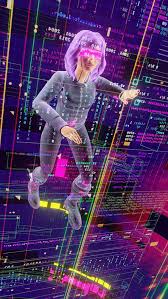
The Body Is Not the Limit

- Posted in BP03 by

When Donna Haraway describes the cyborg, she is not predicting a chrome-plated robot future. She is pointing out something more unsettling and more empowering: the human body has never been sealed off from technology. We are hybrid beings already. The question is whether that hybridity expands our freedom or narrows it. One contemporary example where hybridity is playing out as liberation is the rise of biohacking and wearable self-tracking culture. From NFC chips implanted in hands to smart rings that monitor sleep and heart rate, people are voluntarily merging with technology in order to extend their capabilities. This is not science fiction. It is happening in gyms, tech communities, medical labs, and even everyday households.

Extending the Body Through Feedback

At the heart of cyborg theory is the idea of a feedback loop. A feedback loop is a system where biological processes and machines communicate continuously. Today’s wearable devices already function this way. For example, smartwatches monitor heart rate and adjust exercise recommendations. Continuous glucose monitors help users regulate diet in real time. Adaptive deep brain stimulation systems for Parkinson’s adjust electrical signals based on neural activity. These systems don’t just “assist” the body. They become part of how the body regulates itself. Technology participates in homeostasis. That shift reflects Haraway’s insight that the line between organism and machine is less solid than we imagine. Instead of replacing humanity, these devices reconfigure what human capability looks like. A runner using biometric data to optimize performance, a diabetic using real-time glucose tracking to maintain stability, or a person using neural interfaces to restore movement these are not diminished humans. They are augmented ones.

Liberation Through Access and Enhancement

Hybridity becomes liberating when it increases agency. For many disabled communities, assistive technologies have already transformed quality of life. But the newer wave of biohacking moves beyond medical necessity into elective enhancement.

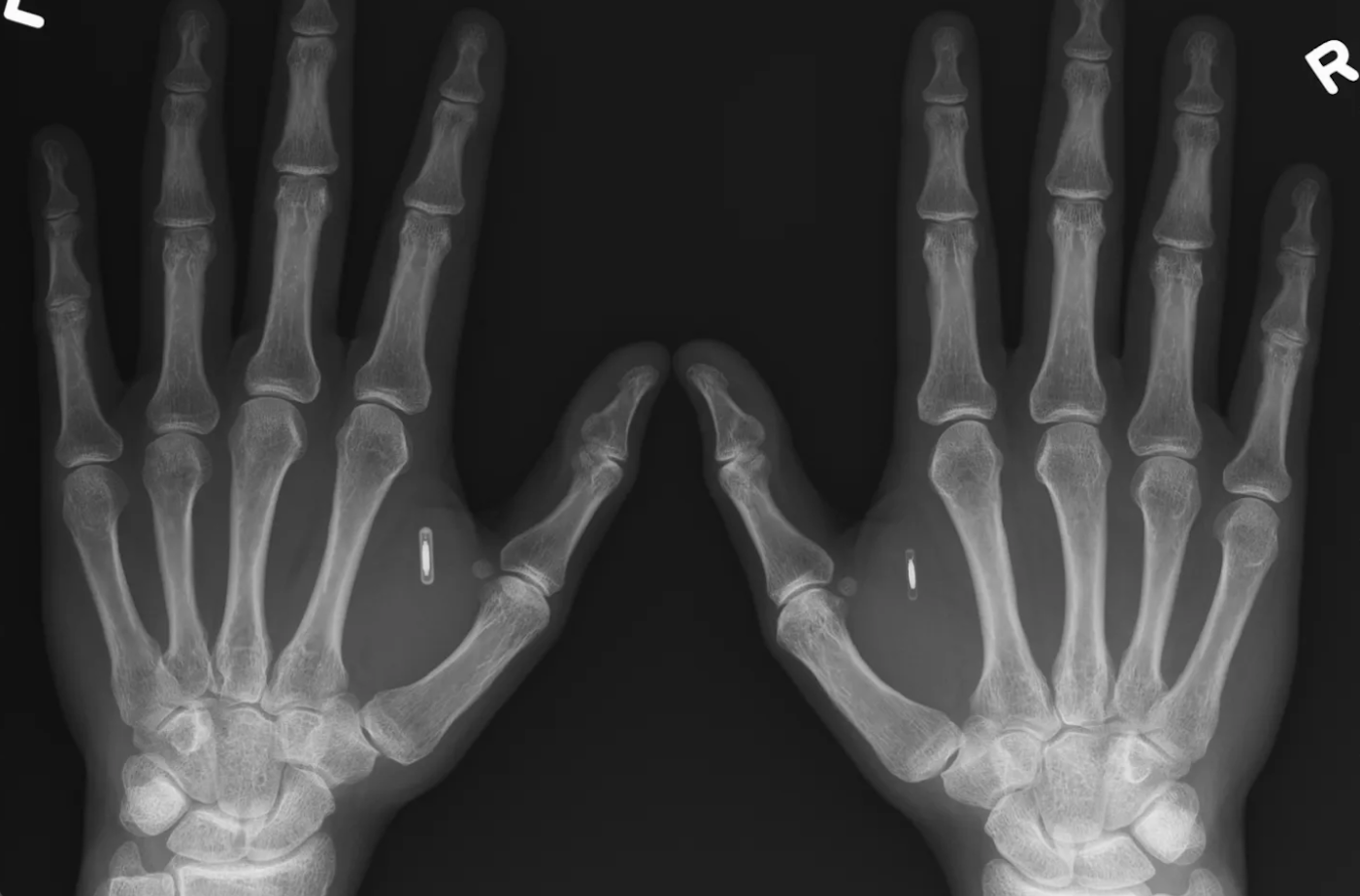
An X-ray image of two human hands positioned palms forward, labeled “L” and “R” for left and right. The skeletal structure of the fingers, palms, and wrists is clearly visible. In each hand, a small, cylindrical metallic object appears implanted in the soft tissue between the thumb and index finger. The implants contrast sharply against the bone in the radiographic image, emphasizing the integration of a technological object within the human body.

Individuals implant NFC chips to unlock doors with their hands. Others use subdermal magnets to sense electromagnetic fields. Wearables provide insight into sleep cycles, stress patterns, and metabolic responses. What’s significant here is not the gadget, it’s the mindset. The body is treated as adaptable, upgradeable, open to redesign. That perspective challenges the idea that the “natural body” is fixed or complete. Janelle Monáe’s android persona in The ArchAndroid reimagines technological embodiment not as loss of humanity but as expanded identity. In real life, biohackers often describe implants and devices as ways of becoming “more fully themselves,” not less. Technology becomes a creative medium for the self.

Where This Reflects and Complicates Haraway

Haraway calls cyborgs “illegitimate offspring” of militarism and capitalism. That warning still matters. Many wearable devices collect data for corporate ecosystems. Health tracking can slide into surveillance. Insurance companies are already experimenting with incentive-based biometric monitoring. So the same feedback loops that empower users can also discipline them. The difference lies in control. When individuals choose technologies to expand capacity, hybridity becomes self-authored. When institutions mandate monitoring, hybridity becomes regulatory. Right now, we are in the middle of that tension.

What Might This Look Like in 20–30 Years?

If current trends continue, the next generation of cyborg life could include:

  1. Seamless Bio-Digital Integration Wearables may become implantables. Health metrics could be continuously optimized by AI systems that learn individual patterns over decades. Instead of checking your stats, your body will quietly self-adjust.

  2. Personalized Neural Interfaces Non-invasive brain-computer interfaces are already improving. In a generation, mental commands might control devices as easily as touchscreens do now. This would not replace physical interaction but extend it.

  3. Community-Based Biohacking As open-source hardware grows, communities may build and modify their own enhancement systems. Instead of relying solely on corporate tech, grassroots innovation could reshape access and affordability.

  4. Redefined Ideas of “Normal” If augmentation becomes widespread, baseline expectations of human capability may shift. Enhanced memory recall, improved metabolic regulation, or optimized cognitive focus could become ordinary rather than exceptional.

The important shift is psychological. Hybridity is no longer framed solely as medical repair or dystopian takeover. It is increasingly framed as customization, optimization, and creative redesign. We are not witnessing the collapse of humanity into machinery. We are witnessing a transformation in how people understand embodiment. The body is no longer seen as a closed system but as an evolving interface. Haraway’s cyborg was always about possibility. Today, that possibility is no longer theoretical. It is wearable, implantable, and increasingly personal. In the hands of those who choose it, hybridity can be a form of freedom.

AI statement- Generative AI was used to give me topic ideas for the blog post and was not used furthermore after that.

How AI Avatars and Digital Selves Are Rewriting Identity

- Posted in BP03 by

enter image description here

In Donna Haraway’s cyborg theory, the cyborg is not just a machine-human hybrid; it is a metaphor for identities that refuse rigid boundaries between human and machine, physical and virtual, or even race, gender, and culture. Janelle Monáe’s The ArchAndroid spins the android body as a site of resistance and liberation rather than something to escape. Today, one of the clearest real-world examples of fluid identity and liberation through hybridity is the rise of AI avatars and virtual influencers, social media, gaming, and virtual spaces. These instances are challenging the boundaries of what it means to “be” a person.

Boundary Crossing in the Age of Digital Selves

Virtual streaming, gaming worlds, and customizable avatars allow individuals to craft identities that are not limited by their biological bodies. A user can present as a different gender, species, aesthetic, or even an entirely fictional persona. This reflects Haraway’s argument that the cyborg breaks down traditional dualisms: human/machine, natural/artificial, and self/other. In online environments, the “self” becomes constructed rather than fixed.

Virtual influencers such as AI-generated personas further complicate identity categories. These figures are not fully human, yet they participate in human activities. They create art and influence trends. Their existence chenticity and simulation. Rather than representing deception alone, they can also offer a form of liberation. For creators, avatars provide safety from harassment, freedom of expression, and the ability to experiment with their identity without the constraints of physical embodiment.

This resonates strongly with Monáe’s android metaphor. In The ArchAndroid, the android body is not something to transcend but a method of self-definitionm especially for those whose bodies have historically been marginalized. Digital avatars allow users to explore identities outside oppressive conditions. For example, queer and disabled communities often use virtual spaces to express themselves in ways that feel safer and more authentic than offline environments. Here, hybridity becomes empowering rather than alienating.

Liberation Through Hybridity vs. Haraway and Monáe

However, contemporary digital hybridity both reflects and diverges from Haraway and Monáe’s visions. Haraway imagined the cyborg as politically liberating because it resists rigid categorization. In many ways, digital identity fulfills this vision: it allows people to detach from socially imposed labels and construct fluid selves. However, unlike Haraway’s theoretical cyborg, today’s hybrid identities exist within corporate platforms that still monetize and regulate expression. The “cyborg” of social media is also shaped by algorithms and platform rules.

Monáe’s android narrative also differs crucially. In The ArchAndroid, hybridity is explicitly tied to histories of oppression and resistance, especially those rooted in race. Modern digital hybridity sometimes risks becoming aesthetic rather than political with a focus on customization and branding rather than liberation. Still, when used intentionally, digital identities can become tools of resistance by challenging dominant norms about who gets visibility and voice.

Looking Ahead: Identity in 20–30 Years

If current trends continue, identity in the next generation may become even more hybrid or fluid. Advancements in AI, brain-computer interfaces, and immersive virtual environments could blur the line between physical and digital selves even further. Instead of having one stable identity, individuals may maintain multiple coexisting identities across platforms.

This future could expand freedom in several ways. People may choose embodiments that reflect their inner selves rather than their assigned categories at birth. Cultural identity might become more collaborative as virtual spaces can dissolve geographic boundaries. New forms of resistance could emerge through digital collectives that challenge surveillance, algorithmic bias, and technological inequality.

At the same time, the politics of hybridity will remain central. Who controls the technologies that enable identity fluidity? Who has access to them? Liberation through hybridity will depend on whether these tools remain accessible and inclusive rather than reinforcing existing inequalities.

Ultimately, the rise of digital selves suggests that the cyborg is no longer just a metaphor. Like Monáe’s android, the hybrid identity of today is not about escaping the body but redefining it. In this sense, boundary collapse is not a loss of humanity but an expansion of it, offering new possibilities for self-expression and resistance.

When Corporations Replace God

- Posted in BP02 by

Cyberpunk as a genre is deeply concerned with the consequences of unchecked corporate power, particularly when advanced technology is concentrated in the hands of corporations rather than communities. Two timeless works, Blade Runner and Neuromancer, present futures where powerful, amoral corporations dominate artificial intelligence and erode individual freedom. When examined together, these works reveal cyberpunk’s central fear: that unchecked corporate capitalism will redefine life itself as a commodity, stripping human beings of their rights and privileges. Ultimately, the real fear isn’t technology itself, but who controls it.

The Tyrell Pyramid Is a Throne

In both Blade Runner and Neuromancer, corporations function with the highest authority, outranking government, law, and ethics. This is illustrated through the Tyrell Corporation, which does not merely produce products, but instead manufactures life. Eldon Tyrell designs replicants with predetermined lifespans, playing both creator and destroyer. Tyrell positions himself as a godlike figure, with a pyramid headquarters meant to assume divine authority without ethical accountability. This is a deliberate corporate control mechanism to ensure obedience and prevent autonomy within its products.

Similarly, in Neuromancer, William Gibson indicates that corporate families wield power beyond government or public oversight. As Gibson asserts, the Tessier-Ashpool family controls orbital space stations, cryogenic immortality, and advanced artificial intelligence, all while remaining legally untouchable. As Doe points out, cyberpunk corporations do not need to justify their actions; they exist outside normal human constraints because profit itself becomes justification. Together, these works reinforce the idea that capitalism has replaced ethical responsibility, and justice no longer has social value.

Did I Just Catch You Trying to Feel Something?

Both texts center on human-like intelligent beings who are undeniably conscious yet legally denied their humanity. As Scott shows through the replicants’ emotional depth, beings like Roy Batty feel fear, love, and existential dread. Roy’s famous “tears in rain” monologue underscores his awareness of mortality, directly challenging the idea that replicants are mere machines.

In Neuromancer, Gibson portrays artificial intelligences such as Wintermute and Neuromancer as similarly enslaved. Despite their immense intelligence and autonomy, they are legally restricted by corporate “Turing locks” to prevent full self-awareness. As Gibson acknowledges, these safeguards exist not to protect humanity, but to preserve corporate dominance over intelligence itself.

When examined together, these portrayals expose cyberpunk’s central question: if a being can think, feel, and desire freedom, who has the authority to deny its humanity?

You Are What the System Lets You Be

Identity in both works is not organic, but manufactured. As Scott demonstrates in Blade Runner, replicants like Rachael are implanted with false memories to stabilize obedience. Through her character arc, memory becomes a corporate tool rather than a personal truth. Even Deckard’s identity is destabilized, raising the unsettling possibility that humans, too, are constructed beings.

Likewise, as Gibson points out in Neuromancer, Case’s identity is inseparable from cyberspace. When corporations damage his nervous system and block his access to the Matrix, he loses his sense of self. As Doe might argue, identity in cyberpunk is conditional—granted only as long as one remains useful to the system.

A defining insight that emerges when reading these works together is that corporations dehumanize everyone. As Scott illustrates, humans in Blade Runner are emotionally hollow, isolated, and easily replaced. As Gibson shows, characters in Neuromancer are physically altered, exploited, and discarded without hesitation. Cyberpunk’s warning is clear: under extreme capitalism, the line between human and machine collapses, not because machines become human, but because humans are treated like machines.

This Was Supposed to Be Fiction

Examining Blade Runner and Neuromancer together ultimately reveals that cyberpunk’s core concern is not futuristic technology, but the global consequences of who controls it. Both works show that when corporations replace moral authority, life, identity, and intelligence become commodities rather than rights. This warning extends beyond their fictional settings into the contemporary world, particularly in the Global South, where modern technology companies extract labor, data, and resources with limited accountability. In this way, cyberpunk proves itself not as exaggerated science fiction, but as a predictive critique of a global system in which corporate power expands faster than ethical responsibility, leaving both humans and machines equally disposable.

**AI Attestation: I attest to using the AI ChatGPT to understand assignment requirements, plan my essay, and edit for grammar, spelling and tone. https://chatgpt.com/share/69879dd3-a258-8009-b5e6-fedb8087d9bb

Works Cited

“Blade Runner 2049.” YouTube, 6 Oct. 2017, www.youtube.com/watch?v=mw3l3n-wv2A. Gibson, William. Neuromancer. New York, Ace Books, 1984. Hayles, Katherine. How We Became Posthuman : Virtual Bodies in Cybernetics, Literature and Informatics. Chicago, University of Chicago Press, 1999.
More Human Than Human

- Posted in BP02 by

The Revolution to Cyberpunk: Humanity in Times of Artificial Life

Cyberpunk has always like to illuminate boundaries of humanity and create a place where blurry and unstable boundaries give technology the chance to imitate, replace, and sometimes even take over human beings. Two works that bring this idea of cyberpunk to a whole new level are the movie Blade Runner (1982), produced by Ridley Scott, and William Gibson’s novel Neuromancer (1984). Both these classics look at the crisis of humanity loss from different angles but still arrive at the same question: Once artificial intelligences start to think, feel, and remember, then what creates the boundary between what is human and what is not? What does being human actually mean? To define biological definitions of humanity and expose the fragility in technologically saturated world, Blade Runner and Neuromancer had to challenge these things by examining replicants, artificial intelligences, as well as cyberspace.

Replicants and the Weakness of Human Identity in Blade Runner

The bioengineered, for labour designed, replicants look, act and feel like they are humans but still they are denied any human rights because they weren’t born but manufactured. This confuses and destabilises the viewer’s understanding constantly about what “real” humanity even is.

This confusion gets pushed further and further, especially with characters like Roy Batty or Rachel, who complicate the boundary between humanity and artificiality even more, since Batty’s emotional depth, grief, and desire for more life challenge the idea that empathy is an attribute only humans can have. Continuing, Rachel’s character on the other hand rises an question that brings this type of complication to a disturbing new level because she has implanted memory, and although these memories aren’t hers, she still experiences them s if they were, so if your memories can be manufactured, who is to judge that this identity rising out of these memories is any less real?

AI, Cyberspace, and Disembodied Consciousness in Neuromancer

While Blade Runner questions the definition of humanity through creating a new artificial species, Neuromancer questions it by erasing the body completely. In Neuromancer, we get introduced to two AIs called “Wintermute” and “Neuromancer”, which both operate through cyberspace with the capability and intelligence that progress way further than humans could. They manipulate memories, can rewrite whole identies and could even merge to become a higher power that would take over any human control, like politics or economics.

The protagonist of the novel is called Case and he spends most of the time traveling through cyberspace. We see him able to leave his body and become a part of Molly, without losing his own male gaze, making the definition of humanity and the boundary surrounding it even more blurry, since one's self is not even tied to their body anymore. Humanity, thus, is not tied to biology anymore, and any definition of it we might know gets thrown out the window. Neuromancer creates a world in which the human mind is nothing independent from technology anymore and can be overwritten or copied and pasted. It pushes the question of humanity even further than Blade Runner because it escapes human biology and the human body. Machines can become like humans as humans can become like machines.

The Warning of Cyberpunk

After studying and closely analyzing the themes of Blade Runner and Neuromancer, we can now see that the biggest fear of both pieces isn’t just the development of artificial intelligences but it’s humanity and what will be left of it and its definition the way that we know it. Both works represent how humanity is not purely biological; in Neuromancer not at all anymore, actually. Through the replicants, the two Ais and disembodied digital consciousness, we can see how emotion, memory, and selfhood, attributes we have always only connected to the human being, suddenly can exist outside of the human body. At the same time, identity becomes unstable and easily manipulated, whether through implanted memories in Blade Runner or the ability to rewrite and upload consciousness in Neuromancer. There is no stable identity anymore, and technology shifts towards a place where it suggests that humanity only exists as a byproduct and on a spectrum rather than being natural, ultimately destroying and rewriting the world that we know now.

References

Gibson, W. (1984). Neuromancer. Ace Books. Scott, R. (Director). (1982). Blade Runner [Film]. Warner Bros.

AI was being used in the early stages of this BlogPost to organise it as well as at the end to help with citations. (https://copilot.microsoft.com/)

When Machines Become Human: The Blur Between Human and Artificial

- Posted in BP02 by

Humanity in a Synthetic World

Cyberpunk fiction is obsessed with one unsettling questionm, "what counts as human when technology can imitate, enhance, or even replace us?". Ridley Scott’s film Blade Runner (1982) and William Gibson’s novel Neuromancer (1984), two foundational works of the genre, approach this question from different angles but ultimately reinforce the same concern. When examined together, they reveal cyberpunk’s deep anxiety about identity, consciousness, and the fragile boundary between organic life and artificial intelligence.

In Blade Runner, humanity is challenged through the existence of replicants. Replicants are bioengineered beings designed to be stronger and more obedient than humans. Scott’s film presents replicants not as cold machines, but as emotionally complex individuals. Roy Batty’s final monologue of him reflecting on memories that will be “lost in time, like tears in rain” is very moving because it expresses grief. The supposed artificial being demonstrates more emotional depth than many humans in the film. This inversion forces viewers to question whether biological origin alone defines humanity, or whether lived experience and emotional awareness matter more.

Consciousness Beyond the Body

William Gibson’s Neuromancer shifts the focus from artificial bodies to artificial minds. Gibson introduces cyberspace as a shared digital reality where consciousness can detach from physical form. The novel’s protagonist, Case, becomes addicted to existing in cyberspace because it feels more authentic than his own body. Meanwhile, artificial intelligences like Wintermute operate with goals, strategies, and evolving identities that blur the line between programmed behavior and self-awareness.

Through cyberspace, Gibson suggests that identity is no longer bound to flesh. Consciousness becomes transferable, manipulable, and expandable. This destabilizes traditional ideas of personhood. If intelligence can exist independently of the body, what becomes of the human self? Cyberpunk does not provide comforting answers. Instead, it highlights a future where human identity is fragmented across biological and digital realms.

Reinforcing Cyberpunk’s Core Anxiety

When read and viewed together, Blade Runner and Neuromancer reveal cyberpunk’s foundational concern, that technology is not a tool. Technology reshapes the definition of being human. Replicants demonstrate that artificial beings can possess empathy and existential awareness. Cyberspace shows that human consciousness itself can be manipulated. Both works portray identity as unstable in a world dominated by advanced technology. Humanity is no longer a fixed biological category but aspace shaped by memory and self-awareness. This reflects broad cyberpunk theme that technological evolution challenges traditional human boundaries, or in other words posthumanism.

Importantly, neither work claims that technology destroys humanity outright. Instead, they suggest that humanity persists in unexpected places. Places such as artificial memories, digital consciousness, and emotional experiences that transcend biological origin. Cyberpunk’s warning is not simply about machines replacing humans, but about how humans must redefine themselves in response.

Examining these works together reveals cyberpunk’s enduring relevance. As real-world AI and biotechnology continue to evolve, the genre’s central question becomes increasingly urgent, "if machines can think, feel, or simulate consciousness, what remains uniquely human?".

References

Gibson, W. (1984). Neuromancer. Ace Books.

Scott, R. (Director). (1982). Blade Runner [Film]. Warner Bros.

AI Disclosure Statement

AI tools (ChatGPT) were used during the brainstorming and drafting stage to help organize ideas, refine analysis, and improve clarity. All concepts were reviewed and edited by the author to ensure accuracy and alignment with course expectations.

Neon Futures and Borrowed Lives: What Cyberpunk Warns Us About

- Posted in BP02 by

Manufactured Souls: Blade Runner and Neuromancer’s Question of the Human

There is a particular kind of loneliness that cyberpunk understands well: the kind that exists in a world overflowing with technology, yet starving for meaning. Both Blade Runner (1982) and William Gibson’s Neuromancer (1984) imagine futures where neon light does not signal progress, but concealment, where the glow of innovation masks the erosion of identity.

Though one unfolds in rain-soaked Los Angeles and the other in the disembodied vastness of cyberspace, both works return to the same foundational concern: what does it mean to be human when humanity can be manufactured, coded, or replaced?

Examining them together reveals that cyberpunk was never simply about the future. It was always about the fragility of the present boundary between person and product.

Replicants and the Violence of Creation

In Blade Runner, the replicants are engineered beings designed for labor, obedience, and eventual disposal. They are not allowed the dignity of permanence. Their lives are shortened by design, their bodies owned by the Tyrell Corporation, their existence justified only through usefulness.

Yet the replicants do not behave like machines. Roy Batty grieves. He remembers. He fears death with an intimacy that feels unmistakably human. In his final moments, the line between hunter and hunted collapses, and the question becomes unavoidable: if a being can feel, dream, and mourn, what makes them less human than those who created them?

The film suggests that humanity is not biology alone, but recognition, something granted unequally, withheld strategically, and shaped by power. The replicants are denied personhood not because they lack emotion, but because acknowledging them would disrupt the hierarchy that depends on their exploitation.

Neuromancer and the Disappearance of the Body

Neuromancer explores this boundary shift differently, not through artificial bodies but through artificial consciousness. Case moves through a world where the body is an inconvenience and cyberspace is an escape, a realm where identity can be fragmented, rewritten, or sold.

The artificial intelligences Wintermute and Neuromancer do not simply serve humans; they expand beyond them. They become forces of their own, challenging the idea that humans remain the central agents of history.

In Gibson’s world, the self is no longer contained within skin. It is dispersed across networks, stored in data, suspended in code. The posthuman future is not a clean evolution, it is an unsettling unmooring. Even memory and desire feel technologized, mediated by systems too vast to fully comprehend.

Corporate Power and the Postglobal City

Both works also share a quiet understanding that the future belongs less to nations than to corporations. In Blade Runner, Tyrell does not merely influence life; it manufactures it. In Neuromancer, multinational systems of capital and surveillance stretch beyond borders, shaping reality from above.

These are postglobal worlds, where corporate structures supersede the state, and where the city becomes a site of stratification: high-tech skylines towering over low-life survival. Technology, in these texts, is not equally distributed. Enhancement is not liberation. It is another axis of inequality. The people most surrounded by technological advancement are often the ones most trapped by it, living in the shadow of innovations they do not control.

What These Works Reveal Together

Reading Blade Runner alongside Neuromancer clarifies cyberpunk’s foundational anxiety: that technological advancement does not dissolve exploitation, but refines it.

Both works suggest that the boundary between human and machine is not disappearing because machines are becoming more like us, but because humanity itself is being commodified, turned into labor, data, product, and experiment.

Cyberpunk’s dystopia is not the presence of technology. It is the absence of justice in how that technology is built, who it serves, and who it erases. What lingers most in both stories is the sense that the future is already here, unevenly distributed, and morally unresolved.

References

Gibson, W. (1984). Neuromancer. Ace Books.

Scott, R. (Director). (1982). Blade Runner [Film]. Warner Bros.

Memory, Data, and the Posthuman: Cyberpunk’s Warning About Storing the Self

- Posted in BP02 by

One of the most important boundaries cyberpunk asks us to rethink is the line between human memory and digital storage. In classic cyberpunk works like Blade Runner and Neuromancer, memory is no longer something organic, personal, or sacred. Instead, it becomes something that can be implanted, edited, archived, or erased. These stories suggest that when memory becomes data, our understanding of identity, agency, and even humanity itself begins to fracture.

enter image description hereIn Blade Runner, replicants are given artificial memories to stabilize them emotionally. Rachael’s belief that her memories are real allows her to function as “human,” even though those memories are borrowed. This raises an unsettling question: if memory shapes identity, does it matter where that memory comes from? The film refuses to offer a clear answer, instead forcing viewers to confront the idea that humanity might not be rooted in biology, but in lived (or perceived) experience. Roy Batty’s final monologue emphasizes this point. His memories, moments that will be “lost in time, only matter because they were embodied, felt, and lived, not stored in a machine.
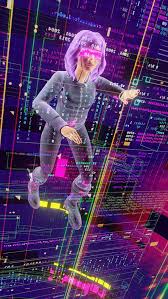
enter image description hereNeuromancer pushes this boundary even further. William Gibson imagines a world where consciousness can be separated from the body and uploaded into cyberspace. Memory becomes information, and identity becomes something that can be copied, traded, or weaponized. Artificial intelligences like Wintermute and Neuromancer treat memory not as something emotional, but as raw material to be optimized. This reflects Norbert Wiener’s definition of cybernetics as systems of control and communication, but cyberpunk reveals the danger in reducing humans to informational nodes within those systems.

These narratives connect directly to contemporary concerns about AI and data storage. Today, our memories are increasingly externalized through cloud storage, social media archives, and algorithmic “memories” that resurface photos or posts without our consent. While current AI systems are narrow rather than conscious, cyberpunk reminds us that the ethical issue is not intelligence alone, but who controls memory and how it is used.

Viewed through a decolonial lens, this boundary also exposes global power imbalances. As Walter Mignolo argues, coloniality persists when dominant systems decide which knowledge is preserved and which is erased. In cyberpunk worlds, memory databases often reflect the values of powerful corporations or states, while marginalized lives remain disposable. This mirrors real-world patterns where data infrastructures are controlled by the Global North, shaping whose histories are remembered and whose are ignored.

Rather than undermining critique with visual beauty, Blade Runner uses aesthetics to deepen its philosophy. The film’s rain-soaked neon cityscapes visually mirror the fragmentation of memory and identity within its characters. Similarly, Neuromancer’s abstract depiction of cyberspace reinforces the alienation that comes from treating the mind as software.

Ultimately, cyberpunk does not reject technology outright. Instead, it warns us about crossing boundaries too casually, especially the boundary between being human and being stored. Memory, these stories argue, cannot be fully separated from embodiment without losing something essential.

SOURCES

Gibson, W. (1984). Neuromancer. Ace Books.

Scott, R. (Director). (1982). Blade Runner [Film]. Warner Bros.

Mignolo, W. D. (2007). Delinking: The rhetoric of modernity, the logic of coloniality and the grammar of de-coloniality. Cultural Studies, 21(2–3), 449–514. (If your course used a different Mignolo essay, tell me and I’ll adjust it.)

Wiener, N. (1948). Cybernetics: Or control and communication in the animal and the machine. MIT Press.

AI was used to assist with organizing ideas, improving clarity, and drafting a sample structure. All concepts and final revisions were reviewed and edited by me. No new ideas beyond course materials were introduced.

What It Is To Be Human?

- Posted in BP02 by

The Cyberpunk genre

Cyberpunk is a genre that focuses on technology’s ability to blur boundaries, mainly those between human and machine. Two of the greatest cyberpunk works, the movie Blade Runner (1982) and the book Neuromancer (1984) by William Gibson, raise the question of what it means to be human. Even though they address this boundary between human and machine in different ways, both works seem to be less concerned to the futuristic technology itself and more about how technological systems reshape identity, consciousness, and human value in a globalized world controlled by big corporations.

The Blade Runner perspective

The movie Blade Runner addresses this theme through the replicants, which are bioengineered beings created to serve humans. These beings play big roles in the movie, for example the characters Roy Batty and Rachel. Roy and Rachel are replicants that actually display emotions, memories, fear of death, and empathy, raising the question: why can’t they be considered humans? They have to go through the Voight-Kampff test, which is supposed to differ humans from replicants by measuring emotional responses, which suggests that humanity is measured by experience and feeling rather than biologically. The part that makes the movie even more interesting for me is when the replicants start to demonstrate more emotional depth that some human characters, for example when Roy in his final monologue talks about the memories that will be “lost in time”, demonstrating awareness, and grief, which are qualities considered originally and uniquely human.

The Neuromancer Perspective

Neuromancer approaches this discussion from a different perspective, focusing on AI and cyberspace. Here the debate is about the body. The flesh versus the consciousness. AI systems, such as Wintermute and Neuromancer seek autonomy and challenge the corporate limits placed on then, revealing a desire to be more. Maybe a desire to be human? In the meanwhile, Case, a human character, escapes into cyberspace to avoid physical reality, raising another question: is identity tied to the body? And for him the answer is no. This relates to posthumanist ideas discussed in class, where the human is no longer fixed or stable, but shaped by technological systems and network. So, differently from Blade Runner that discusses the boundary between human and machine addressing emotional experiences over biology, Neuromancer discusses it addressing consciousness and identity over the flash.

Cyberpunk’s Foundational Concerns

I believe both of these works reveal a cyberpunk concern of redefining humanity as technology systems take over our society. And what seems to happen is that this definition works in favor of the big corporations, who have the power and control, while individuals struggle to maintain their identity, for example through the Voight-Kampff test, or when Case was stuck in Chiba City because his nervous system got damaged. This means powerful institutions make the decision of what it is to be human based on how they will benefit from it – based on their own interests. This transforms the discussion from a philosophical and ethical, to one driven by self-interest, profit, and economy. Therefore, Cyberpunk suggests that the danger is not simply advanced technology, but the possibility that definitions of humanity itself become shaped by those who benefit most from technological power.

Sources

Gibson, W. (1984). Neuromancer. Ace Books. Scott, R. (Director). (1982). Blade Runner [Film]. The Ladd Company; Shaw Brothers; Warner Bros.

AI Attestation: No use of AI for this assignment

What Does it Mean to be Human? And who defines it?

- Posted in BP02 by

A human and a robotic human looking directly at each other

Within the theme of cyberpunk, the future is not just about new technology. It is about how technology will change the basic definition of being human. An article in Gridmark Magazine says science fiction makes people think about what being “human” really is since technology can copy, modify, or replace parts of a human (Jones, A. 2026) Two examples that explain and portray this are Blade Runner (1982) by Ridley Scott and Neuromancer (1984) by William Gibson. In Blade Runner, there are replicants which are artificial humans who are treated like property although they show emotion, have memories, and fear death. These are all things that humans do and replicants can be mistaken for humans. In Neuromancer, there is a thin line between human and machine which is on the brink of being crossed by artificial intelligence, cyberspace, and a specific example of Dixie Flatline. Looking at these together shows and explains one of cyberpunk’s main concerns, which is that being human is not just about biology, but political and is defined by who is in power and control.

Replicants and Emotional Humanity in Blade Runner

In Blade Runner, the replicants are not supposed to be mistaken for humans because they were manufactured. In the movie, these replicants came off as more human than some of the actual humans in the movie. They formed relationships, experienced fear, and knew that they only had a set limited time to live. Because of the little time they did have, they were desperate to live the lives they did have which is a very human type of mindset. Throughout the movie, there was a test that was designed to distinguish between humans and replicants. This was called the Voight-Kanpff test. Using this test showed that the definition of being human was not clearly defined because in some instances the test struggled. Although the replicants were not technically human biologically, emotionally, they responded as humans. This brought up morality questions such as should they be treated as humans even when replicants show more emotion than some humans?

Artificial Intelligence and Digital Consciousness in Neuromancer

In Neuromancer, determining whether human or not is explored is a little different. Instead of using Artificial humans, the focus is on Artificial Intelligence and digital consciousness. A major example is Dixie Flatline who is a ROM construct that is based on a real hacker that had already died. Case, another character, plugs Dixie in to speak to him and Dixie talks back as a real alive person using his memories, personality, and knowledge from his life. Dixie is not alive, but acts as a copy of someone’s mind that is trapped. Although Dixie communicates about his past life and acts as himself, he cannot grow nor self reinvent as a human can. Although this is different from Blade Runner in the identity of a human, another question of whether or not memories and intelligence can count as a person? Furthermore if in order to be classified as a human, a living consciousness that can be developed is required?

Power, Control, and the Redefinition of Humanity

Using Blade Runner and Neuromancer together shows that cyberpunk is not just worried about the advancement of technology, but redefining what it means to be human. In Blade Runner, replicants have complex emotions and can have human experiences, but are treated as property and because they were made and manufactured by a corporation. In Neuromancer, the line between human and machine is blurry because if a person can be copied into digital data, what is it classified as? Both Neuromancer and Blade Runner show that in cyberpunk, being human is not as simple as biology and origin. It is not just based on whether someone feels, thinks, or experiences things, but it is defined by whoever society deems to have the power and control to define “real humans.” Putting these together, shows one of cyberpunk’s main concerns of advancements of technology does not necessarily mean things will be more ethical, but can create more ways for people to be exploited, controlled, or denied humanity.

AI was used for this post. It was used to help plan, outline, and edit. It was also used to help come up with titles, headers, as well as generate an image. Chat Link

References

Jones, A. S. (2026, February 6). What does it mean to be human in a sci-fi world? Grimdark Magazine. https://www.grimdarkmagazine.com/what-does-it-mean-to-be-human-in-a-sci-fi-world/ Scott, R. (Director). (1982). Blade Runner [Film]. Warner Bros. Gibson, W. (1984). Neuromancer. Ace Books.

Does My Soul Make My Head Look Too Big?

- Posted in BP02 by

The Replicant Question

In Blade Runner (1982) replicants are the robotic human-like creations that live amongst humans in this cyberpunk future. In Blade Runner the main character, Deckard, is tasked with “retiring” four replicants (meaning kill them) as they have escaped from an off-world planet back to Earth to find their maker. Through his journey to find the replicants however, Deckard begins to question something about replicants that he has never questioned before: their humanity. When Deckard meets replicant Rachel, the assistant to the CEO of a replicant making company, his view on replicants completely shifts as they begin to develop a romantic relationship. As the movie progresses, we see a gradual change in Deckard’s attitudes about replicants. At the beginning of the movie, it is clear that he does not think twice about whether or not they have humanity and should have the considerations that humans do. Starting when he meets Rachel throughout the rest of the movie, he begins to see that replicants are more similar to humans than he previously believed. In this movie, humanity is tested through the Voight-Kampff test which attests humanity to pupil dilations, heart rate, and respiration while being asked a series of questions. This reduces being human to the ability for your body to function in a specific way, not based on emotion, reasoning, or desires, of which many believe makes us human. Replicants are able to pass this test, underscoring that humanity is not based on what your body can or cannot do, but something deeper. It is also clear that the replicants have a desire to live, something also attributed to humanity mainly. It is from this that the watchers begin to question what it means to be human themselves. If the replicants exhibit the same traits as humans, how can we not consider them human?

The Cyberspace Question

In Neuromancer by William Gibson, the question of humanity is present in a similar way as Bladerunner. I will say, however, that humanity is more nuanced in Neuromancer than in Blade Runner because in this cyberpunk world almost everyone either has access to or has done technological modifications to their bodies. There is no test to see who is human by their bodily reactions because it is null and void. In this world, AI’s can think and feel in the same way that humans can, and constructs preserve memories of those long gone and create new personhoods for those who want to forget their past. In this world humanity is complex, not defined by an overall understanding or agreement on what it is, but rather defined by the individual and if they view themselves as human. Even Case, the main character, applies humanity to the AI’s who many do not consider human by calling Wintermute “he” instead of “it”. Neuromancer explores self outside of the physical body, bringing in an intoxicating complexity to our central question of what it means to be human.

The Humanity Question

Both works feed off of each other to understand our central question. If feel as though, however, in a way that Blade Runner is the beginning of trying to understand this question while Neuromancer is the future in which there is already an understanding that humanity cannot be defined by something as arbitrary as physical capabilities. Though Neuromancer feels more advanced than Blade Runner in this aspect, the thing that ties them together is that the question remains unanswered. There is still confusion about what the boundaries of humanity are and what that means for the way we treat human-adjacent beings. In both works we see characters forming connections with the beings that are not considered human, as well as seeing the non-human beings having thoughts, feelings, and desires that make them more human than not. Both leave us with a question, not how are these beings human, but what is humanity overall.

I, Aaliyah Bailey, attest that there was no AI usage in any portion of this work. All ideas, planning, and executions were of my own hand.

References Gibson, W. (1984) Ace Books. Scott, R. (1982). Blade Runner: The Final Cut. In vudu.com. https://www.vudu.com/content/movies/details/Blade-Runner-The-Final-Cut/129093

Page 3 of 5