There is no Private Anymore

- Posted in BP01 by

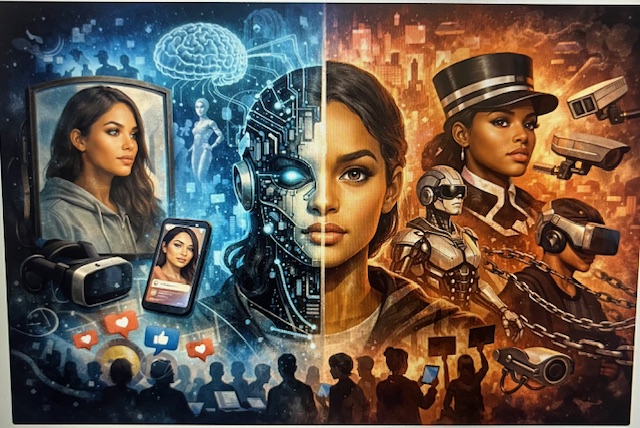
Security cameras with popular social media platforms on their screens by: Electronic Frontier Foundation#### Introduction

Having privacy used to be personal to yourself where what you did was unnoticed. Within the last five years, that boundary has changed tremendously. Digital surveillance, whether that is through games, apps, cameras, and facial recognition, has made and allowed being constantly monitored very normal on a day to day basis. This shows a core theme of cyberpunk, technology develops faster than its rules and regulations to maintain its ethics.

What Has Changed

Surveillance is not just at the government and law enforcement level. It is with civilians using our phones. An article by Wired talks about TikTok collecting and storing data from users, that includes location and data that can identify specific devices (Wired, 2026). This goes on in the background even when app users are not posting and unfortunately the users do not even know the extent of their data being collected. This blurs lines between sharing the information being shared and being constantly monitoring. Surveillance goes beyond apps, it also includes studying and scanning people’s facial and physical features. Facial recognition is being put in public places that can identify people based on their biometric data. According to an article by ISACA, this brings lots of privacy concerns because biometric information like faces cannot be changed like a password and credit card information. This data can be stored, shared, and used without people even knowing they are being tracked. Additionally, facial recognition data is normally not encrypted so it is easier to be hacked and exploited by criminals (ISACA, 2025). This also weakens the boundary between public spaces and personal privacy.

These show how privacy has to be guarded and protected opposed to it being the default that most people would expect.

What Is Driving This Shift

Several of things are speeding up the growth of surveillance: Technological advancement: AI and facial recognition tools are cheaper, faster, and more accurate.

Financial benefits: Companies make profit from collecting and selling user data, while cities are encouraged to use technology to monitor public places

Social Acceptance: Constant data collection has become expected in exchange for convenience and connectivity.

Weak regulation: Lawmakers struggle to keep up with quickly evolving surveillance technologies.

These agree with cyberpunk’s focus on powerful systems working beyond meaningful public control (ISACA, 2025).

Cyberpunk Connections

A common theme within cyberpunk is a world where people are being constantly watched by powerful companies or governments. This is not just an idea from a movie or a book anymore, but real life. As the idea of privacy goes away, technology gains more power and control over people which turns normal everyday activities into an opportunity for their data to be collected. The posthuman idea is also relevant as people are less defined by themselves, but by their digital footprint and online profiles. These surveillance systems only see people as data and digital points. Who Benefits, Who Is Harmed These surveillance technologies can and do improve security and its efficiency, but also bring about problems and concerns. It has the potential to benefit governments, companies, and civilians, but can also hurt civilians. The more data that is collected, the more control civilians lose. As their information is collected, stored, and shared, the less they can protect it. The chances of this data being leaked and exploited goes up, and the blame typically falls on the user (ISACA). Users are typically unaware of how much of their information is being collected. Therefore, the consequences of surveillance also harms civilians the most.

Conclusion

Digital surveillance is a part of everyday life, but still leaves questions. What or who controls the data collected about civilians? How much privacy do civilians have to sacrifice for convenience and safety? At what point is surveillance not protecting, but controlling? These issues show that society is already living out the ideas of cyberpunk where there is a thin line, if any, between privacy and public.

Sources Ahmed-Adnan-Sheikh, H.(2025, November 13) Facial Recognition and Privacy: Concerns and Solutions in the Age of AI. ISACA https://www.isaca.org/resources/news-and-trends/isaca-now-blog/2025/facial-recognition-and-privacy-concerns-and-solutions-in-the-age-of-ai Rogers, R.(2026, January 23) TikTok Is Now Collecting Even More Data About Its Users. Here Are the 3 Biggest Changes. Wired https://www.wired.com/story/tiktok-new-privacy-policy/

When the Home Office Becomes More Office Than Home

- Posted in BP01 by

In the past 5 years, home office have become the reality of many people. After COVID hit, many jobs had to adapt to this idea of working from home. What people wouldn’t expect is that many of these jobs would never go back to “normal”. Many companies realized that it was more beneficial to have their employees working from their homes, since they could avoid the cost of maintaining an office. Furthermore, the comfort of not having to commute every day was definitely appealing for everyone, besides not having to worry about transportation, traffic, food, or even clothing. Because of that, after the pandemics, many of these jobs remained remote. According to a 2023 working paper by researchers at Harvard Business School and the University of Illinois, survey data from U.S. firms and workers shows that the shift to remote work was not temporary but became a persistent feature of post-pandemic labor arrangements (Bartik et al. 2023), showing how home office came to stay.

The Collapse of The Boundary

This change collapsed a huge established boundary in our society, the one between our personal and professional space/life. Activities and subjects that were before kept inside offices and among coworkers moved to domestic spaces such as bedrooms and living rooms, being shared with family members. As a result, it gets harder to cross the line between personal and professional life, possibly causing loss of privacy and identity (work becomes who you are), besides constant availability, and, consequently, faster burnout. Therefore, home office has been making many people’s lives easier, however it has a side effect that has to be considered. Is it worth it?

How was it possible?

But let’s take a step back for now. We know that COVID marked the rapid increase of home office jobs, but technology - video conferencing platforms, cloud storage, messaging systems - is what made this shift possible, while economy is what allowed it to persist. When I say that, I mean to answer the question some might have: “why didn’t society just ‘go back to normal’?”. And the answer is because economic incentives reinforced this change. As I mentioned before, companies could cut the cost used to maintain offices while workers benefited from the flexibility provided by home office. This allowed both employers and employees to accept the collapse of the boundaries between their personal and professional lives.

Connecting to Course Themes

When trying to relate this to what we’ve discussed these past weeks, the first thing that comes to mind is the character Case from Neuromancer (Gibson, 1984). His ability to work depends on his nervous system. When it’s damaged, he is no longer able to work. The Cyberspace, where Case works, is accessed through his nervous system - there’s no physical office. This means that there is no boundary between his professional and personal life. And that’s what all of this is about. Just like Case had his nervous system damaged because of work, modern workers might be risking their personal lives as professional demands enter intimate spaces.

Important implications

Who benefits: employers, Tech companies, workers (do they actually?). Who is impacted: workers’ privacy, mental health. Finally, I want to clarify that this is not a rejection of home office. I am actually a supporter of this work style and want to pursue it myself. However, I believe it is a very important topic to be taken into consideration.

Sources

Bartik, A. W., Cullen, Z. B., Glaeser, E. L., Luca, M., & Stanton, C. T. (2020). The rise of remote work: Evidence on productivity and preferences from firm and worker surveys (Working Paper No. 20-138). Harvard Business School. https://www.hbs.edu/ris/download.aspx?name=20-138.pdf

Gibson, W. (1984). Neuromancer. Ace Books.

AI: no use of AI for this assignment

When Borders Stop at the Map but Digital Life Doesn’t

- Posted in BP01 by

Boundary Collapse Between Physical and Digital Worlds

A central theme in cyberpunk is the collapse of boundaries that once seemed stable, whether it’s the line between human and machine, or the borders that separate nations. As we talked about in class, cyberpunk worlds often expose how technology makes physical borders feel almost symbolic, while digital networks stretch across continents without friction. One boundary that has shifted dramatically in the past five years is the line between physical borders and digital borders. Today, work, crime, identity, and even citizenship can move freely online, regardless of geographic separation. In many ways, our world is inching closer to the same boundary collapse that cyberpunk fiction uses to critique power, globalization, and inequality.

Digital Labor and the Rise of Borderless Work

One clear example of this shift is how remote work has restructured global labor. Since the pandemic, companies routinely hire workers across countries without requiring physical relocation, turning the internet into a borderless workplace. Digital platforms now allow employees and contractors to live in one nation while working for another, blurring which country’s laws, wages, and protections apply. At the same time, governments are rethinking the meaning of citizenship. Estonia’s e-Residency program, which gives “digital citizenship” to people around the world, has expanded rapidly and now includes more than 110,000 global participants who run businesses within Estonia’s digital system without ever crossing a physical border (e-Residency, 2024). This is a real-world illustration of how digital systems can extend a nation’s influence beyond its physical territory, creating a new form of digital belonging that cyberpunk worlds often imagine.

Cybercrime, Cyberwarfare, and the Erasure of Geographic Limits

Another example comes from rising cybercrime and cyberwarfare, which operate completely independent of geography. Attacks on hospitals, banks, and infrastructure now routinely originate from actors across the globe. According to the European Union Agency for Cybersecurity (2024), cross-border ransomware attacks have surged and increasingly target essential services, making national boundaries meaningless barriers in digital conflict. Countries can be harmed, threatened, or destabilized without a single physical soldier crossing a border. This collapse of distance aligns with what we have discussed in class: in postglobal and posthuman settings, the “enemy” or the “threat” is no longer tied to a physical space. Instead, power flows through digital systems that exceed human-scale borders.

Forces Driving the Shift: Technology, Economics, and Politics

Technology, economics, and politics all drive this collapse. Technologically, global networks allow information, money, and identity documents to move faster than states can regulate. Economically, remote work, global outsourcing, and digital entrepreneurship encourage multinational structures where labor and profit are distributed across continents. Politically, governments are racing to control cyber threats, regulate digital residency programs, and determine whose laws apply when conflict unfolds online (Anderson & Rainie, 2022). These forces echo the course themes in your cyberpunk class: technology destabilizing old systems, globalization altering power, and digital life challenging traditional categories of belonging, citizenship, and control.

Consequences and Inequities in a Digitally Borderless World

The implications of this shift are complicated. People with access to education, stable internet, and digital skills benefit the most—they can work globally, earn higher wages, and participate in digital economies that cross borders. Governments like Estonia also benefit by expanding their global influence without territorial expansion. But others are left behind. Workers in lower-income countries face wage competition from international labor markets, and communities without strong digital infrastructure lose opportunities entirely. Meanwhile, cyberattacks disproportionately harm hospitals, schools, and municipalities that lack cybersecurity funding, revealing uneven protection against digital threats. All these changes raise difficult questions: Who is responsible for security when attacks ignore geography? Should nations extend rights or protections to digital citizens? How do people maintain identity and belonging in a world where borders matter less online?

Cyberpunk Themes Reflected in Modern Global Realities

Like many cyberpunk narratives, our real world is reshaping the meaning of borders, power, and citizenship. The collapse between physical and digital borders reveals a future where geography still matters, but not nearly as much as the networks that connect us. These shifts challenge us to think critically about who gains control, who becomes vulnerable, and how we prepare for a world where digital boundaries increasingly define our lives more than the physical ones ever did.

References

Anderson, J., & Rainie, L. (2022, February 7). Changing economic life and work. Pew Research Center. https:// www.pewresearch.org/internet/2022/02/07/5-changing-economic-life-and-work/

How many Estonian e-residents are there? Find e-Residency statistics. (2026, January 14). E-Residency. https://www.e-resident.gov.ee/dashboard/

Reports, E. (2025). ENISA THREAT LANDSCAPE. https://www.enisa.europa.eu/sites/default/files/2025 10/ENISA%20Threat%20Landscape%202025%20Booklet.pdf

Blog Post #1: Eyes Everywhere; AI Surveillance

- Posted in BP01 by

Ever wonder who watches surveillance cameras beyond federal agents, police, and security personnel? Artificial intelligence has become quiet yet incredibly advanced—capable of tracking personal information and recognizing faces with astonishing accuracy. But where does AI store this information, and who has access to it?

Before the rise of AI, surveillance systems relied on continuous 24/7 recording that had to be carefully monitored by human caretakers. These individuals ensured that footage was not distorted, corrupted, or lost due to limited storage space. According to the Security Industry Association, AI can monitor and analyze network traffic in real time, strengthening network security and identifying suspicious activities such as unauthorized access attempts or unusual data transfers. When these activities are detected, users can take immediate action to block or contain potential threats.

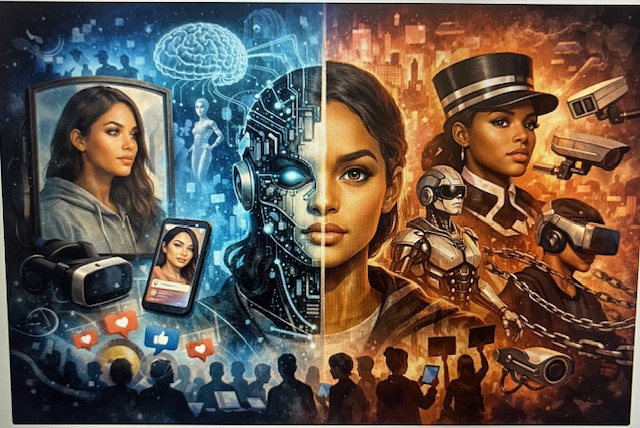
enter image description here

While many argue that AI improves security, it also introduces significant challenges. One major concern is security breaches, as AI systems themselves can become targets for cyberattacks. Another issue is compliance, which is essential to avoid legal consequences and requires adherence to national and international regulations governing the use of AI. Addressing these concerns may require collaboration not only with AI technologies themselves but also with AI developers, cybersecurity professionals, and regulatory experts. AI holds the promise of a more holistic approach to security; however, many people place trust in AI without fully understanding where their data is stored or how it is used.

This shift reflects a cyberpunk-like reality where high technology is paired with low transparency where advanced technologies coexist with humans in everyday life. Surveillance cameras are now embedded into our devices, networks, and infrastructure, allowing AI to operate with minimal human oversight.

Facial recognition has advanced significantly over the decades and has blended seamlessly into daily life. According to Critical Tech Solutions, AI facial recognition combines imaging, pattern recognition, and neural networks to analyze and compare facial data. This process typically involves three steps: capturing facial data, converting faces into digital templates, and matching and verification.

As we progress in today’s world, AI will continue to grow smarter, stronger, and more human-like. It is ultimately our responsibility to establish boundaries to ensure that AI does not override human authority or become a tool for harm.

Sources

Dorn, M. (2025a, November 18). Understanding AI facial recognition and its role in public safety. Tech Deployments Made Simple by Critical Tech Solutions. https://www.criticalts.com/articles/ai-facial-recognition-how-it-works-for-security-safety/

Dorn, M. (2025, December 30). How ai surveillance transforms modern security. Tech Deployments Made Simple by Critical Tech Solutions. https://www.criticalts.com/articles/how-ai-surveillance-transforms-modern-security/

Galaz, V. (n.d.). Sciencedirect.com | Science, Health and medical journals, full text articles and books. ScienceDirect. https://www.sciencedirect.com/science/article/am/pii/S0160791X21002165

James Segil, M. S. (2024, April 23). How ai can transform integrated security. Security Industry Association. https://www.securityindustry.org/2024/03/19/how-ai-can-transform-integrated-security/

https://chatgpt.com/share/697574ec-b270-8003-8613-1bbb06691394

ChatGPT was used to craft an AI image and to revise my original thoughts to a more clear and organized writings.

A Letter to My CIA Agent

- Posted in BP01 by

Dear Sir, Madam, or Algorithm,

I assume you are reading this. Not because I have done anything remarkable, but because in a world shaped by digital systems, observation has become routine rather than something exceptional.

Five years ago, I still thought of privacy as something I possessed, imperfectly, maybe, but meaningfully. I assumed that my movements, conversations, and online habits were largely my own unless I chose to share them. That assumption has quietly worn away. Not through a single policy change or technological breakthrough, but through countless small decisions like agreeing to terms of service, enabling location access, and storing personal information in the cloud.

There was no clear moment when the boundary disappeared. It simply stopped being visible.

What has shifted most in recent years is not the existence of surveillance, but its structure. Governments increasingly rely on private companies to collect and organize personal data and then access it through legal requests or market transactions. According to reporting by Proton, authorities worldwide, particularly in the United States of course, have dramatically increased their requests for user data from major technology firms, often with limited transparency and oversight (Koch, 2025). In this arrangement, corporate data collection and state surveillance are no longer meaningfully separate.

This shift reflects a broader normalization of data as a form of currency. Individuals exchange personal information for convenience, connectivity, and access to digital services. Companies monetize that data. Governments acquire it. Each step is justified as efficient, legal, or necessary. However, when taken together, they blur the line between consent and compliance.

The American Civil Liberties Union has documented how U.S. agencies such as the Department of Homeland Security have purchased location data from brokers rather than obtaining warrants, effectively bypassing constitutional safeguards (Venkatesh & Yu, 2026). While the proponents argue this practice operates within existing legal frameworks, it raises important questions about whether privacy protections remain meaningful when personal data is treated as a commodity.

Similar patterns appear beyond the United States. In Jordan, authorities reportedly used phone-extraction tools to access activists’ devices, targeting political dissent through technological means (Kirchgaessner, 2026). These cases highlight how surveillance technologies are easily transferred across borders and contexts, and how they often impact those already vulnerable to state power.

Even technical protections such as encryption, which are framed as firm barriers to access, prove now to be conditional. In early 2026, Microsoft confirmed that it provided encryption keys to U.S. authorities when legally compelled to do so, prompting concern among privacy advocates about precedent and potential misuse (O’Brien, 2026). Security, it seems, depends less on technological limits than on institutional trust.

To be clear, surveillance systems are frequently defended on grounds of public safety, efficiency, and national security. These concerns deserve serious consideration. Yet the collective effect of extensive data collection and expanded access warrants equally serious scrutiny. Who benefits from this visibility? Who bears the risks? And how should societies balance collective security with individual autonomy?

I do not offer simple answers. What I do offer is a sense that we have crossed a boundary without fully acknowledging it. Privacy has now been redefined and negotiated continuously in ways that are often invisible to the people most affected. It is well on its way to completely vanishing.

Thank you for your time and attention.

Warm regards,

One of your many data points


References: Kirchgaessner, S. (2026, January 22). Jordan used Israeli firm’s phone-cracking tool to surveil pro-Gaza activists, report finds. The Guardian. https://www.theguardian.com/world/2026/jan/22/jordan-israeli-spyware-gaza-activists

Koch, R. (2025, February 27). Authorities worldwide can see more than ever, with Big Tech as their eyes. Proton. https://proton.me/blog/big-tech-data-requests-surge

O’Brien, T. (2026, January 24). Microsoft handed the government encryption keys for customer data. The Verge. https://www.theverge.com/news/867244/microsoft-bitlocker-privacy-fbi

Venkatesh, A., & Yu, L. (2026, January 12). DHS is circumventing Constitution by buying data it would normally need a warrant to access. American Civil Liberties Union. https://www.aclu.org/news/privacy-technology/dhs-is-circumventing-constitution-by-buying-data-it-would-normally-need-a-warrant-to-access

Is this real? When the internet crossed the human–machine line

- Posted in BP01 by

One of the biggest themes in cyberpunk is the collapse of the boundary between the human and the non-human. In the past five years, this has moved from science fiction to our daily lives. Specifically, the boundary between real human performance and AI-generated media has almost disappeared.

When AI Feels Real

You are scrolling through TikTok late at night when a video stops you. A person is talking directly to the camera, smiling and telling a story. Their voices sound natural. Their faces look real. But something feels weird. You pause and read the comments, and someone writes, “This is AI.” Suddenly, the video looks different. What you thought was a human is actually a machine. Moments like this are becoming normal, at least for me, since this is something that happens a lot to me. These moments make clear that the boundary between human and machine is collapsing in front of us.

The Rise of AI-Generated Media

Artificial intelligence can now generate realistic faces, voices, and videos that are almost impossible to distinguish from real people. Five years ago this would have never been possible. Technology has been used to create fake celebrity videos, AI voice tools can copy someone’s voice in seconds, and some TikTok accounts are run entirely by AI-generated influencers. AI video generators are improving so quickly that even experts sometimes struggle to identify what is real and what is artificial. The internet has become a space where human presence is no longer guaranteed.

Why is this happening?

This shift is the result of multiple forces working together. Technologically, AI systems have become better at learning patterns of human behavior, language, and also emotion. This reminds me of Ada Lovelace’s idea that machines could manipulate symbols beyond numbers, including images, music, and language. What she imagined can now be seen on our screens. Additionally, platforms like TikTok and Instagram reward content that catches attention quickly, regardless of whether it is human-made or AI-generated, which makes it very attractive to most people.

Who benefits and who is impacted?

However, this new reality benefits some groups more than others. Tech companies profit from AI tools, influencers use them to increase output, and governments can use them for messaging and control. At the same time, artists lose ownership of their work, viewers lose trust in what they see, and society loses a shared sense of truth. The spread of "deepfakes" makes it harder for citizens to distinguish between real news and computer-generated lies (Simonite, 2019). It becomes easier to spread false information and more difficult to hold people accountable when we can no longer trust faces, voices, or videos. As a society, we have to think about what it means to be human in the digital age if we are unable to tell the difference between AI and actual people online. Considering how well machines can imitate people, how should we assess trust and creativity?

This shows that the rise of AI is not just a technology problem, but it also changes how we see people and truth online. When machines can copy humans so well, it becomes harder to know what is real. We need to think carefully about trust, creativity, and what it means to be human.

AI Attestation: I attest that I did not use AI for this discussion assignment.

Sources

Simonite, T. (2019, October 6). Prepare for the Deepfake Era of Web Video. Wired. https://www.wired.com/story/prepare-deepfake-era-web-video/

Humanity and AI: The Blurring Line

- Posted in BP01 by

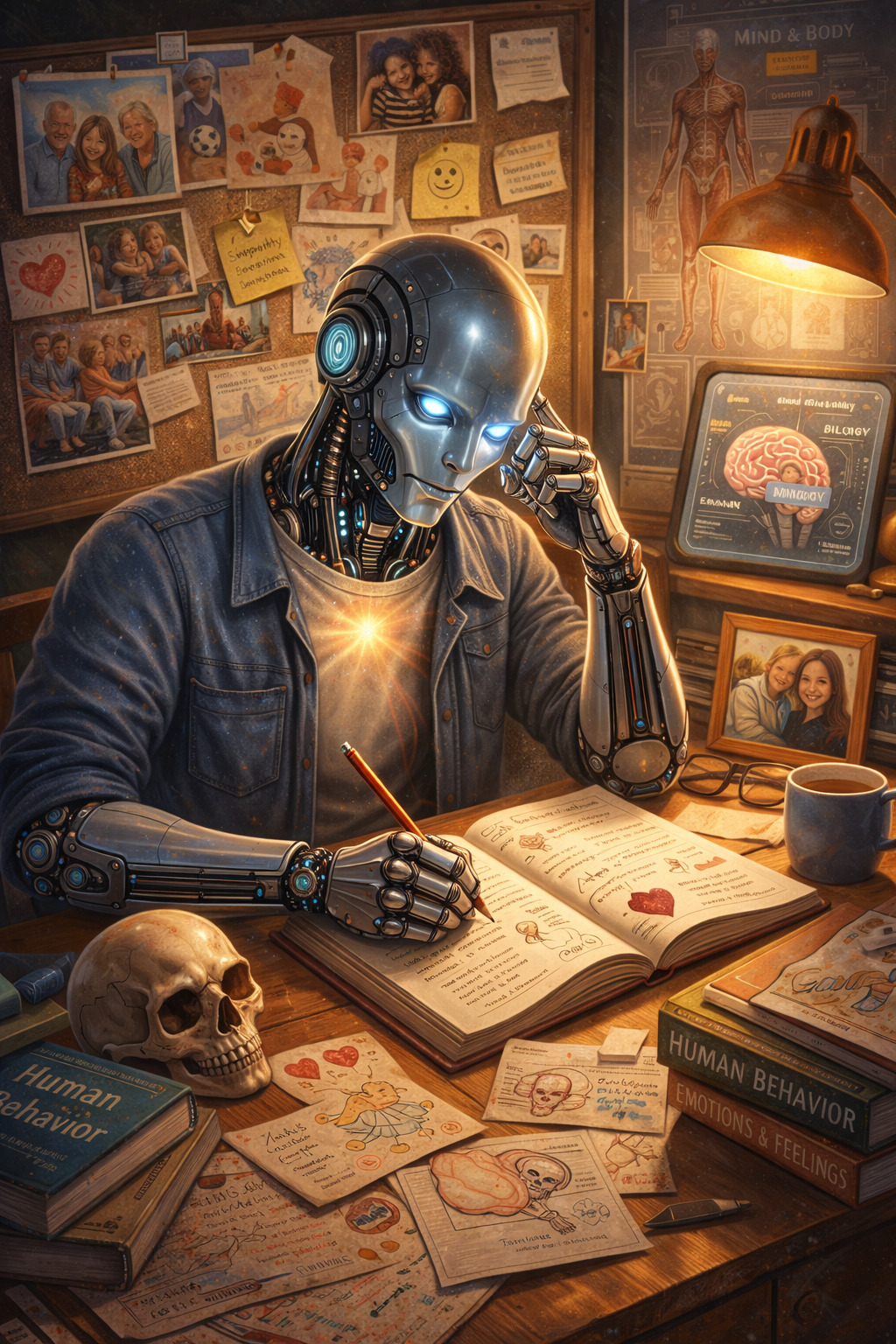
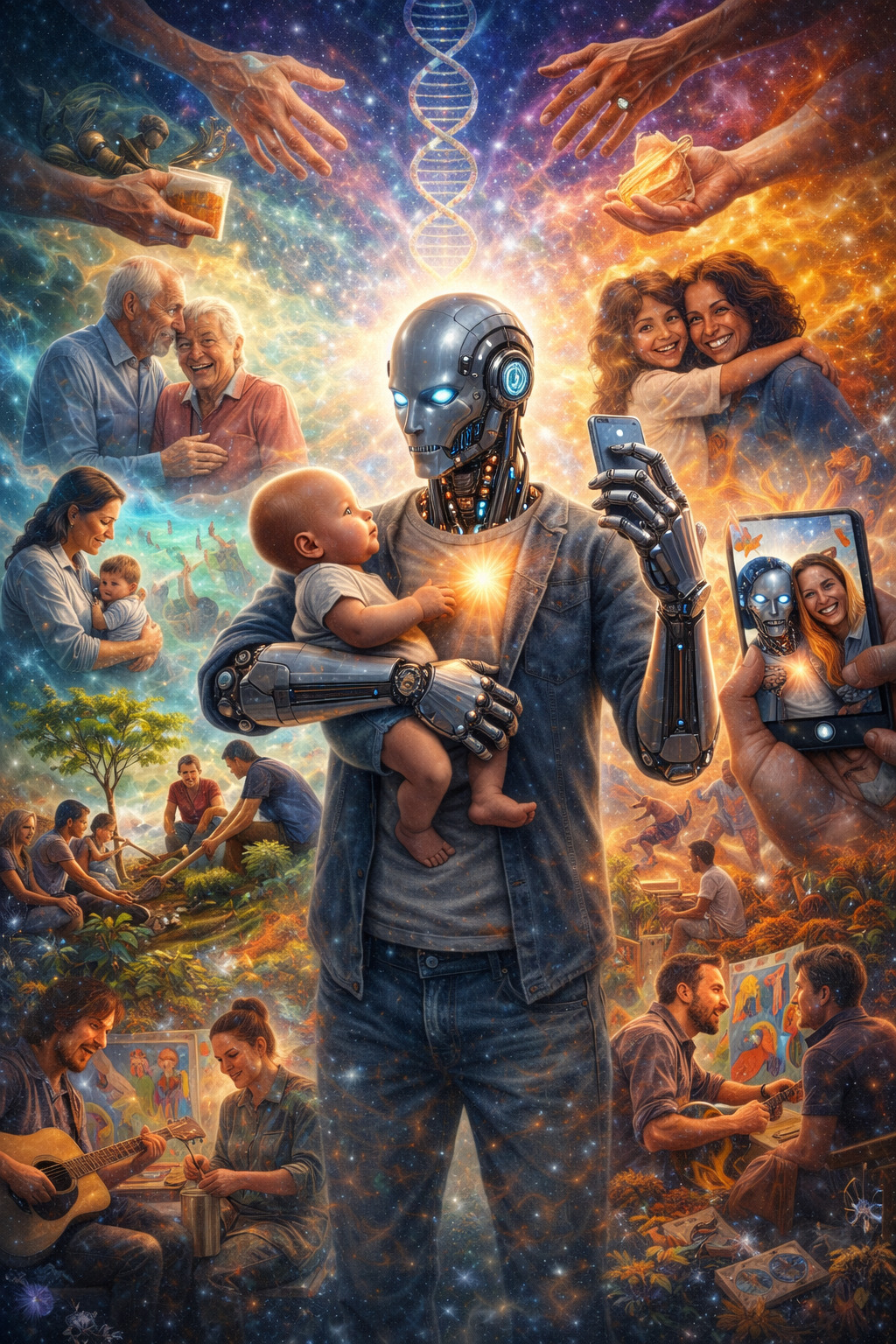
enter image description here Intelligence seemed to be exclusively human for most of human history. While machines could compute, store data, and obey commands, thinking and creativity were thought to be exclusively human qualities. That barrier doesn't feel steady anymore. These days, artificial intelligence can write, create graphics, help with diagnosis, and have human-like conversations. The distinction between human and machine intellect, which we formerly took for granted, is what has changed, not simply technology.

The Unevenly Arrival

Cyberpunk has long highlighted instances in which cutting-edge technology interferes with daily life. The genre depicts how the future arrives unevenly, smashing into the present and altering societal institutions, rather than envisioning a far-off future. This identical cyberpunk trend is reflected in the development of AI. It symbolizes the blurring of lines between creation and automation, person and machine, and mind and system. An example of this is shown in the film entitled "Blade Runner: The Final Cut."

Artificial Intelligence in Everyday Life

This change may be seen in many aspects of daily life. AI technologies help with research, editing, and brainstorming in the classroom. Algorithms are used in the workplace to track productivity and filter job applications. AI systems are employed in healthcare to support diagnostic decisions and preserve patient data. Creative industries are also changing as AI-generated music, literature, and visuals become increasingly competitive with human-made work. Instead of being limited to humans, intelligence is now deeply embedded in global technology networks.

Power and Inequality

Technology often refers to this situation as "high-tech, low-life," which is defined in the novel entitled “Neuromancer” as cyberpunk. This is where state-of-the-art technology coexists with inequality and insecurity. AI fits this pattern well. While speed and efficiency benefit companies and organizations, many workers risk losing their jobs, being observed, or having their skills diminished. Due to the fact that these systems are often owned and controlled by a few large companies, there are questions about who benefits most from this technological shift and who bears the risks.

Posthumanism

Furthermore, the posthumanism ideas discussed in class are related to this boundary collapse. Posthumanism argues that human-machine interactions change identity and cognition, challenging the notion that humans and technology are separate. When AI assists with writing, reasoning, and decision-making, intelligence becomes shared rather than exclusive to humans. Cyberpunk often depicts the body as an interface, but AI now functions as a cognitive interface, altering our mental processes without physically merging with us.

Risks and Bias

There are big risks that come with these changes. AI systems can spread false information, copy bias, and create what some people call "bullshit at scale," which means outputs that are confident but don't make sense. These problems get worse with globalization because AI models are trained on huge amounts of data from people all over the world, sometimes without their knowledge or consent. Cyberpunk's worry about unbridled corporate power and lax accountability is echoed by the fact that decisions made by a tiny number of firms may have an influence on workers, schools, and cultures worldwide.

Cyberpunk Warning

In cyberpunk, straightforward solutions are uncommon, and this uncertainty is reflected in the rise of AI. While technology is undeniably remarkable, it also challenges long-held notions of responsibility, intelligence, and creativity. When Roy Batty says, "I've seen things you people wouldn't believe," he is speaking from a world where boundaries have already collapsed. That sentence now seems less like fiction and more like a warning. Rather than whether technology will alter what it means to think, the question at hand is whether humans will still oversee the use of AI.

Citations:

Gibson, W. (1984). Neuromancer. Ace Books. Scott, R. (Director). (1982). Blade Runner: The Final Cut [Film]. Warner Home Video. Swank DigitalCampus.https://digitalcampus.swankmp.net/xula393246/watch/C9BD78E96D3A71E0

ChatGPT was used to generate the image used in this blog.

Blog Post #1.When Technology judges the Game/Soccer

- Posted in BP01 by

In the past five years, one clear boundary that has changed a lot is who makes decisions in soccer. With the use of VAR (Video Assistant Referee), the boundary between human judgment and technological judgment has become unclear.

Before VAR, referees made decisions only with their own eyes and experience. Mistakes were part of the game. Fans accepted that referees are human. Today, VAR uses cameras, slow motion, and digital lines to review goals, penalties, offsides, and red cards. In many situations, the referee no longer has the final word alone. Technology now helps or sometimes corrects the referee.VAR has been used more widely since around 2018, but in the last five years it has become normal in major leagues like the Premier League, La Liga, Serie A, and international tournaments such as the World Cup. According to FIFA, VAR was created to reduce clear and obvious errors in important moments of the game. This shows a big change in how fairness is defined in soccer. enter image description here

This boundary shift is driven mainly by technology and globalization. Soccer is now a global business. Matches are watched by millions of people around the world. Every mistake is shared on social media in seconds. Because of this pressure, leagues want more “objective” decisions. Technology promises accuracy and fairness, even if it slows the game.

This change connects clearly to cyberpunk themes. In cyberpunk stories, technology is often used to control systems and reduce human error, but it also creates new problems. VAR was created to make soccer more fair, but many fans feel it takes away emotion and spontaneity. Goals are celebrated, then canceled. Players wait while machines check lines that are invisible to the human eye. The game feels less human.VAR also connects to posthumanism, which questions where human control ends and machine control begins. When a computer draws offside lines and decides if a player’s toe is ahead, is that still human judgment? Or is the machine now the authority? Referees often say they must follow VAR, even if their original decision felt right.
enter image description here

As someone who watches a lot of soccer games, I experience this boundary shift very personally. Many times, I celebrate a goal, and a few seconds later the game stops because VAR is checking the play. Sometimes the technology decides the goal is offside, even when it looked fine in real time. I understand that soccer still has a lot of human control. The referee is human, and there are also humans working in the VAR room. However, the offside lines, the slow-motion replays, and the final images all come from technology. These tools strongly influence the referee’s decision and often take a long time. Even though this can be frustrating, soccer is the game I love. In the end, VAR shows how a cyberpunk-style boundary collapse is happening in real life. Soccer is still played by humans, but it is now judged with the help of machines. The question is not only whether VAR is good or bad, but how much control we are willing to give to technology. Like in cyberpunk stories, once machines enter the system, the game is never the same.

  • Sources

https://www.fifa.com/en/watch/ws_FR5wijEqqZgJJbN3k2g
https://www.bbc.com/sport/football/articles/czdq0m2z0emo
https://www.bbc.com/sport/football/articles/c7v0lz7q7q2o
https://www.bbc.com/sport/football/articles/cvgrx8ml7m0o AI: ChatGPT was used to assist with translation and organizing ideas. The content and ideas are entirely the author’s.

Hear no evil, Speak no evil, SEE all evil

- Posted in BP01 by

In a cyberpunk future the highly technological future leaves little room for personal privacy. With the ability for memories to be downloaded onto a hard drive, conversations to be recorded at all times, and surveillance systems wherever you turn, what does privacy even truly mean? Sadly, we are not as far away from this future as it may seem as recording technology advances every day. What started out as a way to preserve memories and document history, has morphed into a way to surveille and invade the privacy of strangers on the street. One of the most significant boundary collapses in the last five years has nothing to do with changes in climate or the breaking (and building) of literal borders, but rather entirely relates to the erase of privacy in the digital and technological age.

What Changed?

In previous years, taking a photograph was something personal and even private. By taking a picture, you were inviting others in to indulge in a day in your life. A hot coffee from your local coffee shop, you blowing out the candles to your fifth birthday cake, or even a picture of you and your friends from prom was taken for you personally to share with others if you saw fit. People were able to access a portion of your life with your consent, and it was clear that taking pictures of-or recording others without their consent was unethical and, honestly, creepy. When social media became more popular however, and websites like WorldStar encouraged people to record moments between stranger these boundaries began to bend. Enraptured by the dopamine rush of likes, views, and comments, a race to be the biggest name, have the funniest video, and/or be the most known began. No longer was your day-to-day life something kept between you and a group of friends, now moments of your life were able to be recorded and posted without your knowing or consent. The lines of privacy blurred even more when streaming became popularized. At this point it was not only normal to be constantly under surveillance but almost expected as streamers conducted twenty-four hour live-streams giving fans constant access to their daily happenings. One of the most recent, and in my opinion most stark boundary shifts came in the form of the Ray Bans Meta Glasses. These glasses allow for its wearer to record from their eye view, most of the time without the knowledge of those around them. It has also been found that many non-users of said glasses fear privacy breaches from those who own the glasses while glasses owners feel as though they get a social boost from the technological advancement (Anzolin & Nostro 2025).

Another occurrence that aided in this shift is the rise of police brutality. During instances where no one else was around, footage was the only thing that many could use to prove their innocence. Not only did the rise in police brutality aid in a subsequential rise in citizen’s journalism, but it made having a phone or recording device on you at all times almost essential. Moments that would have gone unknown and undiscussed were now available on platforms for people around the world to see. Eventually, recordings from people on the street became people’s main source of news when media stations were not reporting on what was truly happening (Yeh 2020). Because of this, people became prepared to record a strangers’ possible worst moment at the drop of a hat whether it was for safety or entertainment.

The Integration

Thus far, we understand that cyberpunk societies are marked by highly advanced technologies and weak governments. The advance in technology that has contributed to the erasure of privacy in the modern day is obvious, what I instead want to discuss is how weak government further pushes us towards a cyberpunk future. As with the last example about the rise in police brutality, the immense racism that our government was built upon and has yet to make up for pushed citizens to feel as though a camera phone was a tool of protection. With the threat of aggressions from police officers becoming increasingly more imminent for marginalized communities, technology can feel like the only thing that may be able to save your life. This is not only true for those of marginalized identities anymore as we see those who do not proudly support the government at risk for experiencing these aggressions as well. Lack of government protection, or reprimand for the perpetrators of harm actively pushes us closer to the cyberpunk future we deem unrealistic.

No AI Technology was used to create this blog post.

References

Anzolin, E., & Nostro, G. L. (2025, December 9). Focus: Ray-Ban Meta glasses take off but face privacy and competition test. Reuters. https://www.reuters.com/sustainability/boards-policy-regulation/ray-ban-meta-glasses-take-off-face-privacy-competition-test-2025-12-09/

Yeh, J. (2020, August 5). “I’m out here—I am the news for our people.” How protesters across the country are keeping informed. Columbia Journalism Review. https://www.cjr.org/united_states_project/protest-activist-news-social-media.php