Becoming Ant(Hu)man: Rethinking Humanity Through Hybrid Bodies

- Posted in BP04 by

The Ant-Human Hybrid Imagine a world where science has once again surpassed its own limits. Not the supernatural world of romance films where a girl falls in love with a boy who turns into a werewolf, but a world where hybridization is not an accident of magic, it is a government‑planned technology designed to create a more efficient society. And instead of a wolf, imagine the hybrid is something far less glamorous but far more radical: an ant. Ants can lift around fifty times their body weight, survive extreme physical pressure, and operate through a form of distributed intelligence that allows entire colonies to function with astonishing efficiency. If humans could integrate these characteristics, we would be forced to rethink labor, individuality, and consciousness itself. Hybridizing with an ant destabilizes the autonomous human subject and aligns directly with the posthuman questions raised by Haraway, Blade Runner, and Ghost in the Shell.

No leaders No Individualism The ant is compelling because of its strength, coordination, and pheromone‑based communication. In Deborah M. Gordon’s Ant Encounters: Interaction Networks and Colony Behavior, she emphasizes that ant colonies “operate without any central control” (Gordon, 2010). This challenges human assumptions about hierarchy and leadership. If ants can coordinate complex tasks without a central authority, then perhaps human societies, which rely heavily on centralized power, could be reimagined. Gordon further explains that “the colony’s behavior emerges from the interactions of its members” (Gordon, 2010), a model that mirrors cybernetic and networked systems seen in Ghost in the Shell. Ants also destabilize Western individualism. They embody collective identity and collective labor. As Gordon notes, “No ant knows what the colony is doing” (Gordon, 2010). Applied to humans, this raises unsettling possibilities: a labor force that works efficiently without necessarily understanding the larger purpose of their work. Ambition, personal dreams, and self‑expression could be replaced by pure functionality. Society might become more efficient, but at the cost of individuality.

Power or Exploitation

If I had to decide how far this hybridization should go, I would choose primarily physical adaptations. Enhanced strength could reduce reliance on heavy machinery in industry or the military, potentially lowering energy consumption. Chemical sensing or a more flexible, role‑responsive body could also be beneficial. But I would avoid deep cognitive or behavioral changes. Losing too much individualism risks creating a society without personal fulfillment. A fully collective consciousness, like an ant colony, might eliminate loneliness, but it would also eliminate creativity, desire, and the sense of purpose that comes from personal goals. A balance of perhaps 30% ant traits and 70% human identity feels like a sustainable mix. Haraway’s cyborg theory helps frame this hybridization as a boundary‑breaking act. The ant‑human hybrid collapses distinctions between human, animal, and machine. It goes beyond technological enhancement and enters the realm of biological fusion, the kind of hybridization that produces “superhumans” in superhero narratives, except grounded in real evolutionary traits rather than fantasy. But Blade Runner warns us of the darker side. Replicants are engineered for labor and exploited because of their strength and obedience. An ant‑human hybrid could easily become a new labor caste: strong, efficient, and less likely to question authority. This mirrors the replicants’ struggle for autonomy and personhood. The ethical and political implications are enormous. Who would be allowed to receive these enhancements? Who would be denied? Any system that assigns hybridization based on “value to the state” risks creating new hierarchies of worth. I have one example of a short movie and story in which a pig‑stomach cancer cure illustrates how enhancements can spiral out of control when people seek them for unintended benefits. Hybridization could follow the same path, a technology meant for survival or efficiency could become a tool for exploitation, inequality, or even crisis. In the end, while a human‑ant hybrid might create new forms of community, I believe it would be a dangerous one. It risks erasing diversity, flattening individuality, and creating a population that can be easily exploited. The potential benefits of strength and efficiency do not outweigh the social and ethical risks of losing what makes human life meaningful.

How Much More Stylish Can I Get?

- Posted in BP04 by

Hybrid Minds: Why I Would Choose a Zebra

If a safe and reversible technology existed that allowed animal traits to merge with human abilities, my choice would be a zebra. Not for the stripes, although, aesthetically speaking, zebras clearly understood the assignment! My interest is in the zebra’s cognitive and behavioral traits. enter image description here

Zebras live almost entirely in the present moment. They respond to threats quickly and decisively, but they do not spend time replaying yesterday’s mistakes or spiraling about tomorrow’s possibilities. That mental orientation fascinates me. Humans, for better or worse, have an extremely active sense of past and future. It allows us to plan, innovate, and build civilizations, but it also invites anxiety, overthinking, and psychological stress.

Switching Cognitive Gears

Imagine being able to temporarily switch cognitive gears. If I were preparing for a big test tomorrow or worrying about all the possible ways things in the world could happen, I could activate that zebra-like mindset. Suddenly, the mental noise fades. Attention collapses into the present moment: what is happening right now, what needs to be solved right now. It would not erase intelligence or awareness; it would simply quiet the endless forecasting engine that human brains often run. My hybridization would involve minor, reversible cognitive adaptations rather than dramatic physical changes. The goal would not be to stop being human. Instead, the zebra traits would act as another perspective I could access when needed. Think of it less like becoming a zebra and more like installing a new cognitive operating system alongside the human one. There is also something appealing about the zebra’s resilience. Zebras exist in environments where danger is common, yet they do not appear paralyzed by fear. They react, adapt, and move forward. That kind of optimistic responsiveness could be powerful in problem-solving situations. It encourages alertness and quick thinking without the mental paralysis that sometimes accompanies human stress.


Humanity: What Are We Actually Protecting?

In this scenario, I would not be willing to give up my humanity. Instead, I see these traits as additive. They would enhance the way I already think and act. My personality, character, and authenticity would remain intact, while the hybridization would simply expand the range of cognitive tools available to me. And that raises an interesting philosophical question: what actually defines “humanity”? Science fiction loves to poke at this.

In Blade Runner, the replicants are biologically engineered humans who struggle with memory, identity, and the desire to live meaningful lives. The film quietly asks whether humanity is about biology or about experience and empathy.

Meanwhile, Ghost in the Shell explores consciousness itself. If memories, personality, and awareness can exist inside cybernetic bodies, where exactly does the “self” reside? The body becomes flexible, but the mind, the ghost in the machine, remains the core question. enter image description here

And then there is A Cyborg Manifesto, where Donna Haraway argues that humans have always been hybrids in some way. Technology, culture, biology, and machines already blend together in our lives. The cyborg, in her view, breaks down the boundaries between human and nonhuman. My zebra hybrid thought experiment fits right into that conversation. It suggests that being human might not be about staying biologically pure. Instead, humanity might be defined by consciousness, creativity, and moral awareness, the ability to reflect on our choices and imagine better futures.

Who Gets the Upgrade?

Of course, the social implications of this technology would be enormous. If hybrid enhancements existed, who would actually have access to them? History often shows that new technologies first appear among people with the most resources, and that could create a new kind of inequality where enhanced individuals gain cognitive or physical advantages over others. This concern already appears in modern debates about genetic editing, cognitive enhancement drugs, and advanced medical technologies. If enhancements become expensive or restricted, they could deepen social divides rather than improve life for everyone.

For that reason, if such technology existed and were available to me, I believe it should be accessible to everyone. Otherwise we risk creating a world where biological advantages become another form of privilege. Slippery slopes in technology are rarely dramatic single leaps—they usually begin with small policy decisions about who gets access.

The Question of Exchange

One part of this idea that I keep circling back to is the idea of exchange. If hybridization means taking something from another species, then it raises a strange and fascinating question: what does the other side receive? In most human-centered technologies, we assume the change only flows one way. Humans modify, humans enhance, humans benefit. But if this imagined technology truly blends two living systems together, even temporarily, then it almost feels incomplete if the exchange is only in our favor. So I wonder what the zebra would receive from me.

Would the process simply pull cognitive traits from the zebra while leaving the animal unchanged? Or would hybridization mean that a small part of my own consciousness, perspective, or behavioral tendencies would be shared in return? In other words, is hybridization extraction, or is it collaboration?

A Different Way of Evolving

In a strange way, that idea reflects something already true about being human. We are constantly evolving, borrowing tools, ideas, and perspectives from everything around us. The difference is that, in this thought experiment, evolution just got a little more creative and a lot more stylish.

So my zebra hybridization is ultimately about perspective. I would remain the intelligent, curious, and authentic being I am, with the added ability to shift mental frameworks when needed. The stripes stay metaphorical, the humanity stays intact, and the mind gains a new way to experience the world.

Now...

I invite you to answer the same question:

If you could hybridize with one animal, what would you choose and why?

Sources

Higgins RJ;Vandevelde M;Hoff EJ;Jagar JE;Cork LC;Silberman MS; (n.d.). Neurofibrillary accumulation in the Zebra (Equus Burchelli). Acta neuropathologica. https://pubmed.ncbi.nlm.nih.gov/842290/#:~:text=Abstract,accumulation%20in%20man%20and%20animals.

Lisitsa, E. (2026, January 16). 5 things zebras can teach us about fighting stress. The Gottman Institute. https://www.gottman.com/blog/5-things-zebras-can-teach-us-about-fighting-stress/

AI Attestation: Ideas are my own, AI used to edit writing
Octopus Intelligence and the Limits of Being Human

- Posted in BP04 by

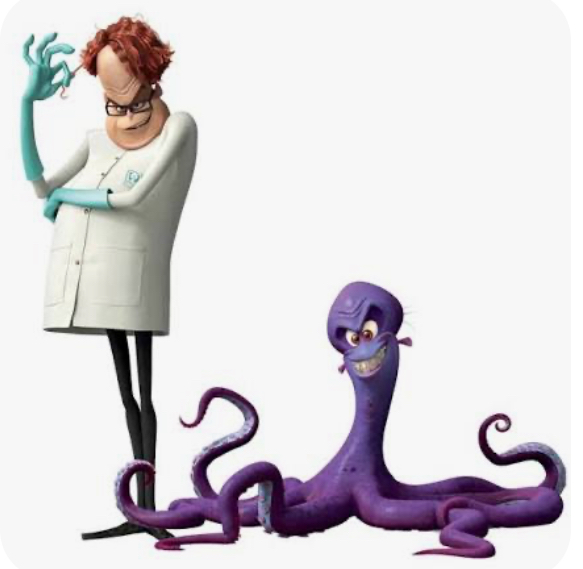
Dave the Octopus in Human and Octopus FormThe thought of humans getting traits and characteristics from other species brings interesting questions about identity and the different limits of enhancing humans. If a technology like this existed, or became legal, I would choose to be hybridized with an octopus. Octopi are known for being extremely smart and having complex nervous systems that work and function very differently from a human brain. Different research on their brain’ show that a big portion of octopus’s neurons run throughout their arms opposed to staying centralized in the brain which allows the animal to interact and respond to its environment in unique ways (Niven & Nakagawa, 2024). This intelligence challenges the idea that cognition must operate like the human mind and brain. The idea of an octopus mixing and blending into human society was kind of shown in the movie Penguins of Madagascar. The villain, Dave the octopus, disguises himself as a human scientist. This brings up a philosophical question on if having intelligence, awareness, and the ability to make decisions make you human even if you do not have a physical human body?

What Traits Would I Actually Want?

If being an octopus human hybrid were possible, I would not want to completely transform into an octopus, but have certain traits and characteristics. Something that octopus are known for is their flexibility, have many arms, problem solving, and being able to camouflage. One of the most interesting though is their problem solving abilities. Octopi are known to be able to interact with things in their environment, solve puzzles, and quickly adapt to new situations. This cognitive flexibility would be helpful for humans (Niven & Nakagawa, 2024). Their physical flexibility is also unique to them as they can move and adjust in different ways that most animals cannot. I would not want to completely give up the human body, having different octopus adaptations would be interesting. For example, having an additional hidden or retractable arm would be useful when multitasking or holding multiple things. Octopi are also able to change the color and texture of their skin to blend into their surroundings. This would not necessarily be needed for survival in a modern world, it would be a cool ability to have. Although these traits and features are cool, I would want to stay mostly human form opposed to full out unrecognizable octopus.

What Actually Makes Someone Human?

Thinking about hybridization, the question of what makes something human comes up. If a person still has consciousness, memories, and the ability to make decisions, physical changes would not completely take away their humanity. This idea is brought up in Ghost in the Shell where identity is not necessarily tied to the body but more so consciousness. Similarly in Blade Runner, replicants look human, but are treated differently and poorly because they are artificially made. Donna Haraway also brings this up in terms of breaking boundaries between humans and nonhuman in A Cyborg Manifesto. She suggests that the line between human and nonhuman is not as fixed and defined as people think (Haraway, 1985). With all of this in mind, a human octopus hybrid would challenge what it would mean to be human.

Who Would Have Access to Human Enhancement?

Another question that would be brought up is who would have access to this technology? Like a lot of new technology, rich people and powerful companies and corporations would initially have access until something new came about then it might be given to the public. New types of inequalities would be created if certain people were able to enhance their abilities. There are already physical enhancements and this already brings about different arguments and separations, but increased intelligence would be on a different level. Similar concerns appear in Blade Runner, where replicants are made with enhanced abilities but are treated as a less than despite being nearly basically identical to humans. This gives advantages in education, work, and other parts of human culture and society. There would be more debates about fairness and what is allowed. Research on animal cognition and nervous systems, such as studies on octopus intelligence, already shows how different forms of biological intelligence can function in complex ways (Niven & Nakagawa, 2024). If humans were able to gain these traits using hybridization or enhancement, more questions about fairness, access, and limits on human abilities would surface.

AI was used to help plan and edit this post. Also used to help with citations and headers and titles. https://chatgpt.com/share/69ace400-8af4-800d-b41f-689b00c9a3b2

Reference

Niven, J. E., & Nakagawa, S. (2024). The evolution of octopus intelligence and nervous system complexity. Proceedings of the Royal Society B: Biological Sciences, 291(2032). https://doi.org/10.1098/rspb.2024.1568

Haraway, D. (1985). A cyborg manifesto: Science, technology, and socialist-feminism in the late twentieth century. Socialist Review.

What if Humans Could Fly

- Posted in BP04 by

There are some questions people are asked at least once in their lives, such as “What animal would you want to be?” Now, imagine a future where this question is no longer hypothetical, and technology actually allows humans to adopt traits from animals. If I had the opportunity to choose one animal to adopt a trait from, I would choose a bird. My choice is based on birds’ ability to fly. I imagine it would provoke a feeling of freedom, and being high in the sky, far from the turbulence of life on the ground, must be peaceful. However, such a possibility would also raise deeper questions about identity and what it really means to be human.

Hybridizing to certain extent

Since I was a kid, I’ve always been fascinated with flying. I would have dreams about it and imagine a reality where I would be able to do it. Even today I still think about how being able to move through the sky could offer a sense of independence and perspective that is impossible on the ground. Personally, if this technology existed, I would not want to completely transform into a bird. I would only want the ability to fly. This would probably require wings and a lighter body, but I would want to keep the change minimal. The goal would not be to become something else, but to expand what the human body can do. However, even small changes like this can raise deeper questions about where the boundary between human and nonhuman begins.

Humanity beyond the physical

One of these questions that comes to my mind is what actually defines being human. If the ability to fly changes the body, does it really change who someone is? For me, humanity is not defined only by our physical form and traits, but by our consciousness and our memories. Think about it with me, a person with wings would still have the same thoughts, relationships, and identity that existed before the transformation. This situation is similar to what happens with the character Major Kusanagi in Ghost in The Shell, whose body is almost entirely cybernetic, but she continues to question what makes her truly herself. Even though her body is artificial, her thoughts, memories, and sense of identity are the same, which suggests that what defines a person might not be their physical body, but their consciousness. In the same way, gaining the ability to fly would change my body, but it would not change who I am as a person.

Connecting to course teams: Haraway and Blade Runner

Donna Haraway in A Cyborg Manifesto argues that technology challenges some boundaries that once were considered stable, such as the boundary between human and machine. At the same time, if it was possible for humans to adopt traits from animals, such as a human with wings, we would see another rigid boundary getting blurred - the one between human and animals. Additionally, the movie Blade Runner addresses how society would see these changes. In the film, the replicants are almost indistinguishable from humans, but still, they are treated as outsiders and hunted down by the Blade Runners. This represents how this debate goes beyond physical and even psychological characteristics, indicating that humanity is defined socially and politically, not just biologically. In the same way, human-animal hybrids’ humanity might be judged based on how the changes and upgrades affect society, making this another political discussion.

The Social Perspective

Another perspective that is important to consider if this technology becomes available is about accessibility - who would have access to it? Just like other advanced technologies, the access would probably be limited to people and groups with greater financial resources. A real example of this can be seen in sports. Researchers like sports ethicist Andy Miah argue that emerging biomedical and genetic technologies can offer unfair advantages to athletes. If some could have access to speed, endurance, and strength upgrades, the game would no longer be fair. The same would happen with human-animal hybrids. If some people could upgrade their bodies and others couldn’t, it would contribute significantly to increasing inequality in our society. Those with access would have physical and psychological advantages over others, raising ethical debates about justice and fairness.

Sources

Haraway, D. (1985). A cyborg manifesto: Science, technology, and socialist-feminism in the late twentieth century. Socialist Review.

Miah, A. (2004). Genetically modified athletes: Biomedical ethics, gene doping and sport. Routledge.

Scott, R. (Director). (1982). Blade runner [Film]. Warner Bros.

Shirow, M. (1989). Ghost in the shell. Kodansha.

AI Attestation: No use of AI for the creation of this post

Designing an Eagle–Human Hybrid Body

- Posted in BP04 by

Why I’d Hybridize with an Eagle

If a safe and reversible technology existed that allowed humans to take on animal traits, I would choose to hybridize with an eagle. I would say eagles represent freedom, independence and especially sharp vision, qualities I often wish I had in my everyday life. I would not want a full transformation, but I would choose meaningful physical and cognitive adaptations without losing my sense of self.

The first trait I would want is enhanced vision, so I could see long distances and notice details much more clearly. This ability would give me a new way of experiencing the world, almost like gaining a second layer of awareness. I would also choose lightweight wings or gliding structures that allow controlled flight or long jumps. I do not need full bird anatomy, but the ability to move through space in a new way feels very exciting. I would also accept some behavioral traits, like sharper focus and stronger situational awareness. Eagles are known for their calm but alert presence, and I think this could help me manage stress. These changes feel like enhancements rather than replacements of who I am. At the same time, I would not want to lose basic human traits like speaking, writing, or making emotional connections with others. I do not want to give up my face, my voice, or my ability to relate to people as a human. For me, “humanity” means having emotions, self‑awareness, memory, moral responsibility and consciousness. So I would accept physical adaptations, but I would want my personality, memories, and sense of self to stay mostly the same.

Blurring the Boundaries Between Human and Animal

Thinking about human–animal hybrids also connects to Haraway, who argues that modern technology breaks down the traditional boundaries between human, animal, and machine. The cyborg represents a world where these categories are no longer clearly separated. A human with eagle traits would be another example of this blurred boundary. This also connects to Blade Runner, where replicants look human but are treated differently because they were artificially created and meant to be “retired.” The film asks whether humanity is defined by biology or by experience and emotion. If someone had enhanced eagle vision or the ability to glide through the air, they might look different, but they could still think, feel, and make decisions like any other human.

Who Gets to Be Enhanced?

Another important issue is who would actually have access to this type of technology. In reality, many advanced technologies first become available only to wealthy individuals or powerful organizations. Philosopher Nick Bostrom has argued that human enhancement technologies could create new forms of inequality if only certain groups are able to use them. If only some people could enhance their physical abilities or senses, they might gain advantages in education, jobs, or even security. This raises ethical questions about fairness and access. Would governments regulate these technologies? Would they be available to everyone, or only to those who could afford them?

Conclusion

Thinking about hybridization and becoming part eagle makes me reflect on what truly defines a person. I believe humanity is more about memory, emotion and consciousness and if those remain intact, even major physical changes would not erase the self. But as i mentioned, the real danger is not transformation itself but mainly who controls it and who gets access to it. Enhancement technologies could expand human potential, but they could also deepen inequality if we are not careful enough.

AI was not used for any part of this assignment.

Sources

Bostrom, N. (2005). IN DEFENSE OF POSTHUMAN DIGNITY. Bioethics, 19(3), 202–214. https://doi.org/10.1111/j.1467-8519.2005.00437.x