Bird's Eye View

- Posted in BP04 by

Apex Vision

To have the thought that a human can remove an eye and replace it with a robotic eye to give a vision beyond what a human can see seems rather close to happening. However, the chances of that in a safe and a reversible procedure seems very difficult. But if I did have to choose, I would go for an eagle. The only portion I suggest to have and it isn't what most would want such as its wings, I on the other side want its cognitive peak focus. While an eagle is known to have immaculate eyesight and have beyond 20/20 shaper vision. For one to have the eye sight of an eagle means to have such sharper detail and a different perception of the world.

enter image description here

The Bald Eagle

In a sense not only is an eagle known for its physical traits hence the reason why it is the National bird of The United States of America, "The bald eagle represents freedom, strength, courage, and independence." I have a heightened experience and to see the world in a different perception to me seems like a way to cancel out all the noise and just focus on what matters to a bird. But to not be picky, I truly would want just the bird's eye vision to escape the thoughts of remembering

enter image description here

The question remains, how much humanity would I be willing to give up is more complex. While prosthetics or a medical implant would be the route to take if ever considered, technology has become so advanced that to differentiate between what is real and what is artificial seems hard to decipher. But to think more realistically, if we do have the technology to make these alterations and maybe not take the eye out of an eagle, but to fabricate one to have the same feeling can be a route to take. However, it is then a person should be aware that they are human and not consumed by artificial intelligence.

In comparison to my beliefs and values, self-awareness is deeply rooted in me. To be able to make human connections and use what was gifted to me naturally, I am also thankful for. But many can wish to have the abilities like an eagle to fly or even see so clearly. But the power to see farther than one should does not mean they should lose the ability to feel disconnected with the human race.

The scary part to even take part of this is that it may be even possible for the wealthy to do. However, those in low income communities would be left out when in a world of advancement that could possibly take part in a competitive job seeking. Over time, this could create a biological divide between those you can find the funds to take this operation against those can not. While an eagle-like enhancement would simply be a step forward to technology advancement, I would consider myself a human with a clear train of thought and being ok with having less than a 20/20 vision....then again that's what contact lenses are for.

Reference:

AI was used to create images

https://chatgpt.com/share/69accdd3-7b70-8003-a3aa-3ff05e664658

The American bald eagle the Bald Eagle has been the National Bird. (n.d.-e). https://www.va.gov/opa/publications/celebrate/eagle.pdf

Visual learning: An interview with James Dicarlo | AI in Neuroscience. (n.d.-g). https://www.liebertpub.com/doi/full/10.1089/ains.2024.0002

I Hear My People, But I Don’t See My People

- Posted in BP03 by

A contemporary example of fluid identity and liberation through hybridity can be seen in the global circulation of Korean pop music, or K-pop. Many Korean idols who pursue hip-hop and rap-aligned sounds adopt stylistic elements rooted in African American culture, including African American Vernacular English, fashion, and choreography. This blending challenges boundaries of race, nation, and authenticity. Identity in this context becomes something performed and assembled from cultural fragments rather than fixed to biology or ethnicity. As a result, K-pop demonstrates how identities can be constructed through crossing boundaries, while also exposing tensions between representation and lived experience.

Hybridity on the Global Stage

The history of Black cultural borrowing in K-pop is well documented. As O. Gaines argues in The Tufts Daily, “Black culture has heavily influenced K-pop’s music, fashion and overall aesthetic since its inception,” yet that influence often goes uncredited or is misunderstood as neutral globalization rather than racialized borrowing. This pattern is not new. In the 1990s, J. Y. Park, founder of JYP Entertainment, performed in blackface alongside background dancers, a moment that revealed how Blackness could be treated as costume within the industry’s early formation. Decades later, Park again received criticism for posting a remix of DNA by Kendrick Lamar, featuring non-Black performers styled with afros and dreadlocks. In these instances, Black cultural aesthetics function as wearable signifiers layered onto Korean bodies. enter image description here
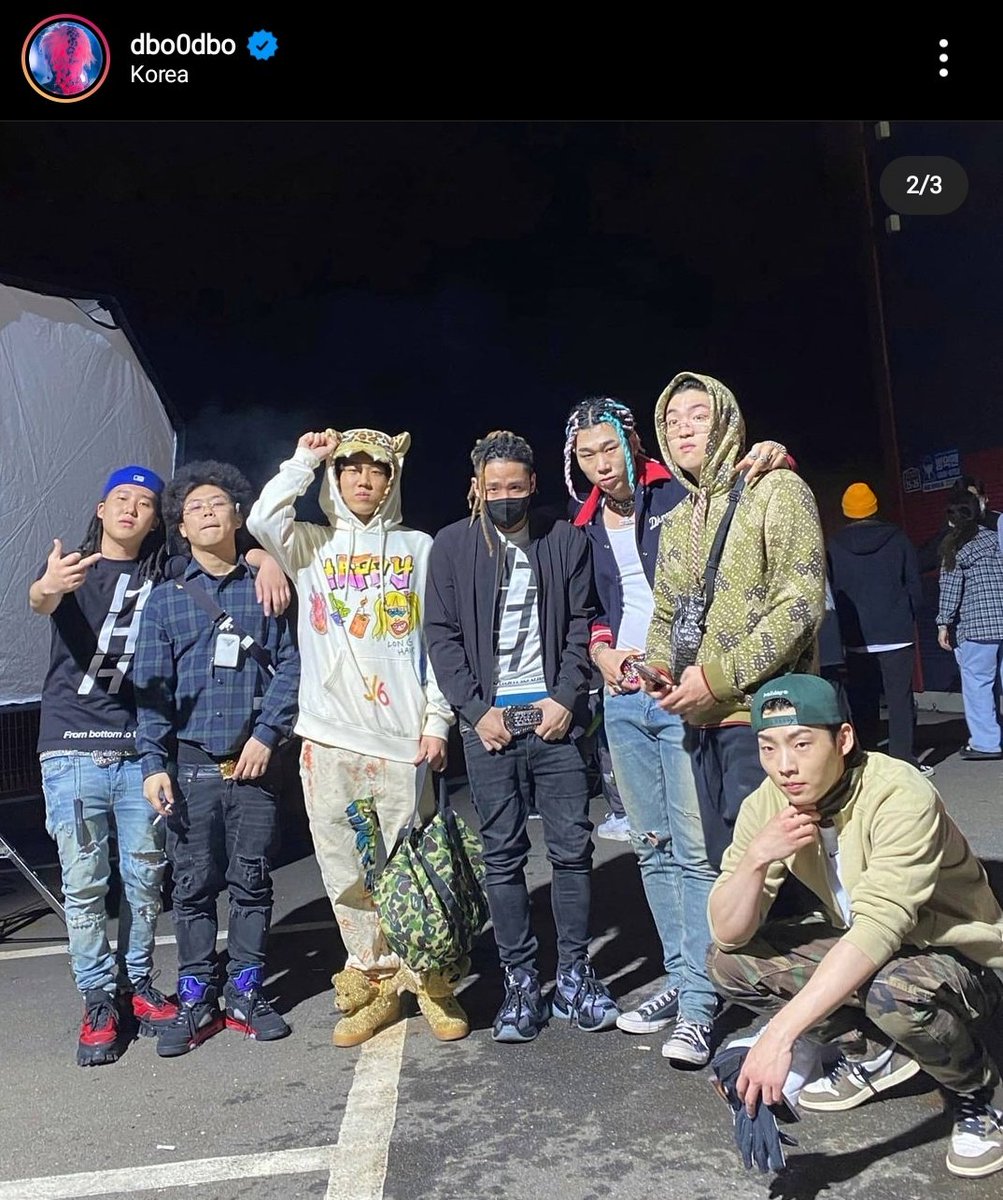
Image: Screenshot from J. Y. Park’s Kendrick Lamar remix performance, originally shared by @CallMeGizzzy on X (formerly Twitter), [June 14, 2021]. Used for commentary and educational purposes.

K-pop artists construct hybrid identities by performing Black musical and aesthetic traditions alongside Korean language and culture, creating fluid identities that cross racial and national boundaries. Groups like BTS incorporate hip-hop choreography, rap flows, and streetwear aesthetics rooted in Black American culture into their global pop identities. This challenges racial boundaries by staging Black cultural forms through non-Black artists, national boundaries by translating African American genres into Korean contexts, and linguistic boundaries by blending Korean and English in rap and pop lyrics. It also destabilizes authenticity boundaries, presenting identity as performance rather than essence.

At the same time, hybridity in K-pop does not only function as appropriation. It also creates new transnational spaces of belonging. In her thesis on fandom and identity, Varma explains that K-pop communities allow fans to “negotiate identity and belonging across national and racial lines,” producing forms of attachment that are not confined to geography or ethnicity. This reflects the liberatory potential of hybridity: identities are no longer anchored solely in nation or race but are assembled through shared media, aesthetics, and affective communities.

This phenomenon closely echoes the theory advanced in A Cyborg Manifesto by Donna Haraway, who argues that identities are hybrid assemblages rather than pure categories. K-pop artists function like cultural cyborgs, assembling identities from multiple systems such as Korean tradition, Black American music, global capitalism, and digital media networks. However, while Haraway celebrates hybridity as boundary-breaking and potentially liberating, K-pop demonstrates that hybridity can also reproduce unequal cultural exchange when certain identities carry historical oppression.

The work of Janelle Monáe offers a revealing contrast. Through Afrofuturist performance, Monáe uses hybridity to center Black identity and reclaim agency. In contrast, K-pop often circulates Blackness globally as a performable identity layer signaling coolness and authenticity. Monáe mobilizes hybridity as resistance from within Black experience, while K-pop illustrates how Blackness can become a globally consumable aesthetic detached from lived history.

The Future of Wearable Identity

Looking ahead 20–30 years, identity may become even more modular and technologically mediated. The rise of AI-generated performers and virtual idols suggests that artists may soon construct personas that are partially human and partially algorithmic. If hybridity already allows cultural identities to be assembled and worn, future technologies may allow identities to be coded, customized, and projected across virtual environments. This could expand freedom of self-expression and create new forms of solidarity across borders. Yet it will likely intensify debates about ownership, authenticity, and historical accountability.

AI Attestation: The AI ChatGPT was utilized to plan and edit this posting. https://chatgpt.com/share/699b4620-def4-8009-9ff7-6e16afa28e35

Citations

Gaines, O. (2022, March 16). K-Weekly: Black appropriation in K-pop (Part 1). The Tufts Daily. https://www.tuftsdaily.com/article/2022/03/k-weekly-black-appropriation-in-k-pop-part-1

Varma, T. (2024). IDENTITY AND BELONGING Identity and Belonging: South Asian Americans Navigating K-pop Industry and Fandom. https://sites.lsa.umich.edu/commmediathesisprogram/wp-content/uploads/sites/1393/2025/01/VARMA-2023.pdf

But Where Are You Really From?

- Posted in BP03 by

The Diaspora is the Modern Day Cyborg

It sounds ridiculous.

The term "diaspora" implies history, migration, and displacement (Bamberger et. al 2021). "Cyborg," in the most stereotypical sense, often brings up concepts of prosthetic limbs, a demolished environment, and the technological landmarks of cyberpunk (Haddow 2021).

But if you break down these two ideas, and strip away the associations that stitch themselves to diaspora and cyborg, it becomes clear that both terms describe the same exact phenomenon.

Who could possibly embody the cyborg concept of defying categories better than someone who never felt comfortable in one? Who could possibly understand hybridity more than someone from many places, speaking many languages, and embracing many histories, but unable to truly be claimed by any?

enter image description here

Living In-Between

Diasporic identity is essentially a messy fusion of cultural, linguistic, political, and historical systems (Zhao 2024). There are hundreds of fragments that you must carefully keep together to create a coherent self.

Just as Haraway's cyborg opposed the concept of purity, kids growing up in the diaspora must understand at a young age that they are composed of too much Other to ever be as purely ethnic as their counterparts. Too Asian to be American, for example, or too American to be Asian.

Over time, this hybridity of identities blended into a point of pride. Tiktoks reclaiming ancestral languages, for example, led to people creating music aimed at showcasing their unique blend of mother tongues. Jokes by people from the diaspora about their own experiences spurred a sense of community that was irrelevant to borders or race. In the same way that Cindy Mayweather from The ArchAndroid refuses to be categorized as human or machine, those living in the diaspora do the same: they refuse to pick between identities.

enter image description here

The Dictation of Space

Who decides what "real" culture is? Who has the authority to police identity? What counts as fluent enough? How do you learn your history when history books were dipped in White ink?

Often, we are taught to respect the boundaries of race and identity without question. Accept tradition blindly, and if you are less than a certain percentage of a race, do not claim to be it.

Gen-Z has pushed against this, choosing instead to engineer their self-images. People are building selves that are fluid, adaptive, and contrary to the binaries imposed on gender, boundary lines, and census boxes.

Case, the protagonist in Neuromancer, describes a world where identity is distributed and updated constantly. Reality is the same way; as people grow, their identities shift. Someone can learn more about a culture they've lost touch with, updating their identity through their own hard work and determination.

References

Bamberger et al. (2021). Diaspora, internationalization and higher education. British Journal of Educational Studies, 69(5), 501–511. https://doi.org/10.1080/00071005.2021.1966282.

Haddow G. Embodiment and everyday cyborgs: Technologies that alter subjectivity [Internet]. Manchester (UK): Manchester University Press; 2021. Chapter 3, Reclaiming the cyborg.

Zhao Z. (2024). Diasporic Identity in Contemporary Sinophone Literature: The Role of Language and Cultural Elements. Journal of psycholinguistic research, 53(1), 13. https://doi.org/10.1007/s10936-024-10058-9