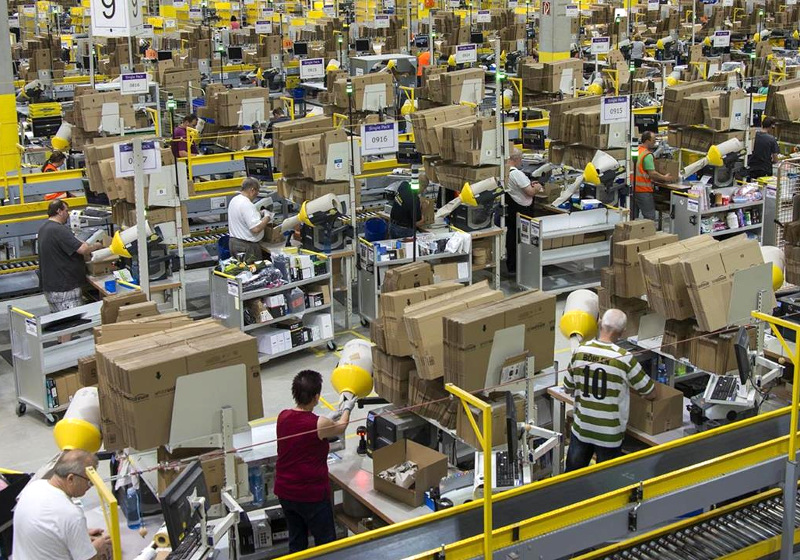
Cyberpunk has always asked a disturbing question: what happens when corporations become so powerful that they begin functioning like governments, but without the accountability of governments? In fiction, corporations like Tyrell in Blade Runner and Tessier-Ashpool SA in Neuromancer control technology, labor, and even human life. Similarly, in S. B. Divya’s Machinehood, corporations profit from systems that push workers to their physical and mental limits while treating them as expendable. While these worlds may seem exaggerated, real-world corporations especially Amazon, show that these concerns are not purely fictional.
Amazon’s scale alone reflects a level of influence that resembles cyberpunk megacorporations. According to its 2024 annual report, Amazon generated $638 billion in net sales, with Amazon Web Services (AWS) contributing over $107 billion, positioning the company not just as a retailer but as a major piece of global digital infrastructure (Amazon, 2025). This matters because AWS supports governments, businesses, and online systems worldwide. When a corporation controls both commerce and infrastructure, its power begins to extend beyond traditional business influence into something more systemic. Similar to the corporations in cyberpunk that shape everyday life itself.
However, the strongest cyberpunk parallel lies in labor practices. A 2024 investigation by the U.S. Senate Health, Education, Labor, and Pensions (HELP) Committee found that Amazon warehouse workers experienced injury rates over 30% higher than the industry average, largely due to intense productivity quotas and algorithmic management systems (U.S. Senate HELP Committee, 2024). These findings suggest that workers are often treated as units of efficiency rather than individuals with physical limits. This mirrors Machinehood, where corporations design systems that extract maximum output from workers regardless of long-term consequences. While Amazon does not literally require performance-enhancing drugs, the pressure to maintain productivity at all costs reflects a similar mindset: the body becomes secondary to output.
Environmental practices also reinforce the cyberpunk comparison. Amazon’s 2024 Sustainability Report states that while the company reduced its carbon intensity by 4%, its total carbon emissions still increased by 6% due to continued growth (Amazon, 2024). This contradiction highlights a common corporate pattern, as efficiency improves expanding environmental impact is paired with it. Cyberpunk fiction frequently portrays corporations presenting themselves as innovative and forward-thinking while contributing to environmental degradation in the background. Amazon’s own data reflects this tension between sustainability messaging and the realities of scale.
So, are we actually heading toward cyberpunk-style corporate dominance? In some ways, yes but not entirely. Cyberpunk should be understood less as a literal prediction and more as an exaggerated critique that helps us recognize real-world trends. Governments still regulate corporations, and democratic systems still exist. However, corporations like Amazon have gained enough influence to shape labor conditions, technological infrastructure, and environmental outcomes in ways that feel comparable to the early stages of cyberpunk worlds.
This issue is not entirely global in the same way. The United States tends to allow larger concentrations of corporate power compared to other regions. For example, the European Union has taken a more aggressive regulatory approach by labeling companies like Amazon as “gatekeepers” under the Digital Markets Act, recognizing their control over digital markets (European Commission, 2023). This suggests that corporate dominance is not inevitable but is influenced by political and cultural choices about regulation.
There are also real-world checks on corporate power. California’s warehouse quota law (AB 701) limits the use of productivity quotas that interfere with worker safety and basic rights, and in 2024, regulators fined Amazon nearly $6 million under this law (California Department of Industrial Relations, 2024). These actions show that intervention is possible. However, they also highlight an important point: regulation often comes after harm has already occurred, rather than preventing it from happening in the first place.
This is where cyberpunk plays an important role. It is not just entertainment, it is a warning. Cyberpunk encourages us to question systems that prioritize efficiency over humanity, growth over sustainability, and profit over well-being. It pushes us to recognize when corporations begin to act less like businesses and more like governing forces in society.
Amazon is not a cyberpunk megacorporation in the literal sense. But it reflects many of the same patterns: massive influence, reliance on human labor as a resource, and the ability to shape everyday life on a global scale. Cyberpunk remains relevant because it reveals what can happen when these patterns go unchecked. Whether that future becomes reality depends not just on corporations, but on how society chooses to respond.
AI Statement
I used AI as a support tool to help organize my ideas, refine the structure of my blog post, and ensure clarity in my writing.
References
Amazon. (2024). Amazon Sustainability Report 2024. https://sustainability.aboutamazon.com/2024-report
Amazon. (2025). Amazon 2024 Annual Report. https://s2.q4cdn.com/299287126/files/doc_financials/2025/ar/Amazon-2024-Annual-Report.pdf
California Department of Industrial Relations. (2024). Warehouse quotas (AB 701). https://www.dir.ca.gov/dlse/FAQ_warehousequotas.htm
European Commission. (2023). Digital Markets Act: Gatekeepers. https://digital-markets-act.ec.europa.eu/gatekeepers-portal_en
U.S. Senate HELP Committee. (2024). The Amazon investigation report. https://www.help.senate.gov/imo/media/doc/amazon_investigation.pdf
 A company that does not seem like a cyberpunk example would be Uber. The premise of it is allowing people to have freedom to work when and wherever they want and also be their own boss. A lot of drivers use Uber as their main source of income, but they do not keep standard protection nor benefits. Different articles show that Uber has built in loopholes so they do not have to pay their drivers fairly and even lock them out of the app. This directly affects their income and them being able to support themselves.This also creates a situation where workers feel stuck, because leaving the platform could mean losing their main source of income without having another option ready. Because of this, Uber looks like more of a system that controls its workers because they depend on it.
## Flexibility Without Protection
This is sort of like Sleep Dealer where the job is an opportunity, instead it kind of traps its workers. Memo chooses to work with the nodes, in the same way Uber drivers chose, but this is based on their situation. Memo needs this job to survive and to send money to his family. In the same way Uber drivers depend on the app for money, but the algorithm controls everything. This type of work does not have stability, protection, or benefits which leaves workers in vulnerable and tough situations (Apouey, et al., 2023). There are also reports that show Uber has loopholes used so they do not have to pay their drivers and workers fairly. These loopholes even go to extremes of locking people off of the app which affects their ability to make and earn money (Business & Human Rights Resource Centre, 2024). In Memo’s situation and the Uber drivers, they are both in a situation where they have limited choices so that “choice” is not really a choice.
## Dependency on Work
A company that does not seem like a cyberpunk example would be Uber. The premise of it is allowing people to have freedom to work when and wherever they want and also be their own boss. A lot of drivers use Uber as their main source of income, but they do not keep standard protection nor benefits. Different articles show that Uber has built in loopholes so they do not have to pay their drivers fairly and even lock them out of the app. This directly affects their income and them being able to support themselves.This also creates a situation where workers feel stuck, because leaving the platform could mean losing their main source of income without having another option ready. Because of this, Uber looks like more of a system that controls its workers because they depend on it.
## Flexibility Without Protection
This is sort of like Sleep Dealer where the job is an opportunity, instead it kind of traps its workers. Memo chooses to work with the nodes, in the same way Uber drivers chose, but this is based on their situation. Memo needs this job to survive and to send money to his family. In the same way Uber drivers depend on the app for money, but the algorithm controls everything. This type of work does not have stability, protection, or benefits which leaves workers in vulnerable and tough situations (Apouey, et al., 2023). There are also reports that show Uber has loopholes used so they do not have to pay their drivers and workers fairly. These loopholes even go to extremes of locking people off of the app which affects their ability to make and earn money (Business & Human Rights Resource Centre, 2024). In Memo’s situation and the Uber drivers, they are both in a situation where they have limited choices so that “choice” is not really a choice.
## Dependency on Work
 image: A representation of corporate power and data surveillance!