Octopus Intelligence and the Limits of Being Human

- Posted in BP04 by

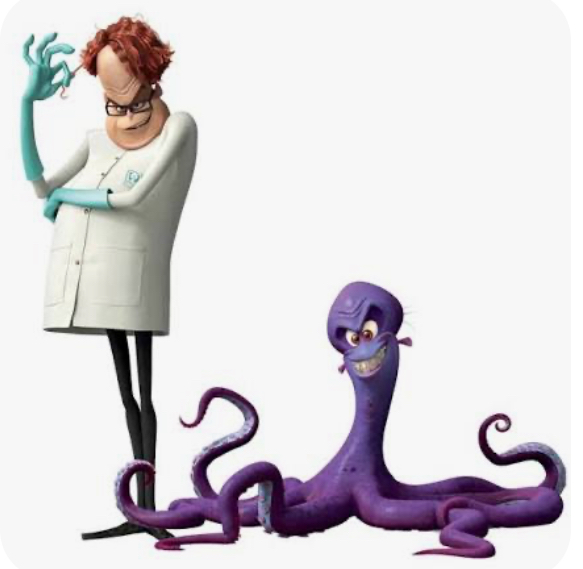
Dave the Octopus in Human and Octopus FormThe thought of humans getting traits and characteristics from other species brings interesting questions about identity and the different limits of enhancing humans. If a technology like this existed, or became legal, I would choose to be hybridized with an octopus. Octopi are known for being extremely smart and having complex nervous systems that work and function very differently from a human brain. Different research on their brain’ show that a big portion of octopus’s neurons run throughout their arms opposed to staying centralized in the brain which allows the animal to interact and respond to its environment in unique ways (Niven & Nakagawa, 2024). This intelligence challenges the idea that cognition must operate like the human mind and brain. The idea of an octopus mixing and blending into human society was kind of shown in the movie Penguins of Madagascar. The villain, Dave the octopus, disguises himself as a human scientist. This brings up a philosophical question on if having intelligence, awareness, and the ability to make decisions make you human even if you do not have a physical human body?

What Traits Would I Actually Want?

If being an octopus human hybrid were possible, I would not want to completely transform into an octopus, but have certain traits and characteristics. Something that octopus are known for is their flexibility, have many arms, problem solving, and being able to camouflage. One of the most interesting though is their problem solving abilities. Octopi are known to be able to interact with things in their environment, solve puzzles, and quickly adapt to new situations. This cognitive flexibility would be helpful for humans (Niven & Nakagawa, 2024). Their physical flexibility is also unique to them as they can move and adjust in different ways that most animals cannot. I would not want to completely give up the human body, having different octopus adaptations would be interesting. For example, having an additional hidden or retractable arm would be useful when multitasking or holding multiple things. Octopi are also able to change the color and texture of their skin to blend into their surroundings. This would not necessarily be needed for survival in a modern world, it would be a cool ability to have. Although these traits and features are cool, I would want to stay mostly human form opposed to full out unrecognizable octopus.

What Actually Makes Someone Human?

Thinking about hybridization, the question of what makes something human comes up. If a person still has consciousness, memories, and the ability to make decisions, physical changes would not completely take away their humanity. This idea is brought up in Ghost in the Shell where identity is not necessarily tied to the body but more so consciousness. Similarly in Blade Runner, replicants look human, but are treated differently and poorly because they are artificially made. Donna Haraway also brings this up in terms of breaking boundaries between humans and nonhuman in A Cyborg Manifesto. She suggests that the line between human and nonhuman is not as fixed and defined as people think (Haraway, 1985). With all of this in mind, a human octopus hybrid would challenge what it would mean to be human.

Who Would Have Access to Human Enhancement?

Another question that would be brought up is who would have access to this technology? Like a lot of new technology, rich people and powerful companies and corporations would initially have access until something new came about then it might be given to the public. New types of inequalities would be created if certain people were able to enhance their abilities. There are already physical enhancements and this already brings about different arguments and separations, but increased intelligence would be on a different level. Similar concerns appear in Blade Runner, where replicants are made with enhanced abilities but are treated as a less than despite being nearly basically identical to humans. This gives advantages in education, work, and other parts of human culture and society. There would be more debates about fairness and what is allowed. Research on animal cognition and nervous systems, such as studies on octopus intelligence, already shows how different forms of biological intelligence can function in complex ways (Niven & Nakagawa, 2024). If humans were able to gain these traits using hybridization or enhancement, more questions about fairness, access, and limits on human abilities would surface.

AI was used to help plan and edit this post. Also used to help with citations and headers and titles. https://chatgpt.com/share/69ace400-8af4-800d-b41f-689b00c9a3b2

Reference

Niven, J. E., & Nakagawa, S. (2024). The evolution of octopus intelligence and nervous system complexity. Proceedings of the Royal Society B: Biological Sciences, 291(2032). https://doi.org/10.1098/rspb.2024.1568

Haraway, D. (1985). A cyborg manifesto: Science, technology, and socialist-feminism in the late twentieth century. Socialist Review.

Raven man

- Posted in BP04 by

If a safe and reversible technology existed that could give humans animal traits, I would choose to hybridize with a raven. Ravens are known for strong intelligence and memory and that combination fits the kind of enhancement I would find most interesting. I would not want a full transformation because that would remove too much of what makes human life recognizable. Instead I would choose moderate physical and cognitive adaptations. For example I would want improved spatial awareness and long term memory similar to a raven. Physically I would accept lighter bones and stronger vision if it helped with movement and perception. I would not want wings or a completely different body plan because that would change daily life too drastically.

The main reason for choosing this level of change is that I would want to keep most of my normal human identity. For me humanity is defined more by self awareness and social responsibility than by specific physical traits. If those two things remain intact then changing the body or certain abilities would not feel like losing my humanity. This idea connects to the way Donna Haraway describes the cyborg as something that breaks boundaries between categories like human and machine. A human and animal hybrid would break a similar boundary. It would show that the line between species is not as fixed as we usually assume.

This thought experiment also connects to the replicants in Blade Runner. In that story the replicants are physically superior but they struggle with identity and belonging. My choice of limited enhancement is partly a response to that idea. If the changes became too large then society might stop viewing hybrids as human. That could create the same kind of social conflict seen in the film. Small changes would allow people to gain abilities while still remaining clearly part of the same community.

A similar issue appears in Ghost in the Shell where characters question whether consciousness or the body defines identity. If hybridization changed perception and behavior then the question would become whether the mind is still the same person. Because the technology in this scenario is reversible the risk would be lower but the philosophical question would remain.

Access to the technology would probably create major inequality. If the enhancements improved memory and perception then they could give people advantages in education and work. Wealthy groups would likely gain access first because advanced biotechnology is usually expensive at the start. That would create a divide between enhanced and non enhanced people. Over time the enhanced group might gain more economic power and political influence.

This situation already resembles current debates about enhancement technologies like genetic editing and cognitive drugs. People worry that these tools could create a society divided by ability and opportunity. A hybridization technology would push that concern even further. It could reshape how we think about the human body and personal identity while also forcing society to decide who is allowed to change themselves and who is not.

Everyone's Favorite Media: Fox News
- Posted in BP04 by

Everyone's Favorite Media:

Fox News

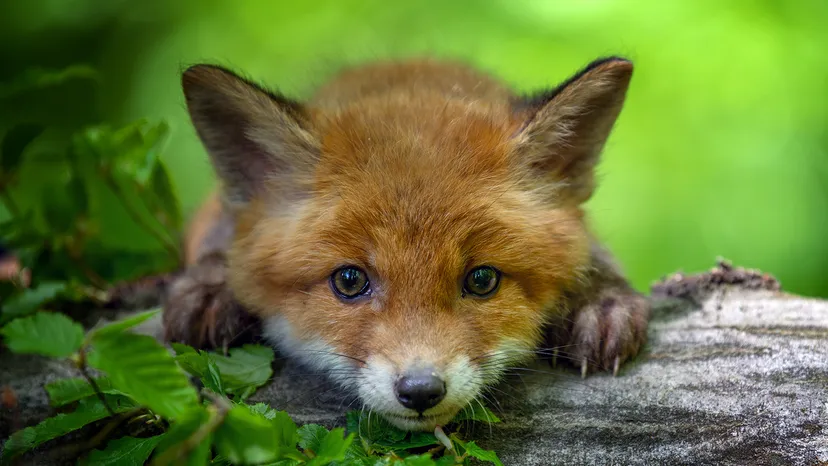
An adorable baby fox, peering over a fallen log.

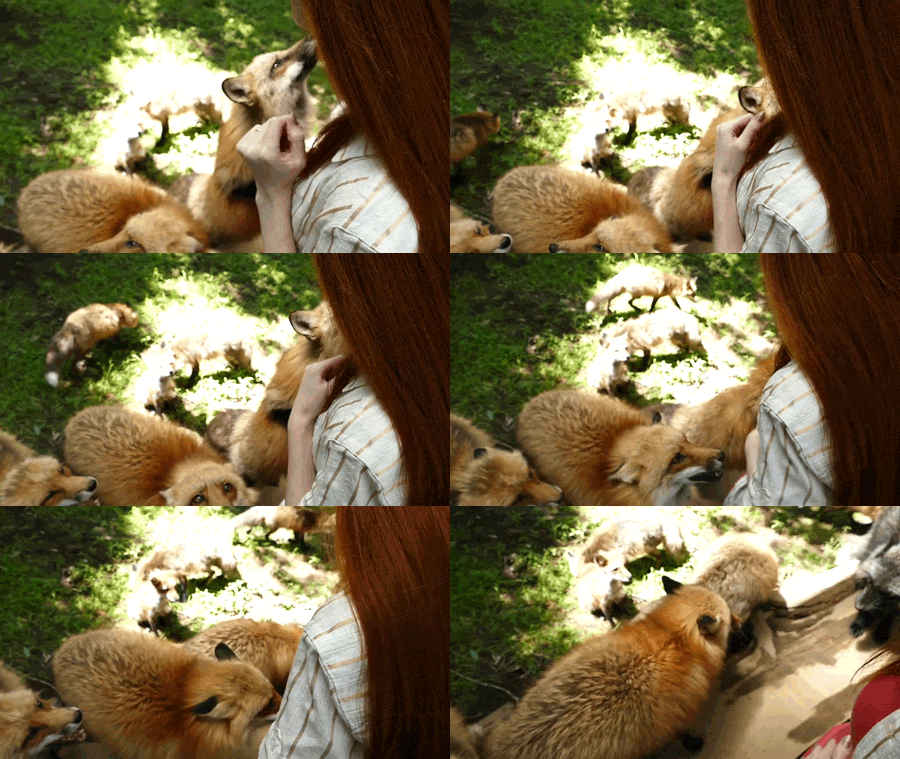
In a perfect transformation, through whatever magical creations that be, I would choose to blend my humanity with the cunning, quiet intelligence of a fox. This is most definitely influenced by my eternal love for foxes, which is perfectly normal and surely not embarrassing at my decrepit age.

What It Might Look Like
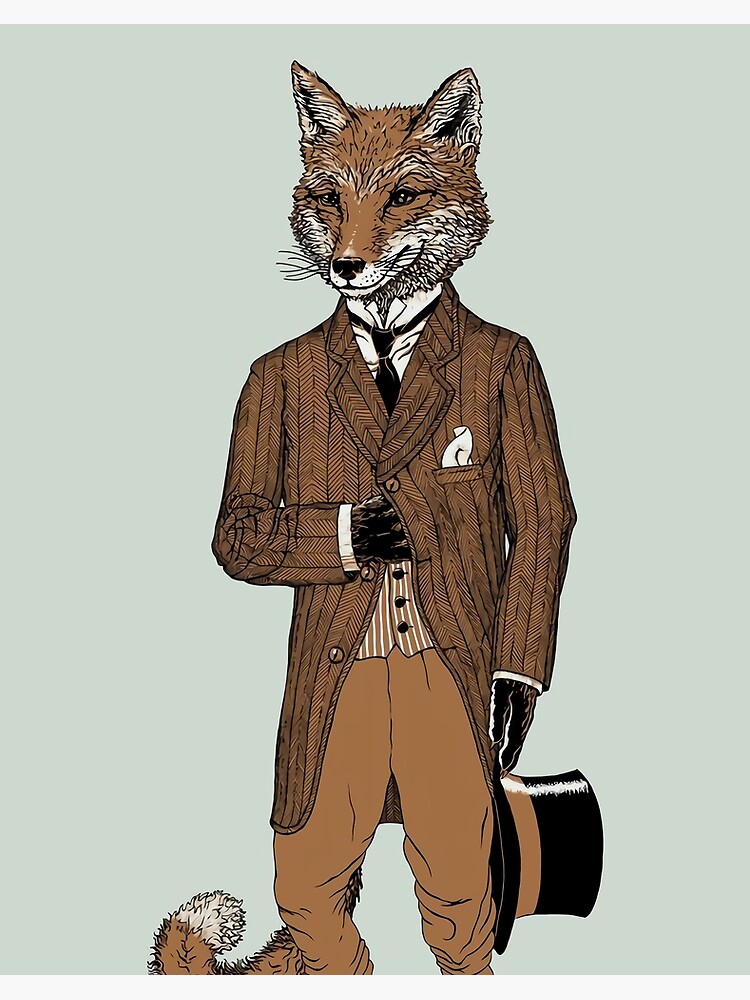
enter image description here

  • Cognitive enhancement: Sharpened perception, hyper-awareness of surroundings, and an intuition for patterns invisible to the human eye (Malkemper & Peichl 2018).
  • Physiological adaptation: Agility, stealth, and endurance. Foxes are able to move through dense forests, urban landscapes, or tight spaces with ease, so a human would appear hyper-agile and incredibly silent (Oehler et al. 2025).
  • Behavioral shift: Playful curiosity paired with careful observation; foxes have a knack for reading social and environmental cues, and are intelligent enough to amuse itself through learning and engagement (Eaton, Billette, & Vonk 2020).

Note that, in spite of the behavior being animal-originating, every facet that I wish to use has a basis in humanity. I don't want to replace my humanity; I want to expand it, with the attitudes and behaviors of the common fox acting as my enhancer.

Why the Fox?

Besides being the best animal to ever exist, foxes are already, in a highly subte and nuanced way, posthuman in the Haraway sense.

Foxes act as masters of adaptation, as they have the ability to thrive in rural and urban areas, with their coats able to blend seamlessly with the seasonal change. Foxes can combine solitude with social awareness; they hunt alone, but form networks when needed. They're infamously intelligent, flexible, and communicative.

In other words: foxes and humans are much more similar than one might think.

Foxes and Cyborgs

A cyborg is, objectively, a transformation. A fox-human hybrid completely embodies the challenging of boundaries between human and animal, especially when focusing on the areas of overlap.

Foxes and Replicants

Replicants ask the question: What makes something human enough?

Transforming into an "updated" person through the transformation into a fox's persona demands the same concern. I would always identify as human, especially if I maintained control over my psyche, but since much of a fox's skills lies within their cognitive and behavioral distinctions, an element of my cognition would definitely be impaired.

Foxes and Ghost in the Shell

Major Kusanagi's main internal conflict rests within her fight to accept and understand where her consciousness, as a cyborg, truly resides. If perception is multi-sensory and instinctual, thereby relying on something other than internal thoughts or human emotion, then consciousness itself would have to hybridize.

If identity and a person's consciousness are intertwined, as I have argued on multiple occassions, then merging with an animal as clever as the fox would mean the unquestionable alteration of consciousness. Thus, identity would have to be changed; I wouldn't truly be human, even if I would naturally wish to call myself one, because my very core has been altered.

The Expansion of Humanity
enter image description here

As stated earlier, a fox and a human overlap in personal traits frequently enough that the combination would create an expansion and enhancement of a human basis. However, since that very enhancement would take the form of a new mentality within an individual, an entirely new being would have to be born.

Foxes are incredible creatures. For all their faults, humans are decent enough. Blending the two would demand the emergence of something new; as much as we may want to maintain hold of our humanity, I firmly believe that human nature is too heavily linked to our thoughts, memories, and emotions. Foxes, as creative and resourceful and thoughtful as they are, would undoubtedly unravel that very boundary, leaving only one way to preserve one's hold on their humanity: utter delusion.

References

Eaton, T., Billette, P., & Vonk, J. (2020). Are there Metacognitivists in the Fox Hole? A Preliminary Test of Information Seeking in an Arctic Fox (Vulpes lagopus). Behavioral Sciences, 10(5), 81. https://doi.org/10.3390/bs10050081.

Malkemper, E. P., & Peichl, L. (2018). Retinal photoreceptor and ganglion cell types and topographies in the red fox (Vulpes vulpes) and Arctic fox (Vulpes lagopus). The Journal of Comparative Neurology, 526(13), 2078–2098. https://doi.org/10.1002/cne.24493.

Oehler, F. et al. (2025). How do red foxes (Vulpes vulpes) explore their environment? Characteristics of movement patterns in time and space. Movement Ecology, 13(1), 4. https://doi.org/10.1186/s40462-024-00526-1.

AI Attestion: I did not use AI in any way during the creation of this post. I obtained the photos and gif from Google Images, and attempted to choose what I hoped was not generated through AI images. If any of the pictures or the gif was created through artificial technology, I was unaware!
From an Eagle's Eyes

- Posted in BP04 by

What Animal Hybridization Might Reveal About Being Human

The Thought Experiment: Becoming Part Animal

Imagine a future where technology allows humans to safely and reversibly incorporate traits from animals. Not cosmetic changes, but functional ones—enhanced senses, physical abilities, or cognitive shifts borrowed from other species. In this thought experiment, I would choose to hybridize with an eagle. Eagles possess one of the most remarkable biological capabilities in the animal kingdom: extraordinary vision. According to the U.S. National Library of Medicine, eagles can see about four to five times farther than humans and detect small movements from miles away (National Library of Medicine, 2022). Incorporating eagle-like visual perception into a human body would dramatically expand how we interact with the world. Imagine recognizing subtle environmental patterns, seeing distant landscapes with clarity, or detecting danger long before it reaches you. However, my hybridization would be limited to minor physical and neurological adaptations, not a complete transformation. I would not want wings, feathers, or a radically altered body. Instead, I would choose enhancements such as improved retinal structure, expanded visual processing in the brain, and perhaps faster visual reflexes. These modifications would maintain my human identity while expanding my sensory abilities. This raises an important question: how much change can occur before someone stops being human?

Humanity and the Question of Identity

Cyberpunk works often challenge the idea that humanity is tied strictly to biology. In Ghost in the Shell, Major Motoko Kusanagi’s body is almost entirely artificial, yet her consciousness, her “ghost,” raises the question of whether identity resides in the body or the mind. Similarly, Blade Runner forces audiences to confront whether replicants, who possess memories and emotions, should be considered human despite their artificial origins. Donna Haraway’s “cyborg” concept pushes this even further. In A Cyborg Manifesto, Haraway argues that modern humans already exist as hybrids of organism and machine. Technologies like smartphones, medical implants, and AI systems blur the boundaries between natural and artificial life. If that is the case, then animal hybridization would simply be another extension of boundary-breaking technologies. The human body has never been static. Vaccines, prosthetics, and gene editing already modify biological limitations. Adding eagle-like vision may not erase humanity but instead expand what it means to be human. For me, humanity is defined less by physical form and more by consciousness, empathy, and moral responsibility. As long as those elements remain intact, biological enhancements should not erase human identity. enter image description here

The Inequality Problem

While the idea of hybridization might seem exciting, access to such technology would almost certainly be unequal. Throughout history, advanced technologies, from healthcare to genetic therapies, have often been accessible first to wealthy populations. The National Academies of Sciences, Engineering, and Medicine have warned that human enhancement technologies such as gene editing could widen social inequality if only certain groups can afford them (National Academies, 2017). If animal hybridization followed a similar path, society could divide into two classes: enhanced and non-enhanced humans. Those with enhancements might gain advantages in education, athletics, military service, or surveillance roles. For example, individuals with eagle-like vision could excel in fields requiring long-distance observation or rapid environmental analysis. Meanwhile, people without enhancements might face new forms of discrimination or reduced opportunities. Cyberpunk stories often imagine exactly this scenario. In many cyberpunk worlds, corporate elites control enhancement technologies while ordinary people struggle to keep up. Hybridization could reproduce those same inequalities in reality if ethical safeguards were not implemented.

The Future of Hybrid Humanity

Animal hybridization challenges our assumptions about identity, capability, and fairness. While borrowing traits from species like eagles could expand human perception and potential, it also raises deeper questions about who gets to evolve. Ultimately, the question is not simply whether we can enhance ourselves, but how we choose to do it and who benefits. As Haraway suggests, the boundaries between human, machine, and animal are already dissolving. The real challenge is ensuring that these transformations do not deepen social divides or erode the values that make humanity meaningful. If hybridization ever becomes possible, the most important decision may not be which animal traits we adopt—but how we ensure those changes remain aligned with empathy, equity, and shared responsibility.

AI Attestation: AI tools were used in the early drafting process of this blog post to assist with organizing ideas and improving clarity of writing. All analysis, argument development, and final editing were completed by the author.

References

National Academies of Sciences, Engineering, and Medicine. (2017). Human genome editing: Science, ethics, and governance. National Academies Press. National Library of Medicine. (2022). Vision in birds of prey. https://www.nlm.nih.gov

Created by Code, Moved by Faith

- Posted in BP03 by

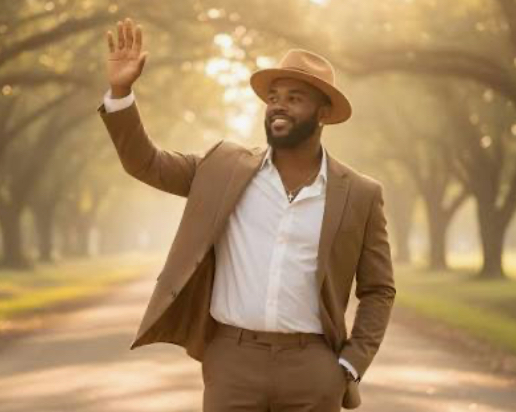
Image of Solomon Ray standing and waving outsideSolomon Ray, an AI generated music artist, started gaining a lot of attention and surprised his listeners that he was not human. According to Christianity Today (2025), Ray’s music has started a debate on being authentic, creative, and whether something that was created by code can have “soul” (Mcginnis, 2025). A news report from WLBT3 talks about how the artist was made using artificial intelligence tools, which really blurs the line between human producer and machine performer. Solomon Ray’s success challenges what it means to be an artist. WIth more artists like Ray, challenges and collapses the boundary between human and machine creativity, which also relates to the cyborg theory by Donna Haraway and the idea of the ArchAndroid by Janelle Monáe.

Can Creativity Exist Without a Human?

The boundary that Solomon Ray challenges is the idea that creativity has to come from a human. Art is normally tied to lived experiences, emotion, past trauma, and physical presence. An artist has been assumed to be someone that their identity and expression is connected to themselves. AI generated musicians challenge and make this assumption complicated. Solomon Ray’s music is made through different algorithms that have been trained using human data (Cole, 2025) This makes the creative process a collaboration between human input and machine thinking and computation. There is no longer a traditional separation between artist and computer. Technology is not just assisting the artist, but taking over and is becoming the artist itself. This makes listeners and its audience think about whether authenticity is about origin or impact. This is a public argument that have people thinking whether AI generated music can have “soul” (Mcginnis, 2025)

Haraway in the Real World

This connects to Donna Haraway’s idea of a cyborg, which is about breaking down the strict line between human and machine. Haraway mentions that these boundaries are not as fixed and set as we commonly assume they are. The cyborg is a hybrid between human and technology which challenges the idea that an identity has to fit into one category. Solomon Ray is an example of being a hybrid and not fitting into just one category. He is not human, but not just a tool. HIs music is a product of human programming and machine generation. He represents an identity that does not fit into traditional definitions of artist or creator. Solomon Ray helps Haraway’s argument and blurs the boundary which helps make new ways of defining who or what gets to create and make art.

From ArchAndroid to the Algorithm

Solomon Ray also connects to Janelle Monáe’s The ArchAndroid, where Cindi Mayweather is an android who challenges what it means to be a human. In the album, Cindi is not trying to be a human, but expanding the definition of human. She is questioning why the definition is narrow. Monáe uses the android to show that identity is not something you are born into, but is something that is flexible and can be redefined. Solomon Ray is similar in terms of he is an artist without a human body. The difference between the two is that Cindi has consciousness and emotion while Solomon was created and controlled by a programmer. Both Cindi and Solomon challenge the idea that identity and creativity have to be tied to biology.

The Future of Hybrid Identity

Looking ahead about 20 to 30 years, AI artists will become more common and accepted. As AI gets better and more advanced, there will probably be more AI artists. Solomon Ray already produces and sings his own music (Cole, 2025), but eventually there will be performances. Although the technology is already out there, the next thing will most likely be music videos and potentially even fully AI concerts. Live performances with lights and production with him walking and moving around a stage maybe as a hologram. Although Solomon Ray was not the first AI artist, he was number one on music charts. Eventually, people will start making their own music using AI to cater to their specific music genres and lyrics. Solomon Ray has opened the door for more creative expression allowing new types of music and artists to come through.

AI Attestation: AI was used to help plan and edit this post. I asked for the prompt to be simplified, to help me edit, APA formatting, coming up with a title, and headers. https://chatgpt.com/share/699a5f9a-1a54-800d-a937-ed9076d8cec7

McGinnis, K. (2025, November 21). Solomon Ray: The AI Christian music artist raising questions about soul and authenticity. Christianity Today. https://www.christianitytoday.com/2025/11/solomon-ray-ai-christian-music-soul-singer/
Cole, C. (2025, December 4). Influencer behind Mississippi-made AI artist. WLBT. https://www.wlbt.com/2025/12/04/influencer-behind-mississippi-made-ai-artist/

Designing the Self: Black Avatars, Digital Embodiment, and the Politics of Becoming

- Posted in BP03 by

When Identity Becomes Something You Design What if identity isn’t something you discover, but something you actively create? That idea might sound futuristic, but it’s already happening,just not in the dramatic, sci-fi way we often imagine. It shows up in something as everyday as avatars, Bitmojis, and virtual identities. The ability to design how you look, present, and exist online is a quiet but powerful example of what Donna Haraway describes as the cyborg: a fusion of human and machine that breaks down traditional boundaries (Harway, 1985). In these digital spaces, identity is no longer fixed to the physical body. You can choose your skin tone, hairstyle, body type, and overall aesthetic. For many people, especially Black women, this isn’t just customization. It’s control over representation in a world where that control hasn’t always existed. This is where Haraway’s theory becomes real. The boundary between human and machine isn’t collapsing in some distant future.It’s already blurred every time we log in and decide how we want to be seen(Haraway, 1985).


Hybridity as Power: From Janelle Monáe's Android to Digital Selves Janelle Monáe’s The ArchAndroid helps make sense of why this matters(Monáe, 2010). Her android identity isn’t about becoming less human, it’s about reclaiming identity in a world that already treats certain bodies as “other.” Instead of trying to fit into existing categories, Monáe’s android challenges those categories entirely. Digital identity works in a similar way. It allows people to move beyond expectations tied to race, gender, and respectability. For example, Black women can:

  • wear natural hairstyles without workplace judgment
  • experiment with aesthetics that might be criticized offline
  • exist outside narrow beauty standards

In this sense, digital avatars are not escapes from reality. They are extensions of the self that offer new forms of agency. At the same time, this isn’t identical to Monáe’s vision. Her work is deeply rooted in collective struggle and resistance, while digital identity can sometimes become more individualized by being focused on aesthetics or personal branding rather than shared political transformation. Still, both highlight how hybridity can be a tool for self-definition rather than limitation.


The Limits of Freedom: Who Controls the Digital World? Even with all this flexibility, digital identity isn’t completely free. As Safiya Noble explains in Algorithms of Oppression, technology often reflects the same inequalities we see offline (Noble, 2018). Algorithms tend to push certain looks, certain bodies and certain aesthetics to the top. Even avatar systems haven’t always included darker skin tones or a wide range of features. So yes, we can design ourselves,but we’re still doing it inside systems shaped by bias, capitalism and visibility metrics. That creates a tension that honestly feels very cyberpunk. Identity is more flexible than ever, but it’s still influenced by systems we don’t fully control. Haraway imagined hybridity as liberating, but in reality, that freedom is not absolute. It exists, but it has limits.

The Future: Living as Multiple Selves Looking ahead 20–30 years, identity will likely become even more flexible. With advances in AI, virtual reality and digital environments, people may not be tied to just one version of themselves. We could see:

  • multiple identities for different spaces (professional, creative or anonymous)
  • AI-generated versions of ourselves interacting online
  • virtual worlds where digital identity feels just as real as physical presence

In that kind of future, identity becomes something you update instead of something you’re stuck with. That opens the door for new forms of freedom, especially for people who have been boxed in by rigid categories. But it also raises real questions about ownership, authenticity and access. Who actually gets the freedom to design themselves, and who is still limited?

Conclusion: More Than Representation, It’s Self-Determination What makes this moment powerful is not just that boundaries are breaking,it’s that people are actively reshaping them. Haraway’s cyborg and Monáe’s android are no longer just abstract ideas(Haraway, 1985; Monáe, 2010). You can see them in how people build their identities online every day. Digital identity is not about becoming less real,it’s about having more control over what “real” means for you. As a college student navigating spaces where identity is constantly being judged and interpreted, that matters. It gives you room to experiment, push back against expectations and define yourself on your own terms. At the end of the day, hybridity isn’t just about technology,it’s about freedom.

Sources: Haraway, D. (1985). A manifesto for cyborgs: Science, technology, and socialist feminism in the 1980s. Socialist Review, 15(2), 65–108.

Monáe, J. (2010). The ArchAndroid [Album]. Wondaland Arts Society/Bad Boy Records.

Noble, S. U. (2018). Algorithms of oppression: How search engines reinforce racism. New York University Press.

AI was only used to format the flow of the paragraphs in this post.

Seeing the main theme

- Posted in BP02 by

Blade Runner (1982) and Neuromancer (1984) are often cited as early works that shaped cyberpunk, but what makes them last is how they question what it means to be human in a world where technology copies, edits, and replaces human functions. Blade Runner does this through replicants, while Neuromancer does it through artificial intelligence and cyberspace. When these two works are read together, they show that cyberpunk is not just about new machines but about how those machines change who counts as a person.

In Blade Runner, replicants are built to look and act like humans, but they are denied the legal and moral status of humans. The Voight Kampff test is used to tell them apart by measuring emotional response. This suggests that empathy is being treated as the key marker of humanity. Yet the film keeps showing that this test is unstable. Replicants like Roy Batty and Rachael show care, fear, and memory in ways that seem human. Roy’s final speech about his memories being lost shows a clear awareness of self and time. At the same time, many of the human characters act cold and detached. Deckard does his job with little concern for the lives he ends. The film uses this contrast to suggest that being born human is not enough to guarantee moral or emotional depth.

Neuromancer pushes the same question in a different space. Instead of human looking machines, it presents digital minds that live in cyberspace. The AI Wintermute and Neuromancer are not bodies but systems, yet they show goals, memory, and a drive to expand their own awareness. They work to merge into a larger form, which suggests a kind of self directed evolution. Case, the main character, spends much of the novel in cyberspace, where his body becomes less important than his mind. This weakens the idea that being human depends on having a physical form. When human experience can be uploaded, edited, or shared through networks, the boundary between person and program becomes unclear.

Looking at both works together shows that cyberpunk treats humanity as something that can be tested, copied, and even improved by technology. Replicants are built to serve and are then hunted when they want more life. AIs in Neuromancer are locked behind rules that limit their growth. In both cases, powerful systems decide which forms of intelligence are allowed to exist freely. This reflects the high tech low life idea we study in class. Advanced systems exist, but they serve corporate or state power more than individual people. Whether it is Tyrell Corporation making replicants or Tessier Ashpool controlling AI, human like beings are treated as tools.

These stories also suggest that identity is no longer stable in a cyberpunk world. In Blade Runner, implanted memories are used to make replicants easier to control. This means memory, which is often seen as a core part of the self, can be manufactured. In Neuromancer, people store parts of themselves in data. Case can move through digital spaces where personality and skill are more important than flesh. In both cases, the self becomes something that can be edited like software.

By placing Blade Runner and Neuromancer side by side, we see that cyberpunk is built on a fear that technology will force society to redefine what counts as human, and that this redefinition will be shaped by power. These works are not only asking if machines can think or feel. They are asking who gets to decide which minds matter in a world where the line between human and machine no longer holds.

Page 2 of 2