Octopus Intelligence and the Limits of Being Human
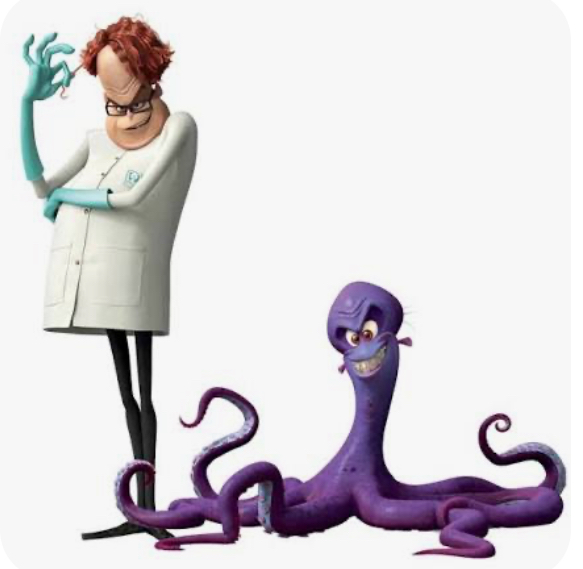 The thought of humans getting traits and characteristics from other species brings interesting questions about identity and the different limits of enhancing humans. If a technology like this existed, or became legal, I would choose to be hybridized with an octopus. Octopi are known for being extremely smart and having complex nervous systems that work and function very differently from a human brain. Different research on their brain’ show that a big portion of octopus’s neurons run throughout their arms opposed to staying centralized in the brain which allows the animal to interact and respond to its environment in unique ways (Niven & Nakagawa, 2024). This intelligence challenges the idea that cognition must operate like the human mind and brain. The idea of an octopus mixing and blending into human society was kind of shown in the movie Penguins of Madagascar. The villain, Dave the octopus, disguises himself as a human scientist. This brings up a philosophical question on if having intelligence, awareness, and the ability to make decisions make you human even if you do not have a physical human body?
What Traits Would I Actually Want?
If being an octopus human hybrid were possible, I would not want to completely transform into an octopus, but have certain traits and characteristics. Something that octopus are known for is their flexibility, have many arms, problem solving, and being able to camouflage. One of the most interesting though is their problem solving abilities. Octopi are known to be able to interact with things in their environment, solve puzzles, and quickly adapt to new situations. This cognitive flexibility would be helpful for humans (Niven & Nakagawa, 2024). Their physical flexibility is also unique to them as they can move and adjust in different ways that most animals cannot. I would not want to completely give up the human body, having different octopus adaptations would be interesting. For example, having an additional hidden or retractable arm would be useful when multitasking or holding multiple things. Octopi are also able to change the color and texture of their skin to blend into their surroundings. This would not necessarily be needed for survival in a modern world, it would be a cool ability to have. Although these traits and features are cool, I would want to stay mostly human form opposed to full out unrecognizable octopus.
What Actually Makes Someone Human?
Thinking about hybridization, the question of what makes something human comes up. If a person still has consciousness, memories, and the ability to make decisions, physical changes would not completely take away their humanity. This idea is brought up in Ghost in the Shell where identity is not necessarily tied to the body but more so consciousness. Similarly in Blade Runner, replicants look human, but are treated differently and poorly because they are artificially made. Donna Haraway also brings this up in terms of breaking boundaries between humans and nonhuman in A Cyborg Manifesto. She suggests that the line between human and nonhuman is not as fixed and defined as people think (Haraway, 1985). With all of this in mind, a human octopus hybrid would challenge what it would mean to be human.
Who Would Have Access to Human Enhancement?
Another question that would be brought up is who would have access to this technology? Like a lot of new technology, rich people and powerful companies and corporations would initially have access until something new came about then it might be given to the public. New types of inequalities would be created if certain people were able to enhance their abilities. There are already physical enhancements and this already brings about different arguments and separations, but increased intelligence would be on a different level. Similar concerns appear in Blade Runner, where replicants are made with enhanced abilities but are treated as a less than despite being nearly basically identical to humans. This gives advantages in education, work, and other parts of human culture and society. There would be more debates about fairness and what is allowed. Research on animal cognition and nervous systems, such as studies on octopus intelligence, already shows how different forms of biological intelligence can function in complex ways (Niven & Nakagawa, 2024). If humans were able to gain these traits using hybridization or enhancement, more questions about fairness, access, and limits on human abilities would surface.
AI was used to help plan and edit this post. Also used to help with citations and headers and titles. https://chatgpt.com/share/69ace400-8af4-800d-b41f-689b00c9a3b2
Reference
Niven, J. E., & Nakagawa, S. (2024). The evolution of octopus intelligence and nervous system complexity. Proceedings of the Royal Society B: Biological Sciences, 291(2032). https://doi.org/10.1098/rspb.2024.1568
Haraway, D. (1985). A cyborg manifesto: Science, technology, and socialist-feminism in the late twentieth century. Socialist Review.