BP05

Blog Post #5: It's Part of the Business

Cyberpunk often centers on corporations more powerful than governments, treating human lives as expendable. We've seen this in the Tyrell Corporation (Blade Runner), Tessier-Ashpool (Neuromancer), and the pill funders (Machinehood).

Choose at least one fictional corporation and analyze its specific powers and practices. Then connect to contemporary reality with concrete examples: tech companies' influence on democracy, pharmaceutical pricing, gig economy labor practices, surveillance capitalism, corporate environmental practices, or AI development control. Use credible sources.

Make your argument: Are we heading toward cyberpunk's corporate dominance? Is this realistic prediction or hyperbolic critique? Consider what enables corporate power, what checks exist, and what role critique plays in preventing dystopia.

It’s Not Fiction Anymore: When Corporations Start to Look Like Cyberpunk

- Posted in BP05 by

One of the most defining features of cyberpunk is the idea that corporations become more powerful than governments, shaping everyday life while operating with minimal accountability. While this once felt like a distant, dystopian future, today’s world suggests that this vision may not be as fictional as we once believed. Companies like Amazon provide a strong real-world example of how corporate power can begin to mirror cyberpunk narratives.

enter image description here

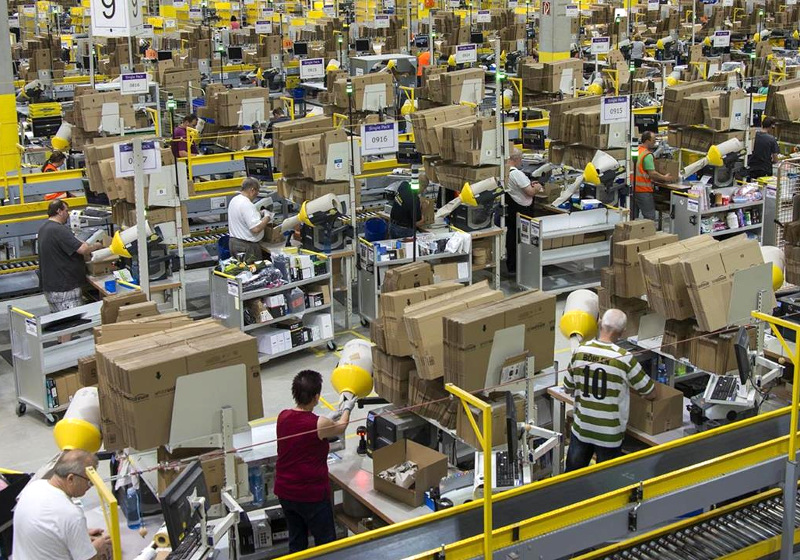
Amazon has transformed global commerce, but its labor practices have raised serious concerns. Investigations by outlets like The New York Times and Reuters have documented intense working conditions in warehouses, where employees are monitored through productivity-tracking systems and face pressure to meet strict quotas. This level of surveillance reflects what scholars describe as “algorithmic management,” where human labor is directed and evaluated by automated systems. In many ways, workers become extensions of a larger technological system rather than independent individuals.

enter image description here

This dynamic strongly resembles corporations in cyberpunk texts like Blade Runner, where the Tyrell Corporation treats replicants as disposable tools, or Neuromancer, where megacorporations operate beyond traditional legal boundaries. In both cases, human value is tied directly to productivity and usefulness—an idea that becomes increasingly visible in modern gig economies and warehouse labor systems.

However, the comparison goes beyond labor. Amazon’s influence on markets, logistics, and even cloud computing infrastructure highlights how deeply embedded corporations have become in everyday life. According to reports from MIT Technology Review, large tech companies now control significant portions of digital infrastructure, giving them power not only over economic systems but also over information flow. This raises concerns about whether corporations are beginning to shape society in ways traditionally reserved for governments.

enter image description here

That said, it would be an oversimplification to say we are fully living in a cyberpunk dystopia. Unlike fictional worlds, modern corporations are still subject to some regulation, public scrutiny, and legal accountability. Governments can impose fines, enforce labor laws, and regulate monopolistic behavior—at least in theory. Additionally, public awareness and activism play a role in challenging corporate practices. This suggests that while cyberpunk provides a useful framework for critique, it may exaggerate certain aspects for dramatic effect.

At the same time, the global dimension complicates this issue. Corporate power is not experienced equally across the world. In some regions, weaker regulatory systems allow corporations to operate with fewer restrictions, while in others, stricter policies limit their reach. This uneven distribution of power reflects broader patterns of globalization, where economic influence often crosses national boundaries more easily than political authority.

Ultimately, cyberpunk serves less as a prediction and more as a warning. It highlights what can happen when technological advancement and corporate power outpace ethical and political oversight. The similarities between fictional corporations and real-world companies like Amazon suggest that these concerns are not purely hypothetical. Instead, they challenge us to think critically about the systems we participate in and the kind of future we are helping to create.

The question is no longer whether cyberpunk’s vision is possible; it is how close we are willing to let it become reality.

AI Statement I used AI to help brainstorm ideas and improve clarity.

SOURCES: 1. The New York Times. (2021). Amazon’s warehouse working conditions. 2. Reuters. (2022). Amazon labor practices and productivity tracking. 3. MIT Technology Review. (2023). Big Tech and infrastructure control.

Fictional Corporations, Real Patterns

- Posted in BP05 by

Cyberpunk stories often show corporations acting like governments, except with less accountability. You see this with Tyrell in Blade Runner, Tessier-Ashpool in Neuromancer, and the pill funders in Machinehood. They control technology, shape everyday life, and treat people as tools. That idea sounds extreme, but parts of it already exist. I think cyberpunk exaggerates reality, yet it is grounded in trends we can see right now. One clear example is surveillance capitalism. Big tech companies collect massive amounts of personal data and turn it into profit. Scholars describe this system as treating human experience like raw material that can be extracted and sold. This data is then used to predict behavior, especially for advertising and content recommendations. That means companies can influence what people see and how they think about issues. Research on digital platforms notes that algorithmic ranking shapes public discourse, which gives corporations indirect political power. A 2024 Pew Research survey found that about 83% of U.S. adults believe social media companies intentionally censor certain political viewpoints, showing widespread concern about this influence. These companies are not governments, but they shape information in ways that resemble political authority. This mirrors cyberpunk corporations. The Tyrell Corporation in Blade Runner designs replicants to serve economic needs, and their individuality becomes secondary. In a similar way, data-driven companies treat user behavior as something to harvest. Tessier-Ashpool SA controls networks in Neuromancer, and whoever controls networks controls society. Today, large platforms dominate communication spaces. The pill funders in Machinehood push productivity-enhancing technology even when it harms workers. That feels close to gig economy systems where flexibility is advertised, but financial pressure keeps people working. In each case, efficiency matters more than individual well-being. Looking at these patterns raises a broader question about whether society is actually moving toward the kind of corporate dominance cyberpunk imagines. The trend is partly realistic. Technology companies now operate globally and sometimes influence policy discussions. Some researchers even compare them to “quasi-nation-states” because of their economic scale and infrastructure control. Still, governments remain powerful. Regulations on privacy, antitrust enforcement, and labor laws act as checks. The European Union, for example, has passed strict data protection rules that limit how companies use personal information. That shows democratic systems can push back. This also is not just an American problem. Different regions handle corporate power differently. Europe tends to regulate more aggressively, while other countries place tighter controls on digital platforms. At the same time, global platforms cross borders, so their influence spreads internationally. What enables corporate power is scale, network effects, and reliance on private infrastructure. Once everyone uses the same platform, leaving becomes difficult, which increases corporate leverage. Cyberpunk works best as a warning rather than a literal prediction. These stories exaggerate certain trends to make risks easier to see. Works like Blade Runner, Neuromancer, and Machinehood highlight how technological power can concentrate in private hands. Public debate, regulation, and criticism act as counterweights. Because of that, the future is not fixed. Corporate influence is growing, but democratic institutions and public awareness still shape how far that power goes.

The Case of Vale in Brazil

- Posted in BP05 by

Cyberpunk stories often show big companies with more power than governments. In the movie like Blade Runner, corporations control technology and even human life. In books like Neuromancer, companies act without limits. These stories may look like fiction, but in the real world, some companies already have a lot of power. One example from Brazil is Vale, one of the largest mining companies in the world. enter image description here

Vale is a company that works with mining, especially iron ore. It is very important for the Brazilian economy, and it operates in many countries. Because of its size and influence, Vale has a strong impact on both the environment and people’s lives. However, this power has also created serious problems.

In 2019, a dam owned by Vale collapsed in Brumadinho, Brazil. This disaster killed more than 200 people and destroyed the environment around the area. Before that, in 2015, another dam disaster (in Mariana) also caused great damage. These events show how a corporation’s actions can affect human life in a very direct and dangerous way.

These two cities, Mariana and Brumadinho, are in my state Minas Gerais, in Brazil, and they are not far from my city. Until today, I still remember these disasters and how scary they were for society. Many people lost family members who lived in the city or worked in the company, it showed how one company’s actions can affect so many lives. This is why it is important to think about these problems and not ignore them. enter image description here

This situation connects to cyberpunk ideas. In many cyberpunk stories, companies focus on profit and ignore human consequences. In the same way, Vale was criticized for not taking enough safety measures before the disasters. Like the corporations in Machinehood, the company had economic power, but the people suffered the consequences.

Another important point is how corporations can be stronger than government control. After the disasters, Vale had to pay fines and compensation. But many people believe that the punishments were not enough compared to the damage caused. This raises an important question: if a company can cause so much harm and still continue operating, does it have too much power?

Are we moving toward a cyberpunk future? In some ways, yes. Vale shows how a company can have a big influence on society, environment, and even politics. However, there are still laws and public pressure that try to control these companies. In Brazil, people protested and demanded justice after the disasters. This shows that society still has a voice.

This is not only a problem in Brazil. Around the world, large corporations influence governments and economies. But different countries respond in different ways. Some places have stronger environmental laws, while others depend more on companies for economic growth. This creates a global situation similar to cyberpunk worlds, where power is not equal. we are not fully in a cyberpunk world yet. Governments, laws, and public opinion still play an important role. Cyberpunk stories help us understand these risks and remind us to be careful about how much power we give to corporations.

Sources https://vale.com/esg/brumadinho https://www.nytimes.com/interactive/2019/02/09/world/americas/brazil-dam-collapse.html https://www.bbc.co.uk/news/resources/idt-sh/brazil_dam_disaster https://g1.globo.com/mg/minas-gerais/desastre-ambiental-em-mariana/noticia/2019/03/09/tragedia-de-mariana-nao-tem-punidos-apos-mais-de-3-anos-e-processo-esta-parado.ghtml I did not use AI, it was all based on my own understanding and research.

BIg Pharma

- Posted in BP05 by

In Blade Runner (Scott 1982), the Tyrell Corporation slogan is "More Human Than HUmans". What this quote means to me is that the Tyrell Corporation manufactures "life" , can control how long a person lives, and charges whatever it wants because there is no alternative. The corporations power is not dictatorship, it is biological. You want to live longer, they make you pay. The NUmbers are Hard to Sit With U.S drug prices are not high, they are extremely inaccessible for most people, especially compared to other countries. Brand-name drugs in the U.S cost 3x (Mulcahy et al., 2024) more than any where else, ever after adjusting for rebates. Some asthma medications are 1,300% higher than the average price across even neighboring countries ( Office of Assistant Secretary for Planning and Evaluation, 2024). Insulin cost nearly t10 times more in the U.S than other OCED countries ( Mulcahy et al., 2024) When Insulin was discovered the scientist sold the patent for one dollar because they thought it should be accessible for the public. One vial the cost $21 in 1999 is now over $300 (Hales et al., 2020) Why is this Allowed to Happen? In Blade Runner, the Tyrell company can charge any price because they do not see it as corruption in a dramatic sense, they see it as "just how they system was built". An example is cancer treatment, when someone is diagnosed with cancer, they are forced to have to pay whatever they are charged because they need the drug regardless of the cost so there is no real competition ( Office of Assistant Secretary for Planning and Evaluation, 2024). In most countries the government negotiates prices based pn what drug is actually worth therapeutically. The result is that Americans pay more for the same medication with no additional health benefit. We are not getting better drugs, we are just consumers that let companies charge sick people whatever they feel like. Is there any Hope?
There might be hope because Pfizer became the first pharmaceutical company to lower they're prices for Medicaid recipients to align with international rates ( Euronews, 2025), which usually only happens because of political pressure and tariffs. But it is definitely not a solution, because many peopole who cannot acces medicaid are still paying high prices. Plus this does not prove that these corporations are not completely immovable. They only respond when they feel threatened. We Are Already Here Being in this class has showed me that cyberpunk is not a warning, but when people are importing drugs from other countries or traveling just be able to afford adequate healthcare at an affordable price ( Pew Research center, 2017), rationing Insuin, and life saving treatments are treated as luxury rather than a right- that is a regular Friday in America. Tyrell Corporation monetized the dependency between humans and the thing keeping them alive. Pfizer is not exactly the same but the same premise still stand, biological necessity as a leverage as a revenue stream. Cyberpunk is already here. enter image description here

Euronews. (2025, October 1). Pfizer agrees to lower prescription drug costs for Medicaid. https://www.euronews.com/business/2025/10/01/pfizer-agrees-to-lower-prescription-drug-costs-for-medicaid Fortune. (2025, January 6). Pfizer has increased prices on over 60 drugs in the U.S. as of Jan. 1. https://fortune.com/well/2025/01/03/pfizer-drug-price-increase-2025/ Hales, C. M., Carroll, M. D., Fryar, C. D., & Ogden, C. L. (2020). The high cost of insulin in the United States: An urgent call to action. Mayo Clinic Proceedings, 95(1), 22–28. https://www.mayoclinicproceedings.org/article/S0025-6196(19)31008-0/fulltext Mulcahy, A. W., Schwam, D., & Lovejoy, S. L. (2024). International prescription drug price comparisons: Estimates using 2022 data. RAND Corporation. https://www.rand.org/pubs/research_reports/RRA788-3.html Office of the Assistant Secretary for Planning and Evaluation. (2024, January 31). Comparing prescription drugs in the U.S. and other countries: Prices and availability. U.S. Department of Health and Human Services. https://aspe.hhs.gov/reports/comparing-prescription-drugs Pew Research Center / PMC. (2017). Importation of drugs into the United States from Canada. https://pmc.ncbi.nlm.nih.gov/articles/PMC5478407/ Scott, R. (Director). (1982). Blade Runner [Film]. Warner Bros.

Pharmacy Mirrors Cyberpunk World

- Posted in BP05 by

A clear similarity of corporate dominance in cyberpunk and that which is seen in our world is the pharmaceutical industry. The pharmaceutical industry’s pricing practices show how corporate power can monetize human lives. These practices directly shape who’s live can be saved and who can get access to things that are means of survival. This is specifically seen in medications like insulin, which are a common topic of discussion because of how expensive this life-changing medication is for those people who are diagnosed with diabetes. Based on data from a research report by Andrew W. Mulcahy and Daniel Schwam, which compares insulin prices in the United States with those in other wealthy countries, it shows that insulin prices in the United States are nearly 10 times higher than in other wealthy countries. Researchers publishing in JAMA Network Open further explain that insulin list prices have steadily increased for decades, even as negotiations made the system more complex and less transparent. This system mirrors cyberpunk corporations like the Tyrell Corporation in Blade Runner. In that world, access to life through replicants is controlled by a corporation that decides who is valuable enough to exist. In reality, pharmaceutical pricing isn’t creating life; it is sustaining it by playing the role of caregiver and allowing for a better quality of life. This issue derives from the fact that big companies, which are components of the capitalistic society, act as intermediaries between drug companies and insurers. Regulators have accused these firms of steering patients toward higher-priced drugs to maximize profits. Just like in fictional texts we have read, like Neuromancer, big corporations dominate entire networks; real-world pharmaceutical and insurance systems create so much control that it is made difficult for individuals to navigate or challenge. I think we are heading toward a cyberpunk future because of the massive influence on public health. When a company can effectively determine whether a patient can afford insulin, it holds a form of biopolitical power that cyberpunk stories exaggerate but do not invent. I think the cyberpunk corporate dominance is a hyperbolic critique. This is because it imagines worlds where corporations have so much power that they basically control who lives and who dies. This is very dramatic, but the insulin situation is a real version of that. Pharmaceutical pricing reveals a major difference between the U.S. and other countries. In many European nations, governments negotiate drug prices directly or impose strict pricing regulations. As a result, insulin costs are far lower abroad. This suggests that the issue is not just corporate greed, but also policy structure. The U.S. healthcare system allows more pricing freedom, while other countries prioritize universal access over market flexibility. Pharmaceutical pricing shows that we are not living in a full cyberpunk dystopia, but we are close enough to see its outlines. When corporations can influence who gets access to life-saving medication, they begin to resemble the powerful entities in Blade Runner and Neuromancer. The difference is that, for now, we still have tools to resist: regulation, public pressure, and critical awareness. Cyberpunk reminds us that the future is not predetermined; it is shaped by how we respond to the systems we build today.enter image description here

Are We Living in a Cyberpunk Prologue?

- Posted in BP05 by

Cooperations

When Corporations Write the Rules: Are We Living in a Cyberpunk Prologue?

In cyberpunk worlds, governments fade into the background while corporations become the real centers of power. From the Tyrell Corporation in Blade Runner to Tessier-Ashpool in Neuromancer, these entities control labor, technology, and even human identity. What once felt like speculative fiction now feels eerily familiar. Across industries, from Big Tech to pharmaceuticals, real-world corporations increasingly shape public policy, economic opportunity, and even the boundaries of human autonomy.

Surveillance Capitalism: Owning Not Just Data, but Behavior

One of the clearest parallels to cyberpunk fiction lies in what scholars call surveillance capitalism. Companies like Google and Meta Platforms collect massive amounts of user data( not just to understand behavior), but to predict and influence it. According to Shoshana Zuboff, this model turns human experience into raw material for profit, often without meaningful consent. This echoes Neuromancer, where corporations don’t just sell products, they shape reality itself. In both cases, individuals become resources. The difference? Today’s version operates quietly, embedded in everyday apps and platforms.

Pharmaceutical Power: Pricing Life Itself

The pharmaceutical industry provides another stark example. Companies like Eli Lilly and Pfizer have faced scrutiny over drug pricing practices, particularly in the United States. For instance, insulin prices rose dramatically over decades, despite the drug being discovered over a century ago. This dynamic resembles Machinehood, where corporate interests dictate access to life-sustaining resources. When essential medicine becomes a profit-maximizing product, human life risks becoming secondary to shareholder value. InsulinInsulin

Gig Economy Labor: Disposable Workers in a Digital Machine

Companies like Uber and DoorDash have revolutionized work, but at a cost. Gig workers are often classified as independent contractors, meaning they lack benefits like healthcare, job security, or minimum wage protections. This mirrors the precarious labor conditions in cyberpunk fiction, where workers are easily replaceable and stripped of rights. The algorithm becomes the boss, opaque, unaccountable, and indifferent. In many ways, the gig economy turns people into extensions of a platform, much like the commodified humans in Blade Runner.

Are We Headed Toward Cyberpunk Reality?

The short answer: partially but not inevitably. Cyberpunk exaggerates for effect, but it is grounded in real trends. Corporate power today is enabled by several factors: Globalization: Corporations operate across borders, often outpacing national regulations. Technological complexity: Governments struggle to regulate rapidly evolving industries like AI. Economic influence: Lobbying and campaign financing allow corporations to shape policy decisions. However, there are still meaningful checks on corporate power. Governments can and do regulate industries; consider antitrust actions against Amazon and Apple. The European Union, in particular, has taken a more aggressive stance on privacy and competition through regulations like the GDPR. Public awareness also plays a critical role. Unlike in cyberpunk worlds, where resistance is often fragmented, today’s citizens, journalists, and researchers actively critique corporate behavior. This critique matters; it shapes public discourse, influences regulation, and holds power accountable.

Is This Uniquely American?

Not entirely, but it is more pronounced in the United States. The U.S. tends to favor market-driven solutions and has historically been more permissive of corporate consolidation. In contrast, European countries often prioritize consumer protection and data privacy. Meanwhile, countries like China exhibit a different model, where corporate power exists but is tightly integrated with state control, raising its own dystopian concerns. enter image description here

Why Critique Still Matters

Cyberpunk is not just prediction, it’s warning. By exaggerating corporate dominance, it forces us to confront uncomfortable truths about power, inequality, and technology. We are not yet living in a Blade Runner world. Governments still exist. Rights still matter. But the growing influence of corporations over data, labor, and healthcare suggests that cyberpunk is less a fantasy and more a mirror, one that reflects what could happen if power goes unchecked. The future is not predetermined. Whether we move toward or away from a cyberpunk reality depends on regulation, public engagement, and our willingness to question who really holds power in society.

References

Zuboff, S. (2019). The Age of Surveillance Capitalism. U.S. Senate reports on insulin pricing (2021–2023). European Commission: GDPR and antitrust cases Academic and policy analyses on gig economy labor practices
More Human Than Human

- Posted in BP05 by

Introduction Elon Musk’s xAI operation influences AI development control by constructing unprecedented computing infrastructure, bypassing regulatory oversight, and accelerating the pace of AI advancement beyond what public institutions can meaningfully regulate. Reporting shows that xAI is operating dozens of methane‑powered turbines, many without proper permits. While building Colossus, a supercomputer projected to be the largest in the world. This gives Musk enormous control over how quickly AI evolves and who can participate in the AI race.

Cyberpunk Comparison This dynamic mirrors the corporate dominance seen in Blade Runner. In the film, the Tyrell Corporation controls replicant production, a technology so advanced and essential that the government cannot regulate it effectively. Tyrell’s motto, “More human than human,” reflects a corporation whose technological ambition outpaces ethical oversight—much like what we see with Musk’s rapid expansion of compute capacity. xAI’s operation of unpermitted methane turbines, its overwhelming influence on local political structures, and its externalization of environmental harm all reinforce this comparison. Like Tyrell, xAI advances its technology at a pace that makes traditional regulation feel slow and outdated. Whoever controls the infrastructure controls the future; this is a form of de facto control.The parallels to Machinehood are equally striking. The pill funders in the novel drive technological acceleration at any cost, hiding the human and environmental consequences behind the promise of innovation. Their power comes not only from wealth but from their ability to dictate the terms of technological progress. The Memphis situation reflects this same logic: a predominantly Black neighborhood becomes a “sacrifice zone” so that xAI can power its AI models. Just as the pill funders obscure the true costs of their technology, xAI frames its project as cutting‑edge innovation while concealing the pollution, health risks, and regulatory violations that make that innovation possible.

Both fictional worlds show corporations gaining control over technological development by centralizing resources, evading oversight, and externalizing harm. xAI’s actions reflect the same logic. By consuming enough electricity to power 100,000 homes, the company consolidates AI development into the hands of a single billionaire. By operating turbines without proper permits, it demonstrates that AI progress can be pursued outside traditional regulatory frameworks. By placing the environmental burden on marginalized communities, it reinforces a cyberpunk pattern in which technological advancement is purchased at the expense of those with the least power. xAI influences AI development control in ways that closely resemble the megacorporations of Blade Runner and Machinehood—through scale, secrecy, political influence, and a willingness to treat human lives as collateral in the pursuit of technological dominance.All the evidence from Memphis suggests that the United States is already experiencing early forms of the corporate dominance depicted in cyberpunk fiction. When private corporations can run industrial‑scale infrastructure in residential neighborhoods—producing more nitrogen oxides than the city’s chemical plants, refineries, airport, and power station combined—they demonstrate a level of autonomy that resembles the megacorporations in these works. Cyberpunk’s warnings are not exaggerated fantasies but emerging realities. What is happening in Memphis shows how quickly technological ambition can outpace democratic oversight and how easily vulnerable communities can be sidelined in the process.

Sources Brabenec, R., et al. (2025, July 7). A billionaire, an AI supercomputer, toxic emissions and a Memphis community that did nothing wrong. Tennessee Lookout. https://tennesseelookout.com/2025/07/07/a-billionaire-an-ai-supercomputer-toxic-emissions-and-a-memphis-community-that-did-nothing-wrong/

AI Attestment AI was used to review the grammar and structure of this essay as well as provide an APA style citation for the source.

Corporate Domination and Cyberpunk Societies: Fiction or Real-life?

- Posted in BP05 by

One of the main characteristics of societies in cyberpunk stories is that corporations are more powerful than the government. They control the world and the people based on their most important goal: profit. In these stories, money matters more than human lives, which is something to be scared of. The worst thing about that is to notice the similarities with real life. Nowadays, big technology companies have great power over individuals. Because they have access to massive amounts of data - such as what people browse, their location, what they buy - they can influence people’s decisions without them even noticing. This is clearly a form of control, and it brings us close to those societies we are so scared about – at least I am - from Cyberpunk stories.

What is really happening?

To make this clear, let’s bring some theory to the discussion. Shoshana Zuboff – American author and professor at Harvard Business School – created the term Surveillance Capitalism to explain how the control by big companies is established. It describes how companies collect people’s data and use it to: 1. Predict what they will do and 2. Influence their decisions. Zuboff explains that companies like Google and Facebook make money by collecting and using personal data (Zuboff, 2019), which means that instead of selling products, companies sell information about people.

The Cambridge Analytica Scandal

In the 2010s, Facebook was involved in the Cambridge Analytica Scandal, where millions of users had their personal data collected without their consent to create highly targeted political messages for campaigns during the 2016 election (Kozlowska, 2018). This episode exemplifies how corporations sell and use people’s data to influence their decisions and thoughts. It shows how powerful corporations have become in our society and how they can influence democratic processes, such as the elections. Additionally, the fact that a company can affect political outcomes like that challenges the government authority.

Are we heading toward Cyberpunk Societies?

Another perspective we can discuss about this situation is how most people are not aware about how much influence corporations have in our society. The truth is, many users put their personal information on websites, without even understanding the effect this can have. People make themselves vulnerable to manipulation simply by completing a survey or a questionnaire. Honestly, it’s like these big corporations see people as sources of data that can be used for profit or strategic purposes. And isn’t this the key idea in cyberpunk stories? Where people are treated less like individuals with their own identities and lives, but more like participants of a greater system of power and control moved by profit. I hate to admit it, but these societies are not fully fictional anymore.

The Tyrell Corporation in Blade Runner

The movie Blade Runner illustrates this situation really well. The Tyrell Corporation creates replicants and uses them to obtain profit, without even considering their humanity or rights. Similarly, Facebook uses people’s data as a resource, which suggests a priority of interests related to profit, rather than people’s rights of privacy, autonomy, and even society’s democracy. Thus, in both situations – fictional and real-life – individuals are treated as tools within a larger system controlled by a powerful corporation, indicating that our society is heading toward cyberpunk’s corporate dominance.

A Globalized Issue

The growth of corporate dominance is not just a problem in the United States. It is true that American companies tend to have more freedom and can operate within less strict rules, but other countries have been dealing with this situation as well. Countries in Europe, for example, have really strict laws about privacy to try to limit how corporations use personal data. Meanwhile, in China, corporate control is tied to the government, which means companies don’t have that much freedom to act. Therefore, even though corporate control and power is dealt differently across countries, it is noticeable that it’s a global issue enabled by technology and globalization. Because of that, it is extremely important to discuss about this in news, media, and in classes, so people are not oblivious to how their personal information is being used and how vulnerable their privacy is in a world moved, and perhaps controlled, by technology and profit.

Sources

Zuboff, S. (2019). The age of surveillance capitalism: The fight for a human future at the new frontier of power. PublicAffairs.

Kozlowska, I. (2018). Facebook and data privacy in the age of Cambridge Analytica. University of Washington. https://jsis.washington.edu/news/facebook-data-privacy-age-cambridge-analytica/

Scott, R. (Director). (1982). Blade Runner [Film]. Warner Bros.

Radioactive Retro Dance Club

- Posted in BP05 by

The issues that we have been exploring all semester bring us to one central question. Are we heading faster to a future that seemed in the far distance? Will corporations dominate and deteriorate the world as we know it? And if so, how will we stop it? Not only does cyberpunk warn us about this future, but it may also be giving us solutions on how to stop it from happening. From the Tyrell Corporation in Blade Runner to the pill funders in Machinehood, we see the damage that large corporations can have on the function of our society as a whole. One of the biggest ways we see corporation domination is in the realm of privacy and surveillance capitalism, a space that may too soon be out of our control. When you use services such as Google and Facebook, there are agreements to the use of your data and personal information that you sign off on every time. In a book written about the current surveillance state, Shoshana Zubodf writes that the data gathered by these companies is used by other companies to predict and influence our behaviors (Kavenna, 2019). Though you may not be aware that you are allowing the use of your data by other companies, if you read the lengthy privacy statements that many just accept, you will find your acceptance to these rules. More corporations such as Tik Tok use algorithms to gather data, facial expressions, locations, and voiceprints to build profiles on who they think that you are and what you would like (10 Eye-Opening Examples of Surveillance Capitalism in Action - VOICES of CAPITALISM, 2025). Though we may like this because it shows us funny videos, what happens when the algorithm changes? In fact, after most of TikTok was bought by the U.S. the privacy policy changed to allow precise location data if you have your location services on (Lin, 2026). This comes at a time where ICE is being deployed in heavily immigrant populated areas and people are being killed by said ICE agents. It makes it that much scarier that there is a way to find your exact location just by trying to find entertainment through Tik Tok. Though not exactly the same, the ideas of constantly tracking and using our data to increase their ad revenue, track our locations, and push propaganda into our lives is reminiscent of the pill funders in Machinehood. In the novel, the pill funders are an amalgamation of all of the wealthy corporations and wealthy people who essentially control the world by making them reliant on their pills. In a similar way, there is a group of a few corporations that are controlling what we see, hear, and interact with through privacy policies. Because of this comparison, I am led to believe that we are not as far away from a cyberpunk corporation-controlled future as it seems. Specifically under the Trump presidency, we stray further and further away from a world where we have personal autonomy and closer to a world with heavy cyberpunk surveillance.

AI was not used in any form of creating this post. All words, thoughts, and plannings are from myself.

References

10 Eye-Opening Examples of Surveillance Capitalism in Action - VOICES OF CAPITALISM. (2025, October 3). Inside Political Science. https://voicesofcapitalism.com/surveillance-capitalism-examples/ Kavenna, J. (2019, October 4). Shoshana Zuboff: “Surveillance capitalism is an assault on human autonomy.” The Guardian. https://www.theguardian.com/books/2019/oct/04/shoshana-zuboff-surveillance-capitalism-assault-human-automomy-digital-privacy Lin, P. (2026, January 27). Under U.S. Ownership, TikTok Poses an Even Greater Threat to Americans’ Privacy. Harvard.edu. https://www.hks.harvard.edu/centers/carr-ryan/our-work/carr-ryan-commentary/under-us-ownership-tiktok-poses-even-greater-threat

When Corporations Start Writing Democracy: Is Microsoft the New Tyrell?

- Posted in BP05 by

In classic cyberpunk works like Blade Runner, corporations like the Tyrell Corporation hold more power than governments, shaping not only economies but human identity itself. While this once seemed like dystopian fiction, the growing influence of modern tech companies, especially Microsoft, raises an unsettling question: are we already living in the early stages of a cyberpunk reality?

Microsoft is no longer just a software company; it is a global infrastructure provider. Through its Azure cloud platform, the company supplies digital services to governments, militaries, and public institutions worldwide. According to reporting from outlets like The New York Times and MIT Technology Review, cloud providers like Microsoft play a critical role in election security, data storage, and even cybersecurity for democratic systems. While this may seem beneficial, it also means that a private corporation is deeply embedded in the functioning of democracy itself.

This reflects a key cyberpunk theme: the outsourcing of public power to private entities. In Neuromancer, corporations operate beyond regulation, controlling information flows and shaping global systems. Similarly, Microsoft’s influence over cloud infrastructure gives it a form of “soft power” that governments increasingly rely on. If a corporation controls the systems that store voter data, secure elections, or manage public communication platforms, the line between public governance and corporate control begins to blur.

Another major concern is artificial intelligence. Microsoft’s partnership with OpenAI and its integration of AI into products like Copilot further expands its influence over how information is generated, distributed, and consumed. AI systems shape what people see, how they understand political issues, and even how they engage with democratic processes. This introduces the idea of algorithmic influence, where decisions that affect millions are guided not by elected officials, but by corporate-designed systems.

However, it is important not to overstate the case. Unlike in cyberpunk fiction, corporations like Microsoft still operate within legal frameworks and are subject to government regulation. Laws regarding data privacy, antitrust enforcement, and AI governance act as checks on corporate power. Additionally, democratic societies still retain the ability to challenge corporations through public pressure, legislation, and activism.

At the same time, this is not just an American issue. Globally, countries interact with tech corporations differently. In the European Union, stricter regulations like the GDPR aim to limit corporate data control. In contrast, other regions may rely more heavily on corporate infrastructure due to limited state resources. This variation highlights how corporate power is shaped by political and cultural contexts, not just technological capability.

So, are we heading toward cyberpunk’s corporate dominance? The answer is complicated. Cyberpunk may exaggerate reality, but it also serves as a warning. The increasing reliance on companies like Microsoft suggests that we are moving toward a world where corporations play a central role in shaping democratic systems. However, the future is not fixed. The presence of regulatory frameworks, public accountability, and global diversity in governance means that this trajectory is still being negotiated.

Ultimately, cyberpunk is less a prediction and more a critique. It forces us to question who holds power and how that power is used. As technology continues to evolve, maintaining a balance between innovation and democratic control will be essential. Otherwise, the line between fiction and reality may become thinner than we expect.

Page 2 of 3