It’s Not Fiction Anymore: When Corporations Start to Look Like Cyberpunk
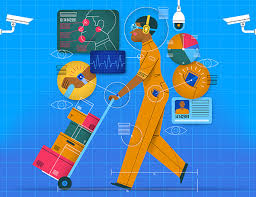
One of the most defining features of cyberpunk is the idea that corporations become more powerful than governments, shaping everyday life while operating with minimal accountability. While this once felt like a distant, dystopian future, today’s world suggests that this vision may not be as fictional as we once believed. Companies like Amazon provide a strong real-world example of how corporate power can begin to mirror cyberpunk narratives.

Amazon has transformed global commerce, but its labor practices have raised serious concerns. Investigations by outlets like The New York Times and Reuters have documented intense working conditions in warehouses, where employees are monitored through productivity-tracking systems and face pressure to meet strict quotas. This level of surveillance reflects what scholars describe as “algorithmic management,” where human labor is directed and evaluated by automated systems. In many ways, workers become extensions of a larger technological system rather than independent individuals.
This dynamic strongly resembles corporations in cyberpunk texts like Blade Runner, where the Tyrell Corporation treats replicants as disposable tools, or Neuromancer, where megacorporations operate beyond traditional legal boundaries. In both cases, human value is tied directly to productivity and usefulness—an idea that becomes increasingly visible in modern gig economies and warehouse labor systems.
However, the comparison goes beyond labor. Amazon’s influence on markets, logistics, and even cloud computing infrastructure highlights how deeply embedded corporations have become in everyday life. According to reports from MIT Technology Review, large tech companies now control significant portions of digital infrastructure, giving them power not only over economic systems but also over information flow. This raises concerns about whether corporations are beginning to shape society in ways traditionally reserved for governments.

That said, it would be an oversimplification to say we are fully living in a cyberpunk dystopia. Unlike fictional worlds, modern corporations are still subject to some regulation, public scrutiny, and legal accountability. Governments can impose fines, enforce labor laws, and regulate monopolistic behavior—at least in theory. Additionally, public awareness and activism play a role in challenging corporate practices. This suggests that while cyberpunk provides a useful framework for critique, it may exaggerate certain aspects for dramatic effect.
At the same time, the global dimension complicates this issue. Corporate power is not experienced equally across the world. In some regions, weaker regulatory systems allow corporations to operate with fewer restrictions, while in others, stricter policies limit their reach. This uneven distribution of power reflects broader patterns of globalization, where economic influence often crosses national boundaries more easily than political authority.
Ultimately, cyberpunk serves less as a prediction and more as a warning. It highlights what can happen when technological advancement and corporate power outpace ethical and political oversight. The similarities between fictional corporations and real-world companies like Amazon suggest that these concerns are not purely hypothetical. Instead, they challenge us to think critically about the systems we participate in and the kind of future we are helping to create.
The question is no longer whether cyberpunk’s vision is possible; it is how close we are willing to let it become reality.
AI Statement I used AI to help brainstorm ideas and improve clarity.
SOURCES: 1. The New York Times. (2021). Amazon’s warehouse working conditions. 2. Reuters. (2022). Amazon labor practices and productivity tracking. 3. MIT Technology Review. (2023). Big Tech and infrastructure control.