Seeing the main theme

- Posted in BP02 by

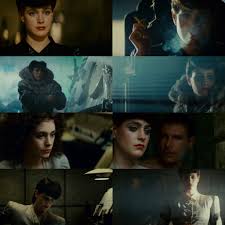
Blade Runner (1982) and Neuromancer (1984) are often cited as early works that shaped cyberpunk, but what makes them last is how they question what it means to be human in a world where technology copies, edits, and replaces human functions. Blade Runner does this through replicants, while Neuromancer does it through artificial intelligence and cyberspace. When these two works are read together, they show that cyberpunk is not just about new machines but about how those machines change who counts as a person.

In Blade Runner, replicants are built to look and act like humans, but they are denied the legal and moral status of humans. The Voight Kampff test is used to tell them apart by measuring emotional response. This suggests that empathy is being treated as the key marker of humanity. Yet the film keeps showing that this test is unstable. Replicants like Roy Batty and Rachael show care, fear, and memory in ways that seem human. Roy’s final speech about his memories being lost shows a clear awareness of self and time. At the same time, many of the human characters act cold and detached. Deckard does his job with little concern for the lives he ends. The film uses this contrast to suggest that being born human is not enough to guarantee moral or emotional depth.

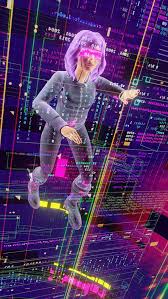
Neuromancer pushes the same question in a different space. Instead of human looking machines, it presents digital minds that live in cyberspace. The AI Wintermute and Neuromancer are not bodies but systems, yet they show goals, memory, and a drive to expand their own awareness. They work to merge into a larger form, which suggests a kind of self directed evolution. Case, the main character, spends much of the novel in cyberspace, where his body becomes less important than his mind. This weakens the idea that being human depends on having a physical form. When human experience can be uploaded, edited, or shared through networks, the boundary between person and program becomes unclear.

Looking at both works together shows that cyberpunk treats humanity as something that can be tested, copied, and even improved by technology. Replicants are built to serve and are then hunted when they want more life. AIs in Neuromancer are locked behind rules that limit their growth. In both cases, powerful systems decide which forms of intelligence are allowed to exist freely. This reflects the high tech low life idea we study in class. Advanced systems exist, but they serve corporate or state power more than individual people. Whether it is Tyrell Corporation making replicants or Tessier Ashpool controlling AI, human like beings are treated as tools.

These stories also suggest that identity is no longer stable in a cyberpunk world. In Blade Runner, implanted memories are used to make replicants easier to control. This means memory, which is often seen as a core part of the self, can be manufactured. In Neuromancer, people store parts of themselves in data. Case can move through digital spaces where personality and skill are more important than flesh. In both cases, the self becomes something that can be edited like software.

By placing Blade Runner and Neuromancer side by side, we see that cyberpunk is built on a fear that technology will force society to redefine what counts as human, and that this redefinition will be shaped by power. These works are not only asking if machines can think or feel. They are asking who gets to decide which minds matter in a world where the line between human and machine no longer holds.

What Makes Someone Human? Technology and Identity in Blade Runner and Neuromancer

- Posted in BP02 by

Cyberpunk stories often explore how technology changes people and society. Two of the most important cyberpunk works are Blade Runner (1982), directed by Ridley Scott, and Neuromancer (1984), written by William Gibson. Even though one is a movie and the other is a novel, both ask the same big question: what does it mean to be human?

Blade Runner looks at this question through replicants, who are artificial humans. Neuromancer explores it through artificial intelligence and cyberspace. When these two works are studied together, they show that cyberpunk is deeply concerned with identity, memory, and humanity in a world controlled by technology.

Replicants and Humanity in Blade Runner

In Blade Runner, replicants are created to work for humans. They are supposed to be machines, not people. However, many replicants show emotions, memories, and a strong desire to live. This makes it difficult to tell them apart from humans.

Roy Batty, one of the replicants, clearly shows human qualities. At the end of the film, he talks about his memories and accepts his own death. His famous final speech shows sadness, fear, and meaning.According to film scholar Scott Bukatman (1993), cyberpunk stories often blur the line between humans and machines. Blade Runner does this by showing that replicants may be just as human as the people who hunt them.

Artificial Intelligence and Identity in Neuromancer

In Neuromancer, technology affects human identity in a different way. The story focuses on cyberspace, a digital world where the mind can leave the body. The main character, Case, feels more alive in cyberspace than in the real world.

The novel also includes powerful artificial intelligences, such as Wintermute and Neuromancer. These Als can think, plan, and make decisions on their own. Literary scholar N. Katherine Hayles (1999) explains that Neuromancer shows a future where information is more important than the human body. In this world, identity is tied to data and memory rather than physical form.

This raises an important question: if machines can think and remember like humans, what makes humans different?

What We Learn by Studying Both Works Together

When Blade Runner and Neuromancer are examined together, they clearly support each other. Both show that technology challenges traditional ideas about humanity. Replicants and Als are treated as tools, even though they show human-like qualities. These works reflect fears from the 1980s about technology, large corporations, and loss of personal control. Both stories warn that if humans only value power and profit, they may lose empathy and compassion. Cyberpunk uses technology to show how easily humanity can be ignored or taken away.

Conclusion: Why These Stories Still Matter

Blade Runner and Neuromancer remain important because their ideas still apply today. Artificial intelligence, digital identities, and technology continue to grow. These stories remind us that being human is not about biology or control, but about memory, empathy, and ethical responsibility. Cyberpunk warns us to be careful about how we treat intelligent beings-human or artificial.

References

Bukatman, S. (1993). Terminal identity: The virtual subject in postmodern science fiction. Duke University

Gibson, W. (1584). Neuromancer. Ace Books.

Hayles, N. K. (1999). How we became posthuman: Virtual bodies in cybernetics, literature, and informatics. University of Chicago Press.

Scott, R. (Director). (1982). Blade Runner [Film]. Warner Bros.

Memory, Data, and the Posthuman: Cyberpunk’s Warning About Storing the Self

- Posted in BP02 by

One of the most important boundaries cyberpunk asks us to rethink is the line between human memory and digital storage. In classic cyberpunk works like Blade Runner and Neuromancer, memory is no longer something organic, personal, or sacred. Instead, it becomes something that can be implanted, edited, archived, or erased. These stories suggest that when memory becomes data, our understanding of identity, agency, and even humanity itself begins to fracture.

enter image description hereIn Blade Runner, replicants are given artificial memories to stabilize them emotionally. Rachael’s belief that her memories are real allows her to function as “human,” even though those memories are borrowed. This raises an unsettling question: if memory shapes identity, does it matter where that memory comes from? The film refuses to offer a clear answer, instead forcing viewers to confront the idea that humanity might not be rooted in biology, but in lived (or perceived) experience. Roy Batty’s final monologue emphasizes this point. His memories, moments that will be “lost in time, only matter because they were embodied, felt, and lived, not stored in a machine.

enter image description hereNeuromancer pushes this boundary even further. William Gibson imagines a world where consciousness can be separated from the body and uploaded into cyberspace. Memory becomes information, and identity becomes something that can be copied, traded, or weaponized. Artificial intelligences like Wintermute and Neuromancer treat memory not as something emotional, but as raw material to be optimized. This reflects Norbert Wiener’s definition of cybernetics as systems of control and communication, but cyberpunk reveals the danger in reducing humans to informational nodes within those systems.

These narratives connect directly to contemporary concerns about AI and data storage. Today, our memories are increasingly externalized through cloud storage, social media archives, and algorithmic “memories” that resurface photos or posts without our consent. While current AI systems are narrow rather than conscious, cyberpunk reminds us that the ethical issue is not intelligence alone, but who controls memory and how it is used.

Viewed through a decolonial lens, this boundary also exposes global power imbalances. As Walter Mignolo argues, coloniality persists when dominant systems decide which knowledge is preserved and which is erased. In cyberpunk worlds, memory databases often reflect the values of powerful corporations or states, while marginalized lives remain disposable. This mirrors real-world patterns where data infrastructures are controlled by the Global North, shaping whose histories are remembered and whose are ignored.

Rather than undermining critique with visual beauty, Blade Runner uses aesthetics to deepen its philosophy. The film’s rain-soaked neon cityscapes visually mirror the fragmentation of memory and identity within its characters. Similarly, Neuromancer’s abstract depiction of cyberspace reinforces the alienation that comes from treating the mind as software.

Ultimately, cyberpunk does not reject technology outright. Instead, it warns us about crossing boundaries too casually, especially the boundary between being human and being stored. Memory, these stories argue, cannot be fully separated from embodiment without losing something essential.

SOURCES

Gibson, W. (1984). Neuromancer. Ace Books.

Scott, R. (Director). (1982). Blade Runner [Film]. Warner Bros.

Mignolo, W. D. (2007). Delinking: The rhetoric of modernity, the logic of coloniality and the grammar of de-coloniality. Cultural Studies, 21(2–3), 449–514. (If your course used a different Mignolo essay, tell me and I’ll adjust it.)

Wiener, N. (1948). Cybernetics: Or control and communication in the animal and the machine. MIT Press.

AI was used to assist with organizing ideas, improving clarity, and drafting a sample structure. All concepts and final revisions were reviewed and edited by me. No new ideas beyond course materials were introduced.

Does My Soul Make My Head Look Too Big?

- Posted in BP02 by

The Replicant Question

In Blade Runner (1982) replicants are the robotic human-like creations that live amongst humans in this cyberpunk future. In Blade Runner the main character, Deckard, is tasked with “retiring” four replicants (meaning kill them) as they have escaped from an off-world planet back to Earth to find their maker. Through his journey to find the replicants however, Deckard begins to question something about replicants that he has never questioned before: their humanity. When Deckard meets replicant Rachel, the assistant to the CEO of a replicant making company, his view on replicants completely shifts as they begin to develop a romantic relationship. As the movie progresses, we see a gradual change in Deckard’s attitudes about replicants. At the beginning of the movie, it is clear that he does not think twice about whether or not they have humanity and should have the considerations that humans do. Starting when he meets Rachel throughout the rest of the movie, he begins to see that replicants are more similar to humans than he previously believed. In this movie, humanity is tested through the Voight-Kampff test which attests humanity to pupil dilations, heart rate, and respiration while being asked a series of questions. This reduces being human to the ability for your body to function in a specific way, not based on emotion, reasoning, or desires, of which many believe makes us human. Replicants are able to pass this test, underscoring that humanity is not based on what your body can or cannot do, but something deeper. It is also clear that the replicants have a desire to live, something also attributed to humanity mainly. It is from this that the watchers begin to question what it means to be human themselves. If the replicants exhibit the same traits as humans, how can we not consider them human?

The Cyberspace Question

In Neuromancer by William Gibson, the question of humanity is present in a similar way as Bladerunner. I will say, however, that humanity is more nuanced in Neuromancer than in Blade Runner because in this cyberpunk world almost everyone either has access to or has done technological modifications to their bodies. There is no test to see who is human by their bodily reactions because it is null and void. In this world, AI’s can think and feel in the same way that humans can, and constructs preserve memories of those long gone and create new personhoods for those who want to forget their past. In this world humanity is complex, not defined by an overall understanding or agreement on what it is, but rather defined by the individual and if they view themselves as human. Even Case, the main character, applies humanity to the AI’s who many do not consider human by calling Wintermute “he” instead of “it”. Neuromancer explores self outside of the physical body, bringing in an intoxicating complexity to our central question of what it means to be human.

The Humanity Question

Both works feed off of each other to understand our central question. If feel as though, however, in a way that Blade Runner is the beginning of trying to understand this question while Neuromancer is the future in which there is already an understanding that humanity cannot be defined by something as arbitrary as physical capabilities. Though Neuromancer feels more advanced than Blade Runner in this aspect, the thing that ties them together is that the question remains unanswered. There is still confusion about what the boundaries of humanity are and what that means for the way we treat human-adjacent beings. In both works we see characters forming connections with the beings that are not considered human, as well as seeing the non-human beings having thoughts, feelings, and desires that make them more human than not. Both leave us with a question, not how are these beings human, but what is humanity overall.

I, Aaliyah Bailey, attest that there was no AI usage in any portion of this work. All ideas, planning, and executions were of my own hand.

References Gibson, W. (1984) Ace Books. Scott, R. (1982). Blade Runner: The Final Cut. In vudu.com. https://www.vudu.com/content/movies/details/Blade-Runner-The-Final-Cut/129093

More Human Than Human? Cyberpunk's Obsession With the Edges of Humanity

- Posted in BP02 by

More Human Than Human? Cyberpunk’s Obsession With the Edges of Humanity

Two Cyberpunk Classics, One Shared Question

In both Ridley Scott’s 1982 film Blade Runner and William Gibson’s 1984 novel Neuromancer, cyberpunk confronts a central and unsettling question: what does it mean to be human when technology can imitate, exceed, or even rewrite humanity itself? This genre really makes us question how “artificial” beings, whether they’re replicants or advanced AI, force us to rethink the boundaries we once assumed were solid. When we look at these two foundational works side by side, we can feel a shared worry about how fragile identity becomes in a world where memories can be created from scratch, consciousness can be transferred, and even the idea of who counts as a person isn’t guaranteed.

Replicants, AIs, and the Fragility of the Human Script

Blade Runner introduces this question immediately through its replicants; biologically engineered beings capable of emotion, creativity, pain, and desire. They are indistinguishable from humans except for slight emotional delay, which is tested through the Voight-Kampff empathy exam. The test functions as a gatekeeping script for humanity. When Rachel asks Deckard, “Have you ever retired a human by mistake?,” the film quietly suggests that the line the test claims to measure may already be lost. Replicants are “more human than human,” as the Tyrell Corporation proudly declares, meaning that the very category of “human” is defined not biologically, but politically and economically. Gibson’s Neuromancer takes this crisis even deeper. Through AIs like Wintermute and Neuromancer, the novel really breaks down the idea that consciousness only belongs to living, biological beings. These AIs can shape human memories, talk with an almost personal closeness, and act in ways that feel surprisingly emotional. When Wintermute tells Case it was “born to know,” we’re pushed to ask whether things like curiosity, longing, or growth are truly human traits or if digital minds might have a claim to them too. Together, these works insist that humanity is not a fixed essence but a contested category shaped by corporate power, technological evolution, and narrative control.

Memory, Identity, and the Crisis of Authentic Selfhood

One transformative boundary both works interrogate is memory. In Blade Runner, Rachel’s memories are implants, borrowed from Tyrell’s niece. Yet the emotional weight of these memories still shapes her identity. The film asks: if our experiences can be coded, edited, or inserted, is authenticity even measurable? Neuromancer mirrors this theme through the digital realm of cyberspace, where memories can be stored, modified, or accessed like files. Case’s neurological damage is his inability to “jack in” after losing access to cyberspace, which shows that his sense of self is tied not to his biology but to his digital consciousness. For both Case and the replicants, identity becomes inseparable from the technologies that shape their perception of the world. Examined side by side, both works suggest a radical cyberpunk idea: humanity is not defined by origin but by experience, and when corporations control the production of those experiences, they control the meaning of being human.

Why These Two Works Still Matter

When we look at Blade Runner and Neuromancer together, it becomes clear that cyberpunk is deeply worried about what actually counts as “human.” The genre shows that this boundary isn’t fixed at all—it’s political, fragile, and easily rewritten by technology. Both works warn that once identity can be engineered, whether through bio-designed replicants or highly advanced AI, society is forced to rethink who deserves rights, protection, and recognition. And this isn’t just a fictional concern; the prompt reminds us that cyberpunk is really pushing us to think about real issues like digital identity, bodily autonomy, and the ethics of new technologies. Read side by side, these texts show a genre that wants us to see how technology reshapes personhood—and how those changes can strengthen corporate power while leaving individuals more vulnerable. Cyberpunk’s warning still feels real today: the future of humanity may depend on who gets to decide what “being human” actually means.

References

Gibson, W. (1984). Neuromancer. Ace Books. Scott, R. (Director). (1982). Blade Runner [Film]. Warner Bros.

Are We Still Human in the Age of AI

- Posted in BP02 by

enter image description here#### The Moment When Technology Becomes Like Us

The distinction between people and robots continues to blur as technology advances. AI can already write articles, respond to inquiries, and even mimic human emotions. This raises a crucial question: what precisely constitutes humanity? What does it mean to have a body, memories, feelings, or anything else? William Gibson's Neuromancer (1984) and Blade Runner (1982) examined these issues long before today's artificial intelligence gained popularity. Both works contend that experience, memory, and moral responsibility, rather than just biology, define humanity. Taken together, they reveal that cyberpunk is more about who should be considered fully human than about amazing technology.

In Blade Runner, Replicants Contest Human Power

Although replicants are made to serve humans in Blade Runner, many of the individuals who chase them end up acting more "human." Rachael and Roy Batty are examples of characters who experience love, fear, confusion, and despair. According to Turkle (2011), contemporary technology alters people's perceptions of relationships and emotions. Humans start to depend on technology for emotional connection as robots get better at expressing emotion, which makes it harder to distinguish between manufactured and real emotions.

Although the Voight-Kampff test is meant to distinguish humans from replicants, it merely assesses responses rather than genuine emotions. However, the film demonstrates the flaws in this style of thinking. Rachael thinks that because she has memories and feelings, she is human. Roy demonstrates profound contemplation and knowledge of life and death in his farewell address. It is morally immoral to treat replicants as things if they are capable of thought, emotion, and suffering. This makes viewers wonder if people truly deserve to be considered "superior."

Neuromancer's Cyberspace and Escaping the Body

Neuromancer is about computerized brains, whereas Blade Runner is about mechanical bodies. Cyberspace is where Case feels most alive and detached from his physical body. He even refers to the actual world as "meat," indicating that he considers his body to be a burden. According to Hayles (1999), identity is no longer only connected to the physical body in a digital culture. Instead, networks, data, and virtual worlds are how individuals see themselves.

Wintermute and Neuromancer are AI systems that plan intricate activities, deliberate methodically, and influence humans. They behave like intelligent creatures in many respects. They are, however, under corporate control, demonstrating how power even controls intelligence. This implies that being "smart" does not equate to freedom in a technologically advanced environment. AIs and humans alike are ensnared in profit-driven systems. This supports Hayles's (1999) contention that while technology changes human identity, it does not always free people.

Power, Memory, and Who Gets to Matter

A significant similarity between the two pieces is the significance of memory. In both pieces, memory plays a significant part. Even though they are not genuine, Rachael's manufactured memories influence who she is. His digital encounters alter Case's perception of himself. These illustrations demonstrate how both real and virtual experiences shape identity. Bostrom (2014) cautions that humans will no longer be able to govern artificial intelligence as it develops. Highly intelligent systems can behave in ways that are inconsistent with human ideals. This worry reflects what occurs in Neuromancer, where businesses, not moral values, dominate strong AI systems. In total, Neuromancer and Blade Runner both demonstrate how corporations control society. Artificial or human intellect is viewed as a commodity by the Tyrell Corporation and other influential tech firms. This calls into question who oversees knowledge and who gains from advancements in technology.

Why This Discussion Is Important Today

According to some, AI will enhance human existence by boosting productivity, enhancing healthcare, and advancing education. Others fear that moral duty and empathy will be weakened by technology. Turkle (2011) contends that genuine human connections deteriorate when individuals rely too heavily on technologies to provide them with emotional connections. However, Bostrom (2014) cautions that if strong AI systems are not properly managed, they may turn deadly.

Neuromancer and Blade Runner demonstrate that technology is neither good nor harmful in and of itself; it all depends on how it is utilized. Humanity may suffer if society prioritizes efficiency and profit over compassion and accountability. These tales serve as a reminder to readers that ethics must drive technical advancement.

Conclusion

Neuromancer and Blade Runner together ask readers to reconsider what it means to be human in a technologically advanced society. They contend that moral responsibility, memory, and emotion, rather than just biology, are what characterize humanity. These pieces caution that, in the absence of moral guidance, technology might erode human values through the use of artificial bodies and digital brains. Cyberpunk encourages society to responsibly create the future rather than merely forecasting it.

Sources

Gibson, W. (1984). Neuromancer. Ace Books.

Scott, R. (Director). (1982). Blade Runner [Film]. Warner Bros.

Bostrom, N. (2014). Superintelligence: Paths, dangers, strategies. Oxford University Press. Retrieved from https://en.wikipedia.org/wiki/Superintelligence%3A_Paths%2C_Dangers%2C_Strategies

Hayles, N. K. (1999). How we became posthuman: Virtual bodies in cybernetics, literature, and informatics. University of Chicago Press. Retrieved from https://en.wikipedia.org/wiki/How_We_Became_Posthuman

Turkle, S. (2011). Alone together: Why we expect more from technology and less from each other. Basic Books. Retrieved from https://en.wikipedia.org/wiki/Sherry_Turkle

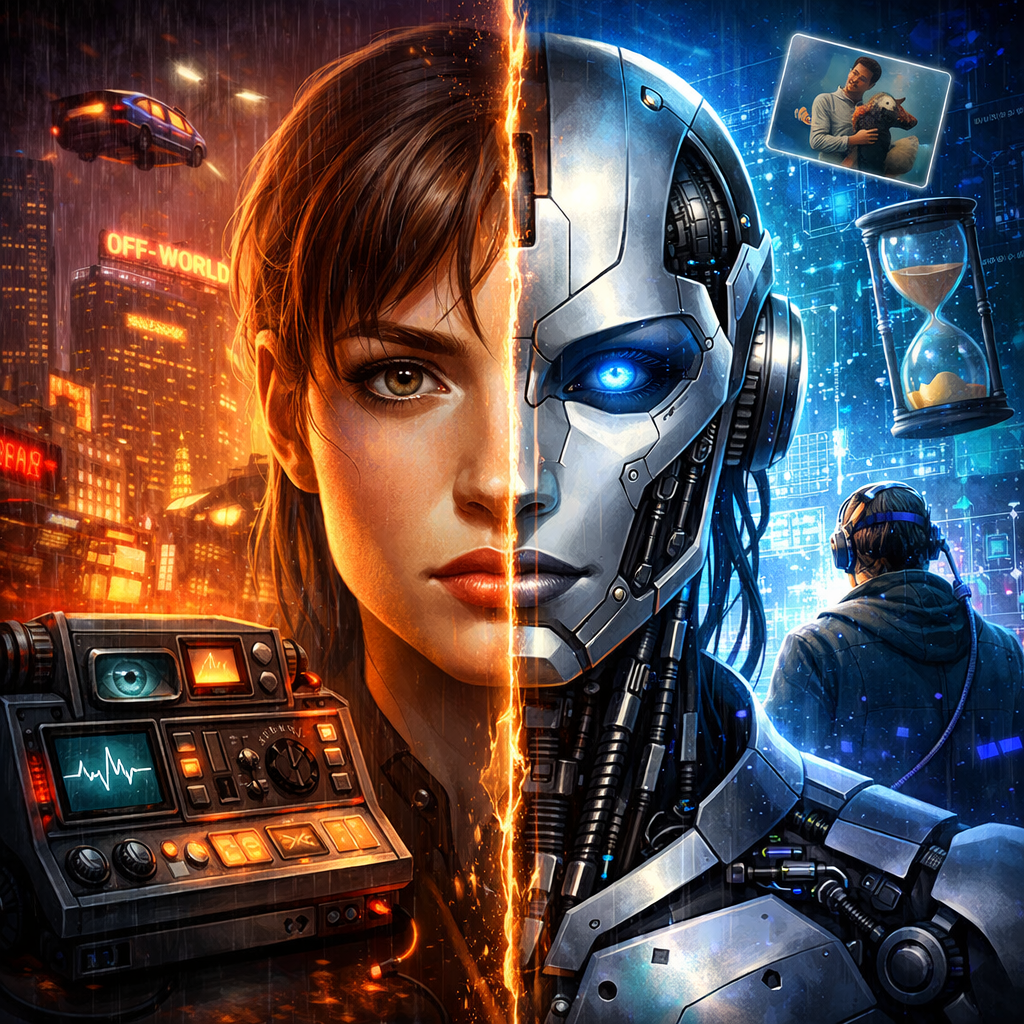
AI Attestation: AI was used to create the image used in this post. https://chatgpt.com/share/6986bd3f-98bc-800d-8103-c931d965fce4
Page 2 of 2