Are We Still Human in the Age of AI
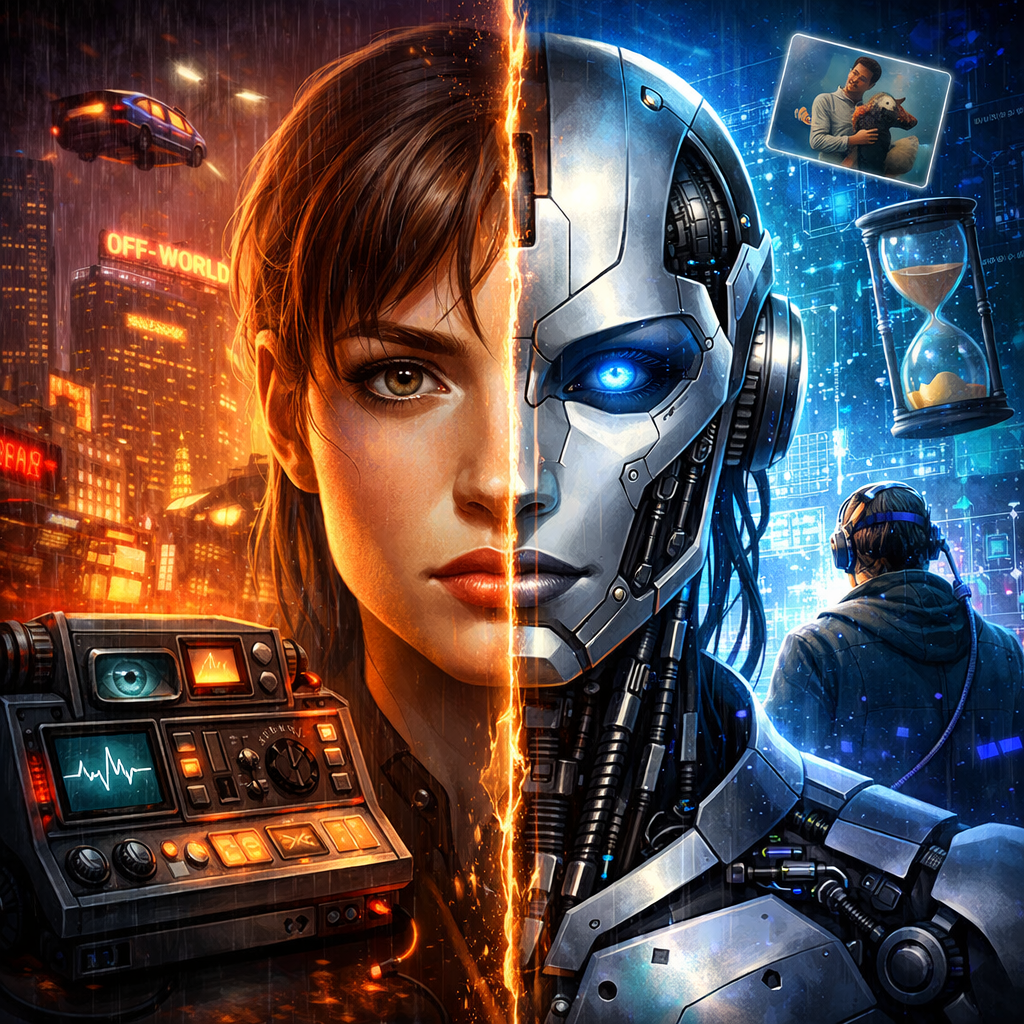 #### The Moment When Technology Becomes Like Us
The distinction between people and robots continues to blur as technology advances. AI can already write articles, respond to inquiries, and even mimic human emotions. This raises a crucial question: what precisely constitutes humanity? What does it mean to have a body, memories, feelings, or anything else? William Gibson's Neuromancer (1984) and Blade Runner (1982) examined these issues long before today's artificial intelligence gained popularity. Both works contend that experience, memory, and moral responsibility, rather than just biology, define humanity. Taken together, they reveal that cyberpunk is more about who should be considered fully human than about amazing technology.
In Blade Runner, Replicants Contest Human Power
Although replicants are made to serve humans in Blade Runner, many of the individuals who chase them end up acting more "human." Rachael and Roy Batty are examples of characters who experience love, fear, confusion, and despair. According to Turkle (2011), contemporary technology alters people's perceptions of relationships and emotions. Humans start to depend on technology for emotional connection as robots get better at expressing emotion, which makes it harder to distinguish between manufactured and real emotions.
Although the Voight-Kampff test is meant to distinguish humans from replicants, it merely assesses responses rather than genuine emotions. However, the film demonstrates the flaws in this style of thinking. Rachael thinks that because she has memories and feelings, she is human. Roy demonstrates profound contemplation and knowledge of life and death in his farewell address. It is morally immoral to treat replicants as things if they are capable of thought, emotion, and suffering. This makes viewers wonder if people truly deserve to be considered "superior."
Neuromancer's Cyberspace and Escaping the Body
Neuromancer is about computerized brains, whereas Blade Runner is about mechanical bodies. Cyberspace is where Case feels most alive and detached from his physical body. He even refers to the actual world as "meat," indicating that he considers his body to be a burden. According to Hayles (1999), identity is no longer only connected to the physical body in a digital culture. Instead, networks, data, and virtual worlds are how individuals see themselves.
Wintermute and Neuromancer are AI systems that plan intricate activities, deliberate methodically, and influence humans. They behave like intelligent creatures in many respects. They are, however, under corporate control, demonstrating how power even controls intelligence. This implies that being "smart" does not equate to freedom in a technologically advanced environment. AIs and humans alike are ensnared in profit-driven systems. This supports Hayles's (1999) contention that while technology changes human identity, it does not always free people.
Power, Memory, and Who Gets to Matter
A significant similarity between the two pieces is the significance of memory. In both pieces, memory plays a significant part. Even though they are not genuine, Rachael's manufactured memories influence who she is. His digital encounters alter Case's perception of himself. These illustrations demonstrate how both real and virtual experiences shape identity. Bostrom (2014) cautions that humans will no longer be able to govern artificial intelligence as it develops. Highly intelligent systems can behave in ways that are inconsistent with human ideals. This worry reflects what occurs in Neuromancer, where businesses, not moral values, dominate strong AI systems. In total, Neuromancer and Blade Runner both demonstrate how corporations control society. Artificial or human intellect is viewed as a commodity by the Tyrell Corporation and other influential tech firms. This calls into question who oversees knowledge and who gains from advancements in technology.
Why This Discussion Is Important Today
According to some, AI will enhance human existence by boosting productivity, enhancing healthcare, and advancing education. Others fear that moral duty and empathy will be weakened by technology. Turkle (2011) contends that genuine human connections deteriorate when individuals rely too heavily on technologies to provide them with emotional connections. However, Bostrom (2014) cautions that if strong AI systems are not properly managed, they may turn deadly.
Neuromancer and Blade Runner demonstrate that technology is neither good nor harmful in and of itself; it all depends on how it is utilized. Humanity may suffer if society prioritizes efficiency and profit over compassion and accountability. These tales serve as a reminder to readers that ethics must drive technical advancement.
Conclusion
Neuromancer and Blade Runner together ask readers to reconsider what it means to be human in a technologically advanced society. They contend that moral responsibility, memory, and emotion, rather than just biology, are what characterize humanity. These pieces caution that, in the absence of moral guidance, technology might erode human values through the use of artificial bodies and digital brains. Cyberpunk encourages society to responsibly create the future rather than merely forecasting it.
Sources
Gibson, W. (1984). Neuromancer. Ace Books.
Scott, R. (Director). (1982). Blade Runner [Film]. Warner Bros.
Bostrom, N. (2014). Superintelligence: Paths, dangers, strategies. Oxford University Press. Retrieved from https://en.wikipedia.org/wiki/Superintelligence%3A_Paths%2C_Dangers%2C_Strategies
Hayles, N. K. (1999). How we became posthuman: Virtual bodies in cybernetics, literature, and informatics. University of Chicago Press. Retrieved from https://en.wikipedia.org/wiki/How_We_Became_Posthuman
Turkle, S. (2011). Alone together: Why we expect more from technology and less from each other. Basic Books. Retrieved from https://en.wikipedia.org/wiki/Sherry_Turkle
AI Attestation: AI was used to create the image used in this post. https://chatgpt.com/share/6986bd3f-98bc-800d-8103-c931d965fce4