blogpost#4 Human–Wild Horse Hybrid
Connection to Horses and Nature
If a safe technology existed that allowed humans to take on animal characteristics, I would choose to become a human–wild horse hybrid. This choice is not random for me. Since I was a child, I have always loved horses. I grew up on a farm surrounded by nature, animals, and open land. Some of my favorite memories are watching horses run across the fields and feeling the peaceful atmosphere of the countryside.
Growing up in that environment created a strong connection between me and nature. Life on a farm feels very different from life in cities. There is more space, more silence, and more time to observe animals and the natural world. For me, being around horses always brought a feeling of freedom and calm. Because of that experience, the idea of sharing some of their abilities feels very meaningful. If I could become a hybrid, I would not want a complete transformation. I would prefer moderate changes, such as greater endurance, stronger muscles for running long distances, and heightened awareness of the environment. Horses have incredible stamina and balance, which would allow humans to move through the world in a very different way.
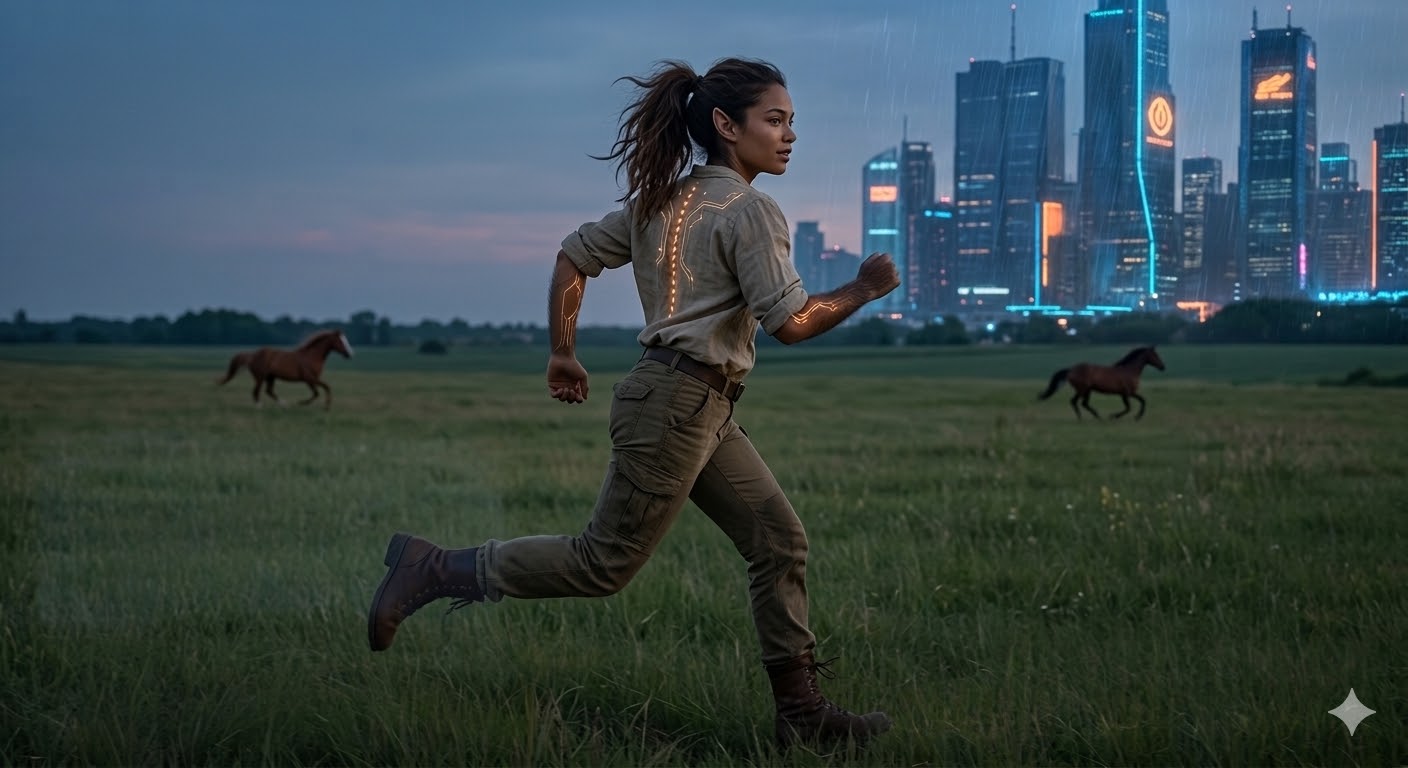
This thought experiment connects strongly with ideas in cyberpunk theory. The scholar Donna Haraway wrote about the concept of the cyborg, which challenges the boundaries between humans, animals, and machines. According to her argument, these boundaries are not always as clear as society assumes. A human–animal hybrid would represent another example of those boundaries becoming flexible. Cyberpunk stories often explore similar questions. In the film Blade Runner, artificial humans known as replicants challenge the idea of what makes someone truly human. They look and behave like people, but society treats them differently because they were created through technology. The anime Ghost in the Shell raises similar questions by showing characters whose bodies are heavily enhanced with cybernetic parts while their consciousness remains human.
In the case of a human horse hybrid, the question becomes, does changing the body change who we are? Personally, I believe that humanity comes more from our consciousness, emotions, and memories than from our physical appearance. Even if someone had horses like strength or speed, they could still be human if they kept their values, relationships, and ability to think critically. However, technologies that enhance humans could also create serious social problems. In many cyberpunk stories, advanced technologies are controlled by powerful corporations or wealthy individuals. This creates a world where some people become enhanced while others are left behind.
The Social Impact
If hybrid technology became real, access would likely depend on money and power. Wealthy individuals might use enhancements to gain advantages in sports, work, or military power. Meanwhile, people without access could fall even further behind. According to the Pew Research Center, experts studying human enhancement warn that these technologies could increase social inequality if they are not distributed fairly. This issue reflects one of the major themes in cyberpunk, technology can improve life, but it can also create new forms of inequality and control. Even with these risks, the idea of hybridization also invites us to think differently about our relationship with nature. Horses experience the world through movement, instinct, and awareness of their surroundings. Sharing some of those abilities might help humans reconnect with nature in ways that modern technology often separates us from. For someone like me, who grew up on a farm, that connection is already meaningful. The feeling of being close to animals and the land is something that has stayed with me throughout my life. Becoming a human wild horse hybrid would symbolize a deeper relationship with the natural world rather than a rejection of humanity. In the end, cyberpunk stories remind us that the future will likely blur the boundaries between humans, animals, and machines. The real challenge will not just be developing new technologies but deciding how to use them responsibly while protecting our humanity.
References
July 26, 2016,Human Enhancement,The Scientific and Ethical Dimensions of Striving for Perfection.
ByDavid Masci https://www.pewresearch.org/?p=93874
Scott, R. (Director). (1982). Blade Runner
Ghost in the shell, (F. Schodt, Trans.),(Original work published 1991)
AI tools were used to create image. The personal experiences, opinions, and final content of this post reflect my own thinking and writing.