Imagine standing at a threshold, not the entrance to a building, but the entrance to a different kind of self. A technology is safe. It is reversible. All you have to do is choose. When I consider the question honestly, my answer comes quickly and without much thought: the black panther.
Not because I want claws, or a coat of obsidian fur, though it would be amazing to have those features. But becausw the black panther represents a particular union of qualities that feel less like fantasy and more like aspiration: patient intelligence, acute awareness, solitary, decisiveness, and an almost preternatural calm in the face of danger. The real question the thought experiment forces us to ask is not which animal wwe find cool, but which qualities we are missing- and what that absence says about us.
The Transformation I would Choose
My hybrid would not be extreme. I am not interested in becoming a totally different creature. The transformation I imagine is moderate, targeted enough to still be meaningful, restrained enough to preserve continuity of self. Physically, I would want enhances sensory perception: the black panthers acute night visions, its ability to hear high frequency sounds beyond human range, and the sharpened olfactory system that lets it track prey through dense jungle. I would want a body that is faster and more agile, capable of fluid, economical movement that big cats are famous for.
Behaviorally and Cognitively , the change I want are subtle but feel more significant. As I researchers have notes, black panther are characterized by remarkable strategic hunting intelligence–an ability to read environments, hold focus, and wait for precisely the right moment before acting. They demonstrate patience as a skill, not as passivity. This sis what I want most. Not physical grace, though id take it- but I more interested in cognitive architecture that makes stillness feel like power rather than absence.
Blockquote What does it mean to 'give up' humanity if the qualities you're gaining–paitence, perceptions, presence–are ones we already recognize as admirable in exceptional human beings?
I would keep my language, my memory, my relationships, my capacity for abstract reasoning and ethical implications. What I would gain is a perceptual and behavioral layer that currently lies beyond human capacity: a heighten awareness of my surrounding, a nervous system that is designed for stillness and precision, and the solitary confidence to act on my own judgement without even thinking about social approval.
The Humanity Question
This where the thought experiments gets genuinely difficult. When we ask how much humanity wed be willing to give up, we are forced to define what humanity even is– and that defintion can be unstable.
A philosopher and bioethicist Davis DeGrazia, writing on enhancement technologies and personal identity, argues that our concern about losing "human nature" through biotechnology change often rests on assumptions we have never examined carefully. as he puts it, the worry that enhancement disrupts identity depends on implausible notions of what makes us who we are in the first place. If what makes me human is my capacity for love, moral reasoning, grief, and curiosity, then againg a panthers night vision changes none of that. But if humanity is defines as a biological boundless– as being confined to the sensory and physical limits of Homo sapiens– then any enhancement dissolves that boundary.
Donna Hawarway, whose 1985 "Cyborg Manifesto" is touchstone for this course, would likely point out that the boundary was never as stable as we imagines. Her cyborg is a figure that refuses categorical purity– human/animal organism/ machine, natural/ artificial. The black panther hybrid I am describing is, in Haraway terms already a cyborg: a creature of mixed categories that cannot be cleanly sorted. And her point is that this is not a horror story. It is liberation from the policing of borders that were always more ideologies than biological.
Course Connection
Blade Runner replicants are "more human than humans" not because they human DNA, but because they have learned to want, remember, and mourn. Ghost in the Shell's Motoko Kusanagi questions her own authentic not because her body is cybernetic, but because she cannot locate the different between genuine memory and an implanted one.
Academic Bioethicist writing an transhumance have increasingly recognize that the real boundary being debated is not biological but social. As one recent study in the journal bioethicist observes, radical genetic enhancement– including the introduction of genes coding for abilities found in other animals could, in principle, produce changes that move us away from our current species identity. The question is whether species identity is what we actually care about, or whether it is a proxy for something more fundamental: continuity of consciousness, moral community, and the recognition of one another as fellow beings deserving of dignity.
My honest answer is that I would give up very little of what I care about. Sharper hearing and faster reflexes do not make me less capable of love. Solitary confidence does not require abandoning connections. In fact, I think that some of the qualities I would gain from a panther– patience, composure, acute presence – would make me a better human being in all ways that actually matter.
Who Gets to Become the Shadow?
if this technology were real, and it followed the pattern of virtually every other significant biotechnology, access would be deeply unequal. Those with wealth and proximity to elite medical infrastructure would choose their enhancements. The rest could not. This is not speculative anxiety– it is already the trajectory of genetic medicine, cometic biotechnology and pharmaceutical enhancements. As researchers studying the ethics of human enhancements have pointed out, technologies that promise to improve humanity in the abstract tend, in practice, to redistribute advantages toward those who already have it.
This inequality is not only economic. It is perceptual. A world divided between enhanced and unenhanced humans would not simply be w a world with different physical capabilities. It would be a world in which the enhances see, heard, responded and decide differently– and in which those differences map onto existing hierarchies of race, gender, class, geography, and etc. Haraway's cyborg was supposed to dissolve these boarders. This uncomfortable truth of our actual world is that boarders are remarkably good at reasserting themselves through new technologies rather than being dissolves by them.
The black panther itself carries a particular cultural weight here. As a figure of beauty, power, and nocturnal intelligence, it has long been associated in the western imagination– with a kind of threatening otherness. To hybridize with this animal is to ask not just which traits I want, but which traits society is prepared to accept in whose body.
Stillness as the Post Human Aspiration
In the end, what draws me to the black panther is something I can only describe as the quality of its attentions. It does not rush. it does not preform. It reads its environment with precision and acts from a place of complete situational awareness. In a world of noise, notifications, and manufactures urgency, that quality feels almost impossible rare.
Perhaps that is the real thing the thought experiment reveals : the animal we choose says something about what we feel we lack, and what we lack says something about what human conditions– in this historical moment, in this paritcual culture– has failed to cultivate. I do not want to become a panther. I want to become the version of myself that has learned something from one.
References
DeGrazia, D. (2005). Enhancement technologies and human identity. George Washington University Department of Philosophy. Retrieved from https://philosophy.columbian.gwu.edu/sites/g/files/zaxdzs5446/files/2023-01/degrazia_enhancement.pdf
Haraway, D. (1985). A cyborg manifesto: Science, technology, and socialist-feminism in the late twentieth century. Socialist Review, 80, 65–108.
Rueda, J. (2024). Genetic enhancement, human extinction, and the best interests of posthumanity. Bioethics, 38(6), 529–538. https://doi.org/10.1111/bioe.13085
Thornberry, M. (2024). Black panther behavioral adaptations for survival. Berry Patch Farms. Retrieved from https://www.berrypatchfarms.net/black-panther-behavioral-adaptations/
Scott, R. (Director). (1982). Blade Runner [Film]. Warner Bros.
Oshii, M. (Director). (1995). Ghost in the Shell [Film]. Production I.G
 The theme song made it sound like the real superpower was predicting the future. But if scientists ever develop technologies that allow humans to borrow traits from other species, my choice would be different. I would not choose wings, sharper eyesight, or animal strength. I would choose a raven’s mind. Ravens are among the most intelligent animals on Earth. They show remarkable abilities in memory, planning, and problem-solving. Thinking about a human-raven hybrid raises an interesting question. What would it mean to borrow intelligence from another species, and what would that say about the boundaries of being human?
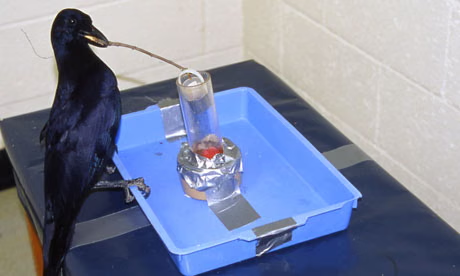 Calling someone a “birdbrain” is usually meant as an insult. In the case of ravens and other corvids, the phrase may deserve reconsideration. Researchers have found that these birds possess impressive cognitive abilities that rival those of many mammals. Ravens and crows demonstrate advanced memory, tool use, and long-term planning. Some studies show that corvids can remember thousands of food locations and recognize individual human faces for years (Philp, 2025). They can also share information about threats with other birds, creating a kind of collective memory within their groups.
Scientists and philosophers studying animal cognition have begun to ask what the world might feel like from a raven’s perspective. Evidence suggests that corvids possess complex emotional lives and forms of consciousness. They can anticipate the intentions of others, hide food strategically, and remember what they stored, where they stored it, and when they hid it (Veit, 2025). These abilities suggest a mind capable of reflection and planning. If human enhancement technologies ever allowed us to borrow traits from other species, the raven’s cognitive toolkit would offer powerful possibilities.
Calling someone a “birdbrain” is usually meant as an insult. In the case of ravens and other corvids, the phrase may deserve reconsideration. Researchers have found that these birds possess impressive cognitive abilities that rival those of many mammals. Ravens and crows demonstrate advanced memory, tool use, and long-term planning. Some studies show that corvids can remember thousands of food locations and recognize individual human faces for years (Philp, 2025). They can also share information about threats with other birds, creating a kind of collective memory within their groups.
Scientists and philosophers studying animal cognition have begun to ask what the world might feel like from a raven’s perspective. Evidence suggests that corvids possess complex emotional lives and forms of consciousness. They can anticipate the intentions of others, hide food strategically, and remember what they stored, where they stored it, and when they hid it (Veit, 2025). These abilities suggest a mind capable of reflection and planning. If human enhancement technologies ever allowed us to borrow traits from other species, the raven’s cognitive toolkit would offer powerful possibilities.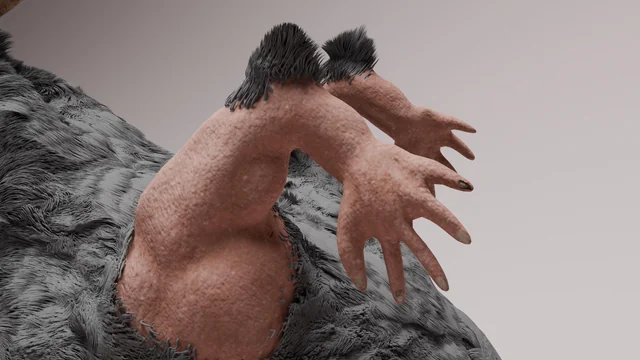 Even with those abilities, I would not want to become completely raven-like. The idea of hybridization becomes interesting when it pushes the boundaries of humanity without fully replacing it. If this hypothetical technology existed, I would choose a mostly cognitive hybridization. My body and social identity would remain human. The traits I would borrow involve memory, spatial awareness, and the ability to plan strategically across long stretches of time.
This kind of hybrid identity connects with ideas we’ve explored throughout the course. Haraway’s cyborg theory argues that boundaries between human and nonhuman identities are more flexible than we often assume. Hybrid identities can challenge rigid categories and open new ways of thinking about personhood. Works such as Blade Runner and Ghost in the Shell raise similar questions. Characters who possess artificial bodies or enhanced cognition still display memory, emotion, and self-awareness. These stories suggest that humanity may depend less on biological origin and more on conscious experience. Borrowing the mental abilities of a raven would push that idea further and invite us to rethink which qualities truly define being human.
Even with those abilities, I would not want to become completely raven-like. The idea of hybridization becomes interesting when it pushes the boundaries of humanity without fully replacing it. If this hypothetical technology existed, I would choose a mostly cognitive hybridization. My body and social identity would remain human. The traits I would borrow involve memory, spatial awareness, and the ability to plan strategically across long stretches of time.
This kind of hybrid identity connects with ideas we’ve explored throughout the course. Haraway’s cyborg theory argues that boundaries between human and nonhuman identities are more flexible than we often assume. Hybrid identities can challenge rigid categories and open new ways of thinking about personhood. Works such as Blade Runner and Ghost in the Shell raise similar questions. Characters who possess artificial bodies or enhanced cognition still display memory, emotion, and self-awareness. These stories suggest that humanity may depend less on biological origin and more on conscious experience. Borrowing the mental abilities of a raven would push that idea further and invite us to rethink which qualities truly define being human.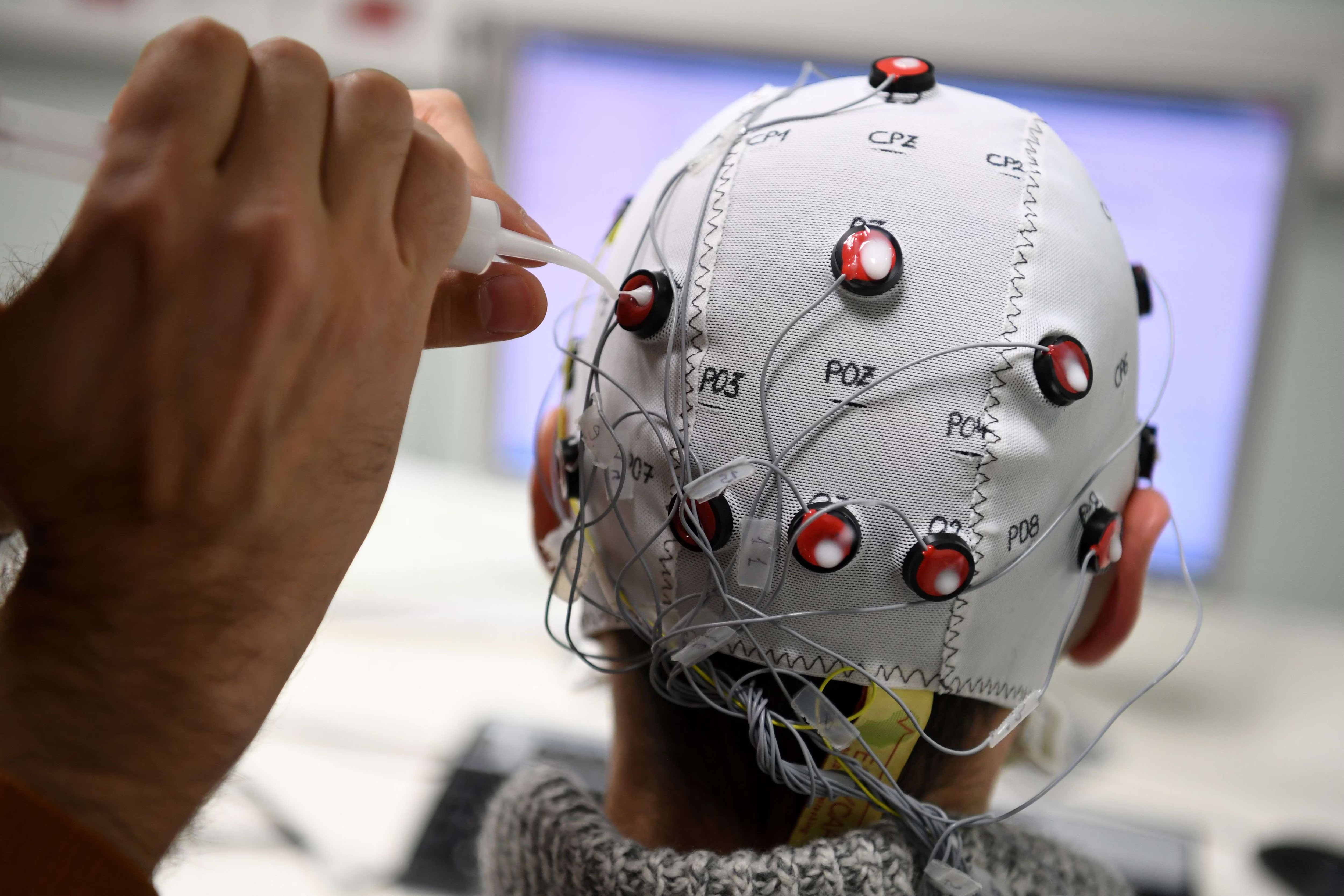 The larger question involves access. If technologies could enhance human abilities by combining traits from other species, who would actually receive those upgrades? Current discussions about human enhancement already raise ethical concerns. Technologies such as brain-computer interfaces or cognitive augmentation could produce individuals with significantly improved abilities, which may reshape power structures in areas like warfare, labor, and education (“Reports on Military Medicine Findings”, 2025).
Researchers also warn that access to enhancement technologies may depend heavily on financial resources. If these technologies remain expensive, they could widen existing social inequalities by allowing wealthy groups to enhance their capabilities while others remain excluded (“Chongqing University Researchers”, 2025). In that case, the future might resemble many cyberpunk stories in which technological upgrades become another way to reinforce social hierarchies.
Thinking about a “raven upgrade” therefore raises broader questions about the future of human enhancement. If humans gain the ability to borrow the strengths of other species, the benefits may depend on how societies regulate and distribute those technologies.
The larger question involves access. If technologies could enhance human abilities by combining traits from other species, who would actually receive those upgrades? Current discussions about human enhancement already raise ethical concerns. Technologies such as brain-computer interfaces or cognitive augmentation could produce individuals with significantly improved abilities, which may reshape power structures in areas like warfare, labor, and education (“Reports on Military Medicine Findings”, 2025).
Researchers also warn that access to enhancement technologies may depend heavily on financial resources. If these technologies remain expensive, they could widen existing social inequalities by allowing wealthy groups to enhance their capabilities while others remain excluded (“Chongqing University Researchers”, 2025). In that case, the future might resemble many cyberpunk stories in which technological upgrades become another way to reinforce social hierarchies.
Thinking about a “raven upgrade” therefore raises broader questions about the future of human enhancement. If humans gain the ability to borrow the strengths of other species, the benefits may depend on how societies regulate and distribute those technologies.