If Humans Could Hybridize with Animals, Where Would We Draw The Line?

- Posted in BP04 by

Rethinking the Human Boundary

Cyberpunk stories often challenge the boundary between humans and technology. In many cases, characters blur the line between biological and artificial life. But what if the boundary between humans and animals could also be changed? Imagine a safe and reversible technology that allows people to adopt animal characteristics and become hybrids. This thought experiment raises questions about identity, power, and inequality. If such technology existed, I would choose to hybridize with an eagle. I would not want a complete transformation, but rather a few specific physical and sensory adaptations that could expand human capabilities while still maintaining my sense of self.

Why an Eagle?

Eagles are known for their incredible eyesight and ability to fly long distances. According to the Cornell Lab of Ornithology, eagles can see several times farther than humans, allowing them to spot prey from great heights (Cornell Lab of Ornithology, 2023). If I could adopt any animal trait, enhanced vision like this would be extremely valuable. Being able to see clearly over long distances could help with exploration, environmental monitoring, or even search-and-rescue work. However, I would not want a full transformation into something that no longer resembles a human. Instead, I would choose limited physical enhancements, such as improved vision and perhaps stronger bones or muscles that support better balance and mobility. These changes would expand human abilities without removing the basic characteristics that define our humanity.

What Defines Humanity?

The bigger question is not just what abilities we gain but what we might lose. Cyberpunk stories like Blade Runner and Ghost in the Shell constantly ask whether identity comes from our bodies or from our consciousness. Donna Haraway's famous essay about the cyborg argues that modern humans already blur boundaries between natural and artificial systems (Haraway, 1991). In that sense, hybridization may simply be another step in a long history of human enhancement.

For me, humanity is defined less by our physical form and more by our ability to think, reflect, and form relationships with others. Our empathy, creativity, and moral reasoning are the qualities that make us human. As long as those abilities remain intact, adding animal traits might not fundamentally change who we are. The real danger would occur if enhancements began to alter our personality, memories, or sense of self.

Inequality and Access

Another important issue is who would have access to this technology. If hybridization became available but only wealthy people could afford it, the result could be a new form of inequality. Some individuals might gain powerful physical or cognitive advantages while others remain unchanged. This could create a society where enhanced humans dominate jobs, sports, or even political power.

Cyberpunk stories often explore this kind of technological inequality. In Blade Runner, replicants are created as powerful beings but are denied rights and treated as disposable tools. In Ghost in the Shell, cybernetic bodies create a world where identity and access to technology shape social status. If hybridization technology followed similar patterns, it could deepen existing social divides rather than improve society.

Conclusion

Human-animal hybridization might sound like science fiction, but it reflects real questions about how far human enhancement should go. Choosing traits like an eagle's vision could improve human capabilities while still preserving our core identity. However, the ethical questions about identity, access, and inequality would be just as important as the technology itself. Like many cyberpunk stories suggest, the real challenge is not whether we can change human boundaries, but how we decide to manage those changes responsibly.

References Cornell Lab of Ornithology. (2023). Bald eagle life history. https://www.allaboutbirds.org Haraway, D. (1991). A cyborg manifesto: Science, technology, and socialist-feminism in the late twentieth century. Routledge.

How Much More Stylish Can I Get?

- Posted in BP04 by

Hybrid Minds: Why I Would Choose a Zebra

If a safe and reversible technology existed that allowed animal traits to merge with human abilities, my choice would be a zebra. Not for the stripes, although, aesthetically speaking, zebras clearly understood the assignment! My interest is in the zebra’s cognitive and behavioral traits. enter image description here

Zebras live almost entirely in the present moment. They respond to threats quickly and decisively, but they do not spend time replaying yesterday’s mistakes or spiraling about tomorrow’s possibilities. That mental orientation fascinates me. Humans, for better or worse, have an extremely active sense of past and future. It allows us to plan, innovate, and build civilizations, but it also invites anxiety, overthinking, and psychological stress.

Switching Cognitive Gears

Imagine being able to temporarily switch cognitive gears. If I were preparing for a big test tomorrow or worrying about all the possible ways things in the world could happen, I could activate that zebra-like mindset. Suddenly, the mental noise fades. Attention collapses into the present moment: what is happening right now, what needs to be solved right now. It would not erase intelligence or awareness; it would simply quiet the endless forecasting engine that human brains often run. My hybridization would involve minor, reversible cognitive adaptations rather than dramatic physical changes. The goal would not be to stop being human. Instead, the zebra traits would act as another perspective I could access when needed. Think of it less like becoming a zebra and more like installing a new cognitive operating system alongside the human one. There is also something appealing about the zebra’s resilience. Zebras exist in environments where danger is common, yet they do not appear paralyzed by fear. They react, adapt, and move forward. That kind of optimistic responsiveness could be powerful in problem-solving situations. It encourages alertness and quick thinking without the mental paralysis that sometimes accompanies human stress.


Humanity: What Are We Actually Protecting?

In this scenario, I would not be willing to give up my humanity. Instead, I see these traits as additive. They would enhance the way I already think and act. My personality, character, and authenticity would remain intact, while the hybridization would simply expand the range of cognitive tools available to me. And that raises an interesting philosophical question: what actually defines “humanity”? Science fiction loves to poke at this.

In Blade Runner, the replicants are biologically engineered humans who struggle with memory, identity, and the desire to live meaningful lives. The film quietly asks whether humanity is about biology or about experience and empathy.

Meanwhile, Ghost in the Shell explores consciousness itself. If memories, personality, and awareness can exist inside cybernetic bodies, where exactly does the “self” reside? The body becomes flexible, but the mind, the ghost in the machine, remains the core question. enter image description here

And then there is A Cyborg Manifesto, where Donna Haraway argues that humans have always been hybrids in some way. Technology, culture, biology, and machines already blend together in our lives. The cyborg, in her view, breaks down the boundaries between human and nonhuman. My zebra hybrid thought experiment fits right into that conversation. It suggests that being human might not be about staying biologically pure. Instead, humanity might be defined by consciousness, creativity, and moral awareness, the ability to reflect on our choices and imagine better futures.

Who Gets the Upgrade?

Of course, the social implications of this technology would be enormous. If hybrid enhancements existed, who would actually have access to them? History often shows that new technologies first appear among people with the most resources, and that could create a new kind of inequality where enhanced individuals gain cognitive or physical advantages over others. This concern already appears in modern debates about genetic editing, cognitive enhancement drugs, and advanced medical technologies. If enhancements become expensive or restricted, they could deepen social divides rather than improve life for everyone.

For that reason, if such technology existed and were available to me, I believe it should be accessible to everyone. Otherwise we risk creating a world where biological advantages become another form of privilege. Slippery slopes in technology are rarely dramatic single leaps—they usually begin with small policy decisions about who gets access.

The Question of Exchange

One part of this idea that I keep circling back to is the idea of exchange. If hybridization means taking something from another species, then it raises a strange and fascinating question: what does the other side receive? In most human-centered technologies, we assume the change only flows one way. Humans modify, humans enhance, humans benefit. But if this imagined technology truly blends two living systems together, even temporarily, then it almost feels incomplete if the exchange is only in our favor. So I wonder what the zebra would receive from me.

Would the process simply pull cognitive traits from the zebra while leaving the animal unchanged? Or would hybridization mean that a small part of my own consciousness, perspective, or behavioral tendencies would be shared in return? In other words, is hybridization extraction, or is it collaboration?

A Different Way of Evolving

In a strange way, that idea reflects something already true about being human. We are constantly evolving, borrowing tools, ideas, and perspectives from everything around us. The difference is that, in this thought experiment, evolution just got a little more creative and a lot more stylish.

So my zebra hybridization is ultimately about perspective. I would remain the intelligent, curious, and authentic being I am, with the added ability to shift mental frameworks when needed. The stripes stay metaphorical, the humanity stays intact, and the mind gains a new way to experience the world.

Now...

I invite you to answer the same question:

If you could hybridize with one animal, what would you choose and why?

Sources

Higgins RJ;Vandevelde M;Hoff EJ;Jagar JE;Cork LC;Silberman MS; (n.d.). Neurofibrillary accumulation in the Zebra (Equus Burchelli). Acta neuropathologica. https://pubmed.ncbi.nlm.nih.gov/842290/#:~:text=Abstract,accumulation%20in%20man%20and%20animals.

Lisitsa, E. (2026, January 16). 5 things zebras can teach us about fighting stress. The Gottman Institute. https://www.gottman.com/blog/5-things-zebras-can-teach-us-about-fighting-stress/

AI Attestation: Ideas are my own, AI used to edit writing
Octopus Intelligence and the Limits of Being Human

- Posted in BP04 by

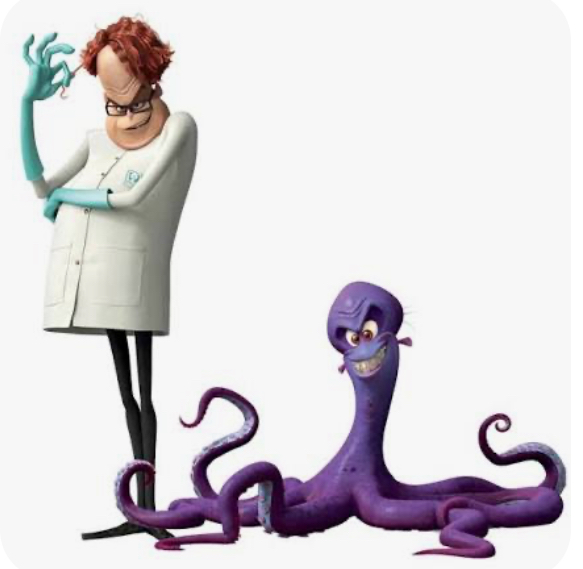
Dave the Octopus in Human and Octopus FormThe thought of humans getting traits and characteristics from other species brings interesting questions about identity and the different limits of enhancing humans. If a technology like this existed, or became legal, I would choose to be hybridized with an octopus. Octopi are known for being extremely smart and having complex nervous systems that work and function very differently from a human brain. Different research on their brain’ show that a big portion of octopus’s neurons run throughout their arms opposed to staying centralized in the brain which allows the animal to interact and respond to its environment in unique ways (Niven & Nakagawa, 2024). This intelligence challenges the idea that cognition must operate like the human mind and brain. The idea of an octopus mixing and blending into human society was kind of shown in the movie Penguins of Madagascar. The villain, Dave the octopus, disguises himself as a human scientist. This brings up a philosophical question on if having intelligence, awareness, and the ability to make decisions make you human even if you do not have a physical human body?

What Traits Would I Actually Want?

If being an octopus human hybrid were possible, I would not want to completely transform into an octopus, but have certain traits and characteristics. Something that octopus are known for is their flexibility, have many arms, problem solving, and being able to camouflage. One of the most interesting though is their problem solving abilities. Octopi are known to be able to interact with things in their environment, solve puzzles, and quickly adapt to new situations. This cognitive flexibility would be helpful for humans (Niven & Nakagawa, 2024). Their physical flexibility is also unique to them as they can move and adjust in different ways that most animals cannot. I would not want to completely give up the human body, having different octopus adaptations would be interesting. For example, having an additional hidden or retractable arm would be useful when multitasking or holding multiple things. Octopi are also able to change the color and texture of their skin to blend into their surroundings. This would not necessarily be needed for survival in a modern world, it would be a cool ability to have. Although these traits and features are cool, I would want to stay mostly human form opposed to full out unrecognizable octopus.

What Actually Makes Someone Human?

Thinking about hybridization, the question of what makes something human comes up. If a person still has consciousness, memories, and the ability to make decisions, physical changes would not completely take away their humanity. This idea is brought up in Ghost in the Shell where identity is not necessarily tied to the body but more so consciousness. Similarly in Blade Runner, replicants look human, but are treated differently and poorly because they are artificially made. Donna Haraway also brings this up in terms of breaking boundaries between humans and nonhuman in A Cyborg Manifesto. She suggests that the line between human and nonhuman is not as fixed and defined as people think (Haraway, 1985). With all of this in mind, a human octopus hybrid would challenge what it would mean to be human.

Who Would Have Access to Human Enhancement?

Another question that would be brought up is who would have access to this technology? Like a lot of new technology, rich people and powerful companies and corporations would initially have access until something new came about then it might be given to the public. New types of inequalities would be created if certain people were able to enhance their abilities. There are already physical enhancements and this already brings about different arguments and separations, but increased intelligence would be on a different level. Similar concerns appear in Blade Runner, where replicants are made with enhanced abilities but are treated as a less than despite being nearly basically identical to humans. This gives advantages in education, work, and other parts of human culture and society. There would be more debates about fairness and what is allowed. Research on animal cognition and nervous systems, such as studies on octopus intelligence, already shows how different forms of biological intelligence can function in complex ways (Niven & Nakagawa, 2024). If humans were able to gain these traits using hybridization or enhancement, more questions about fairness, access, and limits on human abilities would surface.

AI was used to help plan and edit this post. Also used to help with citations and headers and titles. https://chatgpt.com/share/69ace400-8af4-800d-b41f-689b00c9a3b2

Reference

Niven, J. E., & Nakagawa, S. (2024). The evolution of octopus intelligence and nervous system complexity. Proceedings of the Royal Society B: Biological Sciences, 291(2032). https://doi.org/10.1098/rspb.2024.1568

Haraway, D. (1985). A cyborg manifesto: Science, technology, and socialist-feminism in the late twentieth century. Socialist Review.

Raven man

- Posted in BP04 by

If a safe and reversible technology existed that could give humans animal traits, I would choose to hybridize with a raven. Ravens are known for strong intelligence and memory and that combination fits the kind of enhancement I would find most interesting. I would not want a full transformation because that would remove too much of what makes human life recognizable. Instead I would choose moderate physical and cognitive adaptations. For example I would want improved spatial awareness and long term memory similar to a raven. Physically I would accept lighter bones and stronger vision if it helped with movement and perception. I would not want wings or a completely different body plan because that would change daily life too drastically.

The main reason for choosing this level of change is that I would want to keep most of my normal human identity. For me humanity is defined more by self awareness and social responsibility than by specific physical traits. If those two things remain intact then changing the body or certain abilities would not feel like losing my humanity. This idea connects to the way Donna Haraway describes the cyborg as something that breaks boundaries between categories like human and machine. A human and animal hybrid would break a similar boundary. It would show that the line between species is not as fixed as we usually assume.

This thought experiment also connects to the replicants in Blade Runner. In that story the replicants are physically superior but they struggle with identity and belonging. My choice of limited enhancement is partly a response to that idea. If the changes became too large then society might stop viewing hybrids as human. That could create the same kind of social conflict seen in the film. Small changes would allow people to gain abilities while still remaining clearly part of the same community.

A similar issue appears in Ghost in the Shell where characters question whether consciousness or the body defines identity. If hybridization changed perception and behavior then the question would become whether the mind is still the same person. Because the technology in this scenario is reversible the risk would be lower but the philosophical question would remain.

Access to the technology would probably create major inequality. If the enhancements improved memory and perception then they could give people advantages in education and work. Wealthy groups would likely gain access first because advanced biotechnology is usually expensive at the start. That would create a divide between enhanced and non enhanced people. Over time the enhanced group might gain more economic power and political influence.

This situation already resembles current debates about enhancement technologies like genetic editing and cognitive drugs. People worry that these tools could create a society divided by ability and opportunity. A hybridization technology would push that concern even further. It could reshape how we think about the human body and personal identity while also forcing society to decide who is allowed to change themselves and who is not.

I'd Choose To Be A Falcon

- Posted in BP04 by

If Humans Could Hybridize With Animals, I’d Choose a Falcon

enter image description here

Why a Falcon?

If humans had access to a safe and reversible technology that allowed us to hybridize with animals, I would choose the characteristics of a falcon. Falcons have some of the best vision in the animal kingdom and incredible speed when diving through the air. Having those abilities would completely change the way a person experiences the world.

I wouldn’t want a full transformation into something that barely looks human. Instead, I would want moderate enhancements. For example, improved eyesight that allows me to see farther and notice small movements, faster reaction time, and maybe lighter bone structure that could allow gliding with the help of technology. These changes would improve human abilities without completely replacing what makes us human in the first place. For me, the point of hybridization wouldn’t be to abandon humanity. It would be to expand what humans are capable of doing.

What Actually Makes Someone Human?

For me, being human isn’t just about having a human body. Humanity is more about consciousness, self-awareness, and the ability to think about our actions and their impact on other people. Humans form relationships, feel empathy, and make moral decisions. If hybridization changed my body but I still had those qualities, I would still consider myself human.

This idea connects with Donna Haraway’s concept of the cyborg, which argues that the boundaries between human, machine, and even animal are not as fixed as we usually think. Haraway suggests that these categories are socially constructed and constantly changing. A human–animal hybrid would challenge the same boundaries. It would show that identity may not depend on having a purely “natural” human body.

Cyberpunk and the Question of Identity

Many of the stories we’ve studied in this course explore these same questions. In Blade Runner, the replicants are artificial beings who clearly think, feel, and experience the world like humans do. Yet society still refuses to treat them as fully human. That forces us to ask whether personhood should be defined by biology or by consciousness.

Ghost in the Shell raises a similar issue. Major Kusanagi’s body is almost entirely cybernetic, but her consciousness—the “ghost”—is what makes her who she is. The story suggests that identity is not tied to the body alone.

A human–animal hybrid would challenge society in the same way. If a person’s mind, memories, and personality stay the same, then physical changes might not matter as much as we think. These stories suggest that the definition of “human” may be more flexible than we usually assume.

Who Would Actually Have Access?

Even though this kind of technology sounds exciting, it also raises some serious social questions. The biggest one is who would actually be able to use it.

If hybridization technology were expensive, it would probably only be available to wealthy people or powerful institutions. That could create a new type of inequality where enhanced humans have physical or cognitive advantages over everyone else.

Bioethicist Julian Savulescu argues that enhancement technologies could increase inequality if they are only available to privileged groups (Savulescu, 2007). In a world like that, enhanced individuals might dominate certain professions, especially in areas like sports, military roles, or high-level jobs.

This possibility feels very similar to the futures imagined in cyberpunk stories, where technology exists but is controlled by corporations or elites.

Expanding the Idea of Humanity

A human–falcon hybrid would definitely be different from what we consider normal today. But the real question is not whether the body changes. The real question is whether the mind and identity remain the same.

Technology has already started to blur the line between human and machine, and future technologies might blur the line between species as well. Instead of destroying humanity, these changes might actually force us to rethink what humanity really means.

If consciousness, empathy, and moral awareness are what define us, then humanity might be less about biology and more about how we think and interact with the world.

References

Savulescu, J. (2007). Genetic interventions and the ethics of enhancement of human beings. Nature Reviews Genetics, 8(5), 1–7. https://doi.org/10.1038/nrg2046

Haraway, D. (1985). A cyborg manifesto: Science, technology, and socialist-feminism in the late twentieth century. Socialist Review.

AI Use Statement ChatGPT was used to help brainstorm ideas and organize the structure of this blog post.

Why I would hybridize with a butterfly

- Posted in BP04 by

If a safe and reversible technology existed that allowed humans to take on characteristics of animals, I would choose to hybridize with a butterfly. Butterflies are widely recognized as symbols of transformation, beauty, and resilience. Rather than choosing an animal known mainly for strength or speed, I would choose a butterfly because it represents personal growth and change. The process butterflies go through mirrors the way humans also grow and evolve through experiences in life. If I could adopt certain butterfly traits, the most appealing one would be the ability to fly. Having wings will provide a sense of freedom that humans normally cannot experience. Being able to fly would allow me to travel, explore nature from a new perspective, and feel less limited by physical boundaries. In addition to wings, butterflies have high sensitive sensory systems that allow them to detect, environmental cues, such as scents and changes in their surroundings. a hybrid human might gain stronger senses and greater awareness of the environment, which would be useful for both exploration and survival. Butterfly wings are also known for their vibrant colors and intricate patterns. These patterns are unique and often used for communication or protect protection through camouflage. If humans gain similar abilities, it will create a new form of self expressions. Our bodies would then be able to become canvases that reflect identity, personality, and emotion. This would blur the line between biology and art, allowing people to visually express themselves in ways that are currently impossible. even though the idea of gaining butterfly trait sounds exciting. I would still want to remain mostly human. To me, humanity is defined less by our physical form and more by our emotional and social qualities. Humans are capable of empathy, compassion, creativity, and complex relationships. These characteristic shape, our cultures, communities, and personal connections. The idea that humans can merge with non-human traits connects to ideas discussed in a cyborg manifesto. In this work, Donna Haraway argues that modern technology blurs the boundaries between humans animals and machines her concept of the cyborg challenges idea that identity must be fixed, or purely biological a butterfly hybrid would represent this blending of categories, showing that humanity might evolve alongside technology rather than remain separate from it. At the same time, maintaining human consciousness and emotional depth would be important to me. While technology might improve physical abilities, it should not erase the qualities that allow humans to connect with one another. These emotional connections, shaped families, friendships, and communities which are central parts of human life. The concept of human animal hybridization sounds exciting it would also raise serious ethical questions about access. If this technology were expensive, it might only be available to wealthy individuals or powerful institutions. This could create a new form of inequality where enhance humans have advantages over those who remain fully human. Scientific organizations, such as the natural human genome resource institute have already discussed similar concerns surrounding genetic technologies. Advances in biotechnology could greatly improve human abilities and health, but unequal access to wide and social and economic gaps. If only certain groups could afford enhancement society could become divided between enhance and non-enhance people. These concerns are also explored in science fiction such as the Blade Runner and ghost in the shell, which both examine how technology can reshape human identity and create new social divisions. These stories remind us that technology progress, often raises and important questions about ethics, power, and equality. But even with that hybridizing with a butterfly could offer incredible abilities, like flight, hide in senses and new forms of expression I would still want to keep the majority of my human identity. My humanity is defined by the ability to care about others for meaningful relationships and learning from experiences. These qualities shape who we are as individuals and as a society. In the end, the possibility of hybridization raises, important questions about identity in the future of humanity. Technology may allow humans to expand their abilities and ways we have never imagined, but the challenge will be ensuring that these advancement strengthen human values rather than replace them. A butterfly hybrid could symbolize grow growth and transformation, but it is the human qualities of empathy, connection, and understanding that should always remain at the center of who we actually are.

Reference

Haraway, D. J. (1991). A cyborg manifesto: Science, technology, and socialist-feminism in the late twentieth century. In Simians, cyborgs, and women: The reinvention of nature (pp. 149-181). Routledge. National Human Genome Research Institute. (n.d.).

Division of Genomics and Society. U.S. Department of Health and Human Services. https://www.genome.gov/about-nhgri/Division-of- Genomics-and-Society

No AI was used to generate this text

I’m Finna Tweet Out

- Posted in BP04 by

I remember in Pre-k when we had to do a presentation about our chosen bird. It didn’t take long for me to decide that I wanted to do my presentation on hummingbirds. As a child, I was under the impression that they must have loved to sing and hum, given their name, and that was something that resonated with me. Even though it wasn’t the objective of the project, I knew from a young age if I could get to be any animal I would be a hummingbird. To this day that remains true.

The Flying Jewels Or Should I Say Jules?

Humming birds happen to be the smallest of migratory birds, known for their impressive wing fluttering and polychromatic color scheme. Humming birds are often referred to as the flying jewels of the world due to their vibrant plumage that tends to sparkle like gems when refracting light. But a beautiful appearance is not the only thing the humming bird has to offer. Hummingbirds are some of the most efficient pollinators in the world, meaning if they were to be removed from their habitat, it would suffer immensely. Although they can be quite small in size, weighing less than a nickel, their might is not to be questioned. However, even beyond their physical capabilities, hummingbirds mean so much symbolically, representing joy, energy, and resilience. It is believed that they can represent positive transformation, overcoming obstacles, romance, and even be spiritual signs from those you love that have passed away.

It’s A Bird… It’s A Plane… It’s A Girl With Feathers…?

When I think about how far I would go with merging with a hummingbird, I feel like there are two ways it could go. On one hand I could see a more simple modification, like the addition of bionic wings that fuse to nerve endings in the spinal cord or something. I think that would be the least complex merge, still maintaining the physical human body simply with enhancements. On the other hand, I could also see the development of technology that turns you into your animal of choice, maybe through a serum, but ultimately the anatomical structure of the human body would be transformed into that of a hummingbird, in my case. However, even though the body would change, I would still maintain my own consciousness and spirit. Furthermore there could be a counter serum that could change one back into their human form.

With that said, I don’t think either option would truly hinder one’s humanity. Granted, I find humanity to be defined beyond the body and more so within someone’s morality, consciousness, and soul. I don’t think that technological advancements or enhancements would inherently remove or damage someone’s humanness. But, everyone is different and it is easy for some to get lost in constantly enhancing themselves until they lose who they are. That stands true even in our own society. So while I don’t think humanity would be lost, I do believe that there is something to gain from merging with the hummingbird, whether it be with option one or two. Either way I would be able to fly, which now that I think about it, I probably wouldn’t fly that much because I’m afraid of heights. But I guess that poses the question of whether or not merging with the hummingbird would erase my fear and replace it with the bird’s natural instinct to fly. I think this particular aspect reminds me most of Haraway’s cyborg manifesto in which she champions the hybrid organism that is a blend of physical traits but the culture or mannerisms of two organisms.

Eeeny Meeny Miny Moe

In a perfect world, everyone would have equal access to the proposed technology that would allow one to merge with their favorite animal. But if taking into consideration both the real world and the dynamics present within most cyberpunk works, it is not far-fetched to say that the technology would be monopolized. It would be yet another example of high tech-low life, in which mega corporations and large wealthy families would abuse resources to produce the technology as they see fit, and distribute said technology to whom they see fit. It is possible that this could produce an unfair power dynamic between regular humans and those who are hybridized. On one end, those who have access to merging with animals could come to make up the upper class of society being afforded immense privileges while non-hybridized human beings make up the lower working class. On the other end the situation could be flipped, those in power might see an opportunity in merging human beings with animals, focusing only on the heightened abilities it might produce. They could then decide to hybridize people against their will in order to make up an enhanced work force. Ultimately the working class could end up being subjected to extremely harsh conditions that divide them from the rest of humanity. Both of which are narratives that happen often in cyberpunk genres.

All of that makes me question whether or not something like this should be possible. Granted I’m not sure if we would ever be able to develop the extensive technology necessary to merge human beings with animals, but even if we could it doesn’t necessarily mean that we should. If such a feat would not be easily accessible to everyone and would incite more violence, division, and recklessness within society, I don’t think that the possibility would be worth it. Sigh… I guess that means I won’t be a hummingbird any time soon.

*AI was not used in any way to generate this post. This includes structure, format, ideas, and source research.

References:

Smithsonian (2018). Hummingbirds. Smithsonian’s National Zoo. https://nationalzoo.si.edu/migratory-birds/hummingbirds

Haraway, D. (1985) A cyborg manifesto. Science, Technology, and Socialist- Feminism in the Late Twentieth Century. Socialist Review https://www.sfu.ca/~decaste/OISE/page2/files/HarawayCyborg.pdf

Redefining Humanity Through Human Hybridization

- Posted in BP04 by

As the future of technology advances toward unimaginable depths, the idea of human innovation through reversible animal adaptations has led to a rethinking of humanity. If this procedure were possible, people could temporarily gain key senses and characteristics of animals—keen sight, swift movements, cunning, and cognitive decision making. Utilizing key themes in major cyberpunk science fiction, this transition raises distinct questions about identity, humanity, and morality.

If I had a choice, I would hybridize with a very intelligent bird like a raven or crow. According to the Cornell Lab of Ornithology, crows and ravens are capable of recognizing human faces, remembering threats, and using tools to solve problems. Beyond their survival qualities, they are very swift and adaptable animals that use their wings and small frames to navigate the world and build a community for their family and clan. Because of these abilities, hybridizing with a highly intelligent bird would offer both cognitive and sensory advantages while still allowing me to remain mostly human.

Even if I were to combine with any animal, it is very important that the changes to my human body are minor or moderate so that I may retain mainly human qualities about myself. More specific qualities that led to my choice of a bird would be their heightened vision. As a perpetual and avid glasses wearer/enjoyer, I will admit that the tasks of having to put on a tool every morning so that I may survive in this world is not as advantageous as you may think… To be able to wake up and see with a higher sharpness and to process the visual stimuli that I receive would lead to an overall better way of life. Using the Cornell Lab of Ornithology, they mention that birds rely heavily on their vision for locating food, shelter, and for spatial analysis when recognizing their environments. The lab mentions that certain birds demonstrate remarkable long-term memory and spatial awareness. These traits could enhance human learning and problem-solving without completely changing human identity.

Cyberpunk Theory in Literature

Drawing back to the cyberpunk theory of Donna Haraway’s A Cyborg Manifesto, she challenges the Western traditions of “Human vs Machine.” Haraway describes these dissolving boundaries as “leaky distinctions” that clearly blur the line between the physical real and the non-physical machine. The idea can be translated to all things “non-human” as we begin to redefine what is defined as an “animal” and what is a “human.” Whatever the physical outcome of the hybridization between the two would be a phenomenon not yet recorded in history that would reshape the way we approach biology, culture, and society.

Moreover, using cyberpunk fiction like Blade Runner and Ghost in the Shell, the context for humanity can be seen as being redefined in both pieces of literature. In Blade Runner, the replicant characters emulate humanity so well that their existence begins to challenge what is human and what is not. Their ability to experience human qualities such as emotion, memory, and empathy reflects their parallel to humanity. To add on, Ghost in the Shell points out themes that make the audience ponder whether or not the replacement of the physical body by something inhuman changes a person’s identity. Though the “shell” may be replaced, the person—referred to as the ghost—remains as the true identifier of an individual.

The Effects of Hybridization in Society

As we have debated in every advancement in human history, we must discuss the effects of hybridization in the context of our world, plagued with inequality, and its ethical implications in our society. Emerging advancements come with a cost, and the question of affordability and access to larger populations would be an important factor. With the high expense of the procedure, this innovation would only be a possibility for a small portion of the world that may lead to some social and biological disadvantages. With this, you may see discrimination against those who cannot afford the hybridization. The segregation and emergence of the enhanced and the un-enhanced as a label for those with the change can lead to a new identifier of organisms.

Because of this, the biggest challenge may not be the technology itself but how society chooses to regulate and distribute it. Without ethical guidelines, enhancements designed to improve human life could instead reinforce existing inequalities.

Rethinking Humanity with Hybridization

Ultimately, the possibility of human and animal hybridization will force us to redefine what makes humans human. If bodies can be enhanced and modified with other species, then already established biological boundaries alone cannot determine who we are.

We may need to evolve and rethink the capacity for humanity as certain traits of self-awareness, empathy, and ethical accountability. Using cyborg theory, technological change will continue to blur the lines between the lines we once believed were fixed. Like most adaptations to our world, the real question is not whether these boundaries will change, but how we will respond when they do.

References

Cornell Lab of Ornithology. (2020). Crows and ravens: Family Corvidae. Cornell University. https://www.allaboutbirds.org

Haraway, D. (1985). A cyborg manifesto: Science, technology, and socialist-feminism in the late twentieth century.

AI Disclosure Statement

AI was used to assist with proofreading, correcting grammar, identifying minor spelling errors, and formatting references. The final ideas and content were written and reviewed by the author.

Why Would You be a Pig?

- Posted in BP04 by

Rethinking Intelligence: Why Pigs?

After researching “Smartest Animals,” I came across one that I did not expect: pigs. As I continued to read, I found that, apart from the slaughter farms that we are used to seeing them in, they are quite intelligent. So, when asked what animal that I would hybridize with, I would choose a pig. I feel that they are misunderstood due to the environment that they are often placed in, which I identify heavily with since I am Black and a woman.

Now, if I could hybridize with a pig, I would stop at cognitive adaptations because the lifestyle that they have to live is not great. They are placed in crowded, unclean conditions so they can be used for our own pleasure. They aren’t given the opportunity to reach their full potential because their place in life has already been determined. Regarding their cognitive state, they have great memory, are socially and emotionally aware, and have intelligence that outranks some animals that we consider to be the smartest. Even though I have these traits as a person, it interests me that pigs have all these traits as well and no one ever talks about them. They are only known for being stupid, lazy, and unclean, but none of these things are true. I think this is why I identify with them so much, because when the world stereotypes me as a Black woman, it is never to show my full potential, only to degrade me and put me in a box.

Humanity, Identity, and the Limits of Hybridization

I also would only go as far as cognitive hybridization because I think any further combining would leave me with less humanity. As I would change physically and behaviorally, other people would stop seeing me as a human. While I believe every living thing has purpose and is important, to be viewed as human there are certain traits I must maintain, like a resemblance to humans physically and behaviorally. I think humanity is heavily related to the way we think, reason, feel, and look. If I become too much like a pig, I would lose a lot of these traits that connect me to humanity.

When considering a technology like this, I see the greatest connection to Donna Haraway’s idea of the cyborg. The cyborg breaks the binary boundaries that are set by society by being part human and part machine. It takes the hierarchical nature of the binaries away because it is not choosing to be one or the other; it is both and neither—it is something brand new. The binary between humans and animals places humans higher on the hierarchical scale. With a technology like this, it allows for humans to merge with animals, thus breaking that binary. While this could be a good thing, there could be a host of issues that occur due to its implementation.

Inequality and Ethical Questions of Hybrid Technology

While I think everyone should have access to this technology, realistically, it will only be available to the wealthy given the cost of something like this. People who are poor may be stuck like those in Neuromancer who began to get unsafe operations to upgrade in order to survive. Since people will begin to use this technology to possibly get the speed of a cheetah or the strength of a gorilla, those who cannot afford the best will have to do their best to keep up. Those who were able to afford the better operation will likely develop some sort of superiority over those who could not, which can create a similar division to that of the wealthy and the poor now. This thought experiment forced me to see many things that I had not considered. Introducing a technology like this could be helpful and initiate great scientific innovations. However, like all other things, there will be good and bad, as well as many ethical, legal, and moral questions raised. How would our rights change? Who would benefit from the new systems created? I think these questions, and many others, should be considered if this type of technology was developed.

AI Attestation: AI was used to edit the grammar of the final draft and create headings.

Life as an Elephant

- Posted in BP04 by

A HUMAN-ELEPHANT REALITY

If I were to reimagine society in a way where humans and animals were hybridized, and technology was used to transfer animal characteristics, I would choose an elephant. I would choose elephants because they are commonly recognized for their memory, emotional intelligence, and strong social bonds. For obvious reasons, I would avoid transferring elephants' physical characteristics and focus mostly on cognitive and behavioral changes. I would /have abilities while maintaining my basic human form. According to elephant cognition researcher Joshua Plotnik, elephants demonstrate complex problem-solving skills, empathy, and self-recognition in mirror tests, traits often associated with advanced intelligence (Plotnik, de Waal, & Reiss, 2006). These cognitive traits could deepen rather than diminish the human experience.

DEFINING HUMANITY

The occurrence of this hybridization will raise questions about what crosses the boundary of completely losing humanity. We must define what humanity actually is. Humanity is defined less by our physical form and more by our consciousness, empathy, and moral reasoning. This relates closely with Donna Haraway’s cyborg theory, which challenges the strict boundaries between human, machine, and animal. Haraway argues that modern technology has already blurred these lines, making hybrid identities increasingly common. In this sense, an elephant-human hybrid would simply extend a process that has already begun through genetic engineering and digital technology.

DISPARITIES IN THIS REALITY

This hybrid technology can cause disparities in our society. Access to this new technology would likely depend on wealth, displacement, and political power. Only certain groups of people could access and seek the benefits. These people are going to gain advantages in aspects of life such as health, education, and work. This can cause issues and create a divide between “enhanced” and “unenhanced” humans. If elephant-like memory or emotional intelligence became available enhancements, societies would have to decide whether such changes should be regulated, limited, or widely distributed.

REANALYSING BOUNDARIES OF HUMANITY

Hybridizing with an elephant would represent an attempt not to abandon humanity but to expand it. The goal would be to enhance qualities humans already possess. At the same time, the possibility of hybridization would challenge long-standing assumptions about what it means to be human. Just as cyborgs, replicants, and cybernetic consciousness question the boundaries between human and machine in our course texts, animal and human hybrids would blur the boundary between human and animal. In doing so, they might reveal that humanity is not a fixed biological category but an evolving identity shaped by technology, ethics, and culture.

The idea of a human and elephant hybrid is not simply a fantastical thought experiment; it is a lens through which we can examine the deepest questions about human identity. Drawing on Haraway's cyborg theory, the boundaries between human, animal, and machine have never been as stable as we once believed, and technology, ethics, and culture continuously reshape what it means to be human. Rather than fearing this evolution, we might embrace it as an opportunity to become more empathetic, more connected, and more conscious, not less human, but more fully so.

AI Use Statement

This blog post was developed with assistance from ChatGPT to help organize ideas, refine writing structure, and generate headings. I reviewed, edited, and approved all content to ensure it accurately reflects their own ideas and interpretations

References

Bostrom, N. (2005). In defense of posthuman dignity. Bioethics, 19(3), 202–214. https://doi.org/10.1111/j.1467-8519.2005.00437.x

enter image description here

Page 4 of 6