Corporate Power in Cyberpunk
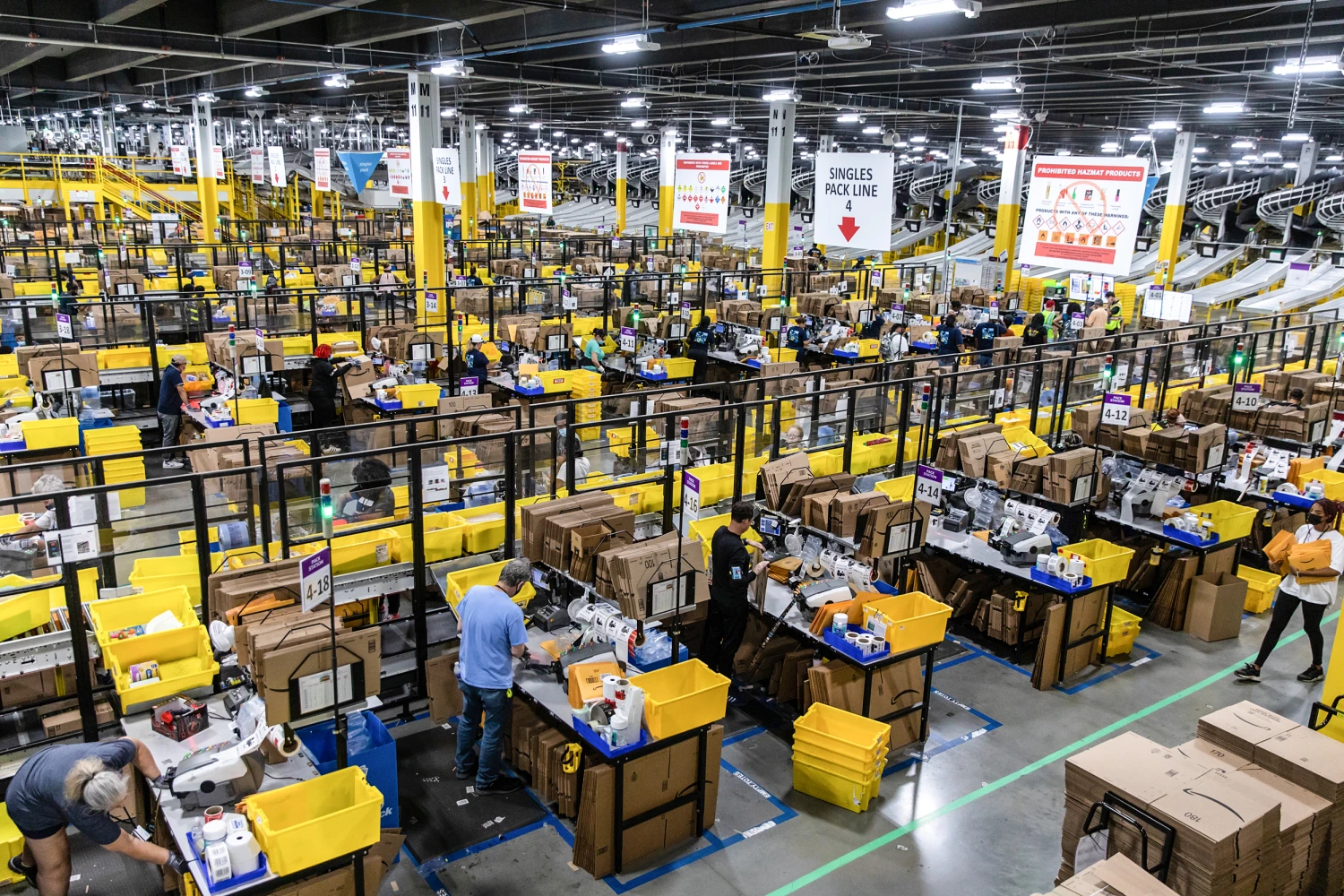
The subgenre of Cyberpunk fiction has reimagined a possible future for our society. We see human life redefined by rapid technological advancements that join many other systemic issues, even amplifying them. Specifically, the exploitation of workers by corporations has become a central topic of discussion, as profit is often prioritized over human well-being. In these cyberpunk works, we see corporations controlling the labor of their workers and the conditions of everyday life in the name of technology. Real-world corporations such as Amazon resemble cyberpunk corporations through surveillance, labor control, and data-based exploitation, suggesting that while we are not fully in a cyberpunk dystopia, we are moving toward a system where corporate power increasingly resembles it, especially within digital capitalism.
Drawing on the works of Karl Marx, we identify the concept of alienated labor, in which workers become separated from the product of labor and from the act of labor itself. In Amazon’s case, workers have limited autonomy over their tasks, while being monitored by cameras and supervisors who will score them on their productivity (Ghaffary & Chandra, Vox, 2020). Digital capitalism has led to the ability to quantify productivity and allow workers to be penalized or fired for not obtaining quotas outlined by data analytics. As a result, the quantification of human labor by digital metrics now includes a psychological demand, as constant monitoring reduces autonomy and increases pressures to meet needs that are not human.
Using examples from cyberpunk narratives, Blade Runner’s Tyrell Corporation forces control over replicant life forms while prioritizing profit over ethical obligations, and in Neuromancer, Tessier-Ashpool S.A. represents corporations that operate beyond traditional economic and governmental powers. All of these examples mirror Amazon, where workers have raised concerns about physically demanding conditions, including standing for long hours without breaks and experiencing repetitive motion injuries. Paired with the ongoing debate for fairer wages, these factors contribute to an environment in which workers are being exploited, while their compensation is arguably not sufficient (New York Times, 2021). Reflecting on the boundaries between humans and technology, the integration of surveillance systems, data analytics, and performance metrics illustrates how technological advancement can intensify existing power structures rather than eliminate them. The similarities between the fictional businesses of cyberpunk literature and the modern workplace fortify that corporate dominance is not unusual in Western powers, especially the United States of America.
To continue, large corporations shape the democratic process through lobbying and participating in political matters. Amazon has invested heavily in lobbying efforts in the United States, spending millions of dollars annually to influence legislation related to taxation, labor laws, and antitrust regulation (OpenSecrets, 2023). These corporations can not only actively shape the economic outcomes in the market by funneling their financial resources to influence policy and align with their agenda. Moreover, research on political economy shows that economic elites often have disproportionate influence on policymaking through networks, access, and lobbying, rather than formal governmental roles (Gilens & Page, 2014). By concentrating democratic influence on a select few, policymaking can be influenced towards the benefit of the advantaged, which means someone is being more disadvantaged. The conversation gets more interesting as we evaluate figures such as Elon Musk, who has been recognized in public policy forums and as the former Senior Advisor to the President of the United States under the Trump Administration. Research on wealth and political influence has shown that economic elites and organized interest groups often have a substantial impact on public policy in the United States (Gilens & Page, 2014). Though not an official, Musk’s ability to surpass qualified individuals to assume the government title, thus influence, strengthens the argument that democratic power has a preference for high-income individuals and corporations.
These developments raise the question of whether such patterns are uniquely American. While corporate political influence exists globally, the United States is a supergiant in the corporate world and is known for its campaign finance system, deep lobbying industry, and the magnitude of its free-enterprise economic involvement in policymaking. Studies of comparative political systems suggest that regulatory frameworks in other countries can place stronger limits on corporate participation in politics, though globalization and digital markets increasingly allow corporations to operate across national boundaries and influence multiple regions simultaneously (Gilens & Page, 2014). So, as a country, we are not fully a dystopian cyberpunk-like system but rather are gradually shifting towards that as our reality. Ultimately, cyberpunk offers a lens on the struggle between the power of corporations and democratic oversight, and human exploitation. Though it has not reached the level of Neuromancer or Blade Runner, we can see workers are experiencing similar exploitative levels as seen by the Amazon company, and corporate elitism has an influence in political policy.
References Gilens, M., & Page, B. I. (2014). Testing theories of American politics: Elites, interest groups, and average citizens. Perspectives on Politics, 12(3), 564–581. https://doi.org/10.1017/S1537592714001595
Ghaffary, S., & Chandra, S. (2020). Amazon workers describe difficult conditions and strict productivity monitoring. Vox. https://www.vox.com
NBC News. (2021, August 1). Amazon now employs almost 1 million people in the U.S. https://www.nbcnews.com/business/business-news/amazon-now-employs-almost-1-million-people-u-s-or-n1275539
OpenSecrets. (2023). Amazon lobbying spending. https://www.opensecrets.org
The New York Times. (2021). [Article on Amazon workers and working conditions] https://www.nytimes.com
AI was used only to format references.