Which Animal Would I Select?
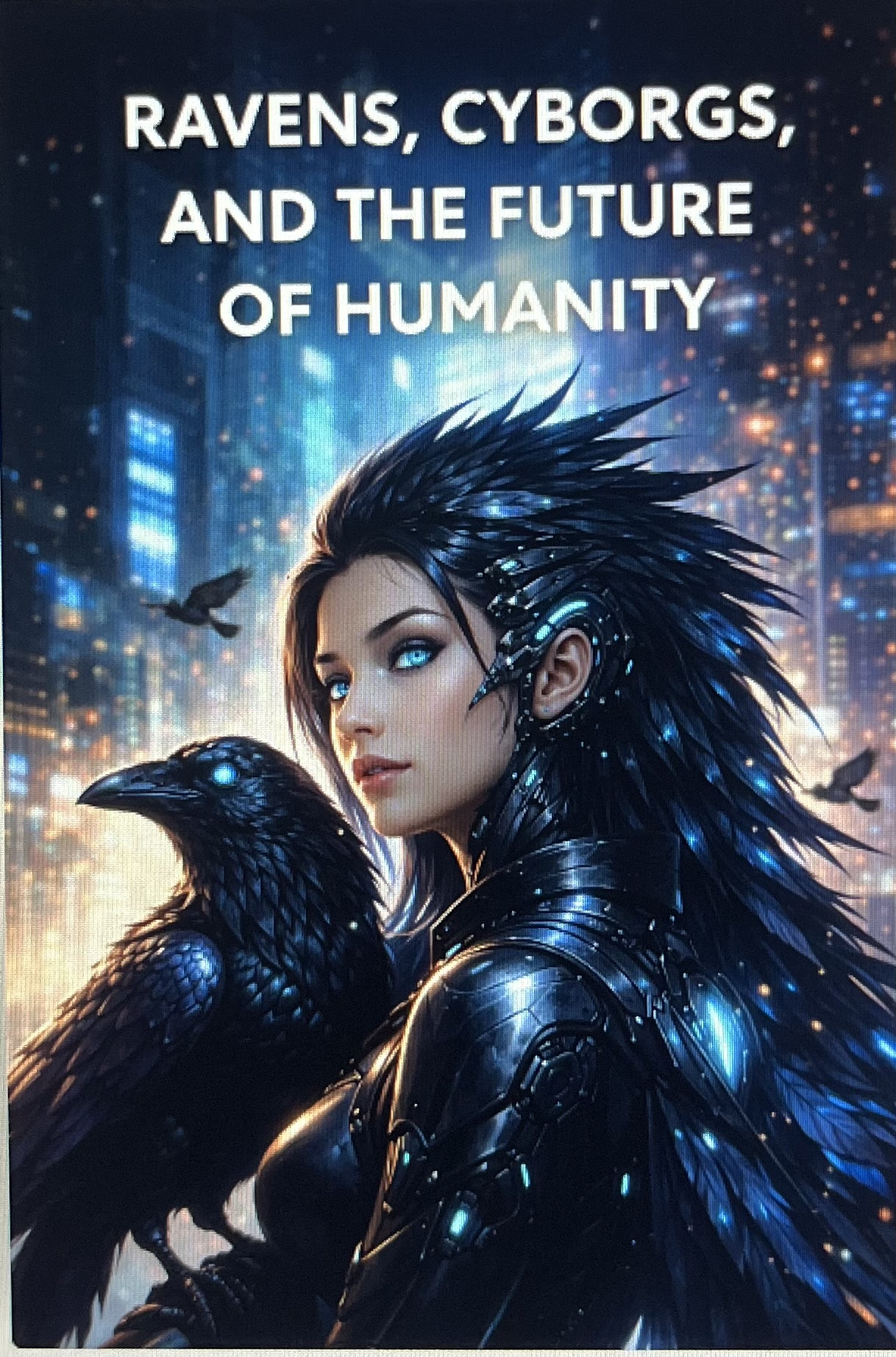
I believe I would prefer to hybridize with a raven if there were a safe and reversible technique that enabled people to adopt animal traits. Ravens are highly clever birds. They can solve issues, retain complicated knowledge, and even make plans. In a study published in the journal Science, cognitive scientists Can Kabadayi and Mathias Osvath (2017) have discovered that ravens can make plans for future occurrences, demonstrating a degree of reasoning that was previously believed to be exclusive to humans.
I wouldn't want to completely change into something that hardly resembles a person. Rather, I would go for little raven-inspired cognitive changes. For instance, it would be helpful in daily life to have a better memory, be more aware of my surroundings, and be able to solve problems more quickly. Additionally, I would tolerate minor physical enhancements like improved vision or faster reflexes, but I wouldn't desire drastic modifications like wings or feathers. In my opinion, the goal should be to improve rather than totally replace what people are now.
What Defines Humanity?
As I think about this idea, I find myself asking more deeply: what truly makes someone human? In my view, humanity is more than just the body we are born with. It depends more on qualities like self-awareness, empathy, creativity, and moral judgment. Even if I had some animal traits, I would still feel human if those qualities stayed the same. This is shown in the article titled “Ravens are better at planning than four-year-olds,” which mentioned that ravens sometimes perform planning tasks as well as or better than 4-year-olds.
Feminist theorist Donna Haraway (1985), in her influential essay “A Cyborg Manifesto,” argues that it is difficult to distinguish between people, animals, and machines. According to Haraway, biology and technology are already combined in many aspects of contemporary life, including prostheses, artificial organs, and medical implants. As a result, the idea of a hybrid person is not as implausible as it may appear. Rather, it questions conventional notions of what it is to be human.
Similar queries can also be seen in the cyberpunk film Blade Runner (1982). Although the replicants in the film appear human and even exhibit emotions, society views them as less than human. This begs the question of whether awareness and experience or biology are the sources of humanity. The characters in Ghost in the Shell debate whether identity is derived from the intellect or the body. Even if a person's body changes, are they still the same person if their memories and awareness remain the same?
The same types of issues would be raised by human-animal hybrids. I would still classify someone as human if they acquired animal talents but retained human feelings, values, and thinking.
Who Would Have Access?
The technology would likely lead to significant disparities even if it were safe. Since new technologies are typically costly, only affluent individuals or powerful nations may have access to them. This also leads to a division between social groups that may widen further if some individuals can improve their physical, mental, or memory skills while others are not. Improved people may benefit in leadership, education, and employment. Society may eventually begin to split between those who are improved and those who are not.
Human enhancement technologies already create questions about societal pressure and fairness, according to bioethicist Julian Savulescu (Savulescu, 2007). People may feel compelled to make improvements if they become widespread to stay competitive. What begins as a decision may gradually turn into an expectation.
Humanity Future
Human-animal hybrid technology would bring humanity closer to what many scholars refer to as a posthuman future, in which the boundaries of the human body and mind are no longer set. But I don't think this would inevitably mean the end of mankind. Rather, it could only make us reconsider how we define it.
Gaining new skills could increase human potential rather than eliminate it if individuals retain essential human traits like empathy, awareness, and moral responsibility. The greatest obstacle would not be the technology in such, but rather how society decides to control and disseminate it.
The greatest obstacle would not be the technology per se, but rather how society chooses to utilize it and who has access to it. The true question is not whether we can alter humanity, but rather whether we can do it fairly and responsibly, much like the cyborgs, replicants, and augmented people we find in cyberpunk fiction.
References
Kabadayi, C., & Osvath, M. (2017). Ravens parallel great apes in flexible planning for tool-use and bartering. Science, 357(6347), 202–204. https://doi.org/10.1126/science.aam8138
Jasiunas, L. (2018). Ravens are better at planning than four-year-olds. Faunalytics. https://faunalytics.org/ravens-better-planning-4-year-olds/
Donna Haraway (1985). A manifesto for cyborgs: Science, technology, and socialist feminism in the 1980s. Socialist Review, 80, 65–108.
Blade Runner. (1982). Directed by Ridley Scott. Warner Bros.
Ghost in the Shell. (1995). Directed by Mamoru Oshii. Production I.G.
AI Attestation: ChatGPT was used to develop topics for the different blog sections, along with an image creation