Is this real? When the internet crossed the human–machine line

- Posted in BP01 by

One of the biggest themes in cyberpunk is the collapse of the boundary between the human and the non-human. In the past five years, this has moved from science fiction to our daily lives. Specifically, the boundary between real human performance and AI-generated media has almost disappeared.

When AI Feels Real

You are scrolling through TikTok late at night when a video stops you. A person is talking directly to the camera, smiling and telling a story. Their voices sound natural. Their faces look real. But something feels weird. You pause and read the comments, and someone writes, “This is AI.” Suddenly, the video looks different. What you thought was a human is actually a machine. Moments like this are becoming normal, at least for me, since this is something that happens a lot to me. These moments make clear that the boundary between human and machine is collapsing in front of us.

The Rise of AI-Generated Media

Artificial intelligence can now generate realistic faces, voices, and videos that are almost impossible to distinguish from real people. Five years ago this would have never been possible. Technology has been used to create fake celebrity videos, AI voice tools can copy someone’s voice in seconds, and some TikTok accounts are run entirely by AI-generated influencers. AI video generators are improving so quickly that even experts sometimes struggle to identify what is real and what is artificial. The internet has become a space where human presence is no longer guaranteed.

Why is this happening?

This shift is the result of multiple forces working together. Technologically, AI systems have become better at learning patterns of human behavior, language, and also emotion. This reminds me of Ada Lovelace’s idea that machines could manipulate symbols beyond numbers, including images, music, and language. What she imagined can now be seen on our screens. Additionally, platforms like TikTok and Instagram reward content that catches attention quickly, regardless of whether it is human-made or AI-generated, which makes it very attractive to most people.

Who benefits and who is impacted?

However, this new reality benefits some groups more than others. Tech companies profit from AI tools, influencers use them to increase output, and governments can use them for messaging and control. At the same time, artists lose ownership of their work, viewers lose trust in what they see, and society loses a shared sense of truth. The spread of "deepfakes" makes it harder for citizens to distinguish between real news and computer-generated lies (Simonite, 2019). It becomes easier to spread false information and more difficult to hold people accountable when we can no longer trust faces, voices, or videos. As a society, we have to think about what it means to be human in the digital age if we are unable to tell the difference between AI and actual people online. Considering how well machines can imitate people, how should we assess trust and creativity?

This shows that the rise of AI is not just a technology problem, but it also changes how we see people and truth online. When machines can copy humans so well, it becomes harder to know what is real. We need to think carefully about trust, creativity, and what it means to be human.

AI Attestation: I attest that I did not use AI for this discussion assignment.

Sources

Simonite, T. (2019, October 6). Prepare for the Deepfake Era of Web Video. Wired. https://www.wired.com/story/prepare-deepfake-era-web-video/

Who Are You?

- Posted in BP01 by

The Collapse

The sense of being.

One boundary that has shifted dramatically in the last five years is the boundary between the self.

That’s a broad claim, I know. Let me explain.

The Erosion of Self

As the world leans further into global media, constant connectivity, algorithmic identity, and hyper-consumerism, our sense of self has started to thin out. Cyberpunk stories obsess over the blur between biological existence and computer simulation, and that obsession feels less speculative every year. People are increasingly unsure what it means to simply exist outside of systems, screens, and feedback loops.

To live. To experience. To be you.

Play “I Gotta Feeling” by the Black Eyed Peas.

Okay—back to it.

The Posthuman Argument

Scholar N. Katherine Hayles describes the posthuman perspective like this: there is no essential difference between biological existence and computer simulation, or between a human being and an intelligent machine. Both are just different media for processing and storing information. If information is the essence, then bodies are merely interchangeable substrates.

That’s the theory.

I disagree.

Why It Matters

I think there is an essential difference.

Humans are not just operating systems with skin. Yes, our bodies rely on brains, and brains process information—but reducing us to that strips something vital away. This perspective leaves no room for spirit, soul, or embodied meaning.

We are not just consciousness floating through hardware. We are integrations of culture, ancestry, memory, movement, and feeling. We carry history in our bodies.

The Difference

Let’s pause for a moment and talk about something simple: the difference between being smart and having wisdom.

A quick Google definition: Smart means quick-witted intelligence—or, in the case of a device, being programmed to act independently. Wisdom is the ability to apply knowledge, experience, and judgment to navigate life’s complexity.

Now connect that back to this conversation.

Someone—or something—can be incredibly intelligent and still lack wisdom. Without lived experience, discernment, struggle, and context, where does that intelligence actually place you? Who are you without trials, without contradiction, without growth?

Blurred Lines

That lived interiority—existing within ourselves—is what keeps the blurred line between human and machine from fully disappearing.

Some people see that line and keep attempting to erase it anyway. When we start viewing “the mind as software to be upgraded and the body as hardware to be replaced,” those metaphors don’t stay abstract. They shape real decisions about what technologies get built and who they’re built for. Too often, they’re designed to reflect a narrow set of bodies, values, and experiences—creating mimics of humanity rather than serving humanity as a whole.

And yes, that’s where the boundary truly blurs.

But even here, there’s a choice.

As Norbert Wiener warned, the challenge isn’t innovation itself—it’s whether that innovation is guided by a benign social philosophy. One that prioritizes human flourishing. One that preserves dignity. One that serves genuinely humane ends.

Think About It

So I’ll leave you with this.

Continue to be you. Be human. Have a soul. Be kind. Be compassionate. Smile on the good days—and the bad ones. Love.

And I’ll end with a question that sounds simple, but never is:

Who are you?

Sources

Wikimedia Foundation. (2026, January 7). Wisdom. Wikipedia. https://en.wikipedia.org/wiki/Wisdom#:~:text=Wisdom%2C%20also%20known%20as%20sapience,and%20ethics%20in%20decision%2Dmaking.

Oxford languages and Google - English: Oxford languages. Oxford Languages and Google - English | Oxford Languages. (n.d.). https://languages.oup.com/google-dictionary-en

Hayles, N. K. (1999). How we became posthuman: Virtual bodies in cybernetics, literature, and Informatics. University of Chicago Press.
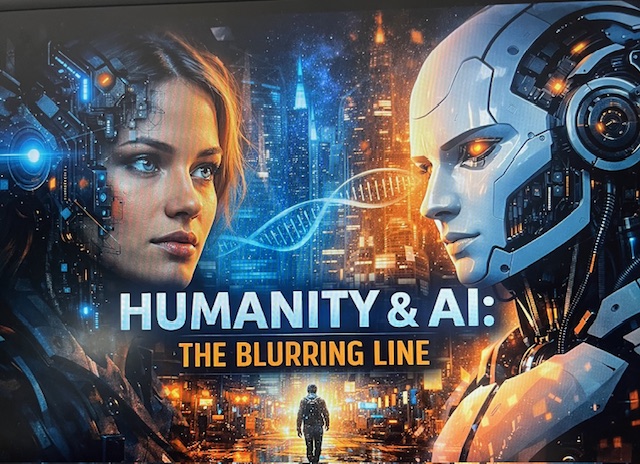
Humanity and AI: The Blurring Line

- Posted in BP01 by

enter image description here Intelligence seemed to be exclusively human for most of human history. While machines could compute, store data, and obey commands, thinking and creativity were thought to be exclusively human qualities. That barrier doesn't feel steady anymore. These days, artificial intelligence can write, create graphics, help with diagnosis, and have human-like conversations. The distinction between human and machine intellect, which we formerly took for granted, is what has changed, not simply technology.
The Unevenly Arrival

Cyberpunk has long highlighted instances in which cutting-edge technology interferes with daily life. The genre depicts how the future arrives unevenly, smashing into the present and altering societal institutions, rather than envisioning a far-off future. This identical cyberpunk trend is reflected in the development of AI. It symbolizes the blurring of lines between creation and automation, person and machine, and mind and system. An example of this is shown in the film entitled "Blade Runner: The Final Cut."

Artificial Intelligence in Everyday Life

This change may be seen in many aspects of daily life. AI technologies help with research, editing, and brainstorming in the classroom. Algorithms are used in the workplace to track productivity and filter job applications. AI systems are employed in healthcare to support diagnostic decisions and preserve patient data. Creative industries are also changing as AI-generated music, literature, and visuals become increasingly competitive with human-made work. Instead of being limited to humans, intelligence is now deeply embedded in global technology networks.

Power and Inequality

Technology often refers to this situation as "high-tech, low-life," which is defined in the novel entitled “Neuromancer” as cyberpunk. This is where state-of-the-art technology coexists with inequality and insecurity. AI fits this pattern well. While speed and efficiency benefit companies and organizations, many workers risk losing their jobs, being observed, or having their skills diminished. Due to the fact that these systems are often owned and controlled by a few large companies, there are questions about who benefits most from this technological shift and who bears the risks.

Posthumanism

Furthermore, the posthumanism ideas discussed in class are related to this boundary collapse. Posthumanism argues that human-machine interactions change identity and cognition, challenging the notion that humans and technology are separate. When AI assists with writing, reasoning, and decision-making, intelligence becomes shared rather than exclusive to humans. Cyberpunk often depicts the body as an interface, but AI now functions as a cognitive interface, altering our mental processes without physically merging with us.

Risks and Bias

There are big risks that come with these changes. AI systems can spread false information, copy bias, and create what some people call "bullshit at scale," which means outputs that are confident but don't make sense. These problems get worse with globalization because AI models are trained on huge amounts of data from people all over the world, sometimes without their knowledge or consent. Cyberpunk's worry about unbridled corporate power and lax accountability is echoed by the fact that decisions made by a tiny number of firms may have an influence on workers, schools, and cultures worldwide.

Cyberpunk Warning

In cyberpunk, straightforward solutions are uncommon, and this uncertainty is reflected in the rise of AI. While technology is undeniably remarkable, it also challenges long-held notions of responsibility, intelligence, and creativity. When Roy Batty says, "I've seen things you people wouldn't believe," he is speaking from a world where boundaries have already collapsed. That sentence now seems less like fiction and more like a warning. Rather than whether technology will alter what it means to think, the question at hand is whether humans will still oversee the use of AI.

Citations:

Gibson, W. (1984). Neuromancer. Ace Books. Scott, R. (Director). (1982). Blade Runner: The Final Cut [Film]. Warner Home Video. Swank DigitalCampus.https://digitalcampus.swankmp.net/xula393246/watch/C9BD78E96D3A71E0

ChatGPT was used to generate the image used in this blog.

Blog Post #1.When Technology judges the Game/Soccer

- Posted in BP01 by

In the past five years, one clear boundary that has changed a lot is who makes decisions in soccer. With the use of VAR (Video Assistant Referee), the boundary between human judgment and technological judgment has become unclear.

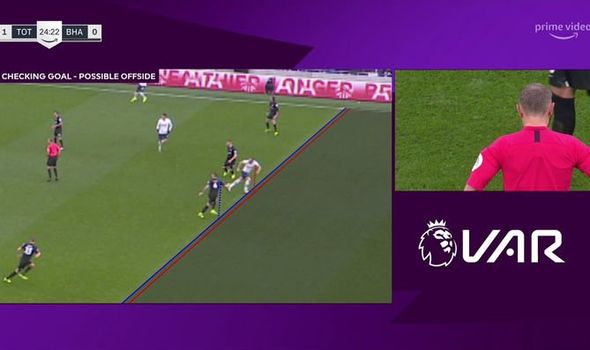
Before VAR, referees made decisions only with their own eyes and experience. Mistakes were part of the game. Fans accepted that referees are human. Today, VAR uses cameras, slow motion, and digital lines to review goals, penalties, offsides, and red cards. In many situations, the referee no longer has the final word alone. Technology now helps or sometimes corrects the referee.VAR has been used more widely since around 2018, but in the last five years it has become normal in major leagues like the Premier League, La Liga, Serie A, and international tournaments such as the World Cup. According to FIFA, VAR was created to reduce clear and obvious errors in important moments of the game. This shows a big change in how fairness is defined in soccer. enter image description here

This boundary shift is driven mainly by technology and globalization. Soccer is now a global business. Matches are watched by millions of people around the world. Every mistake is shared on social media in seconds. Because of this pressure, leagues want more “objective” decisions. Technology promises accuracy and fairness, even if it slows the game.

This change connects clearly to cyberpunk themes. In cyberpunk stories, technology is often used to control systems and reduce human error, but it also creates new problems. VAR was created to make soccer more fair, but many fans feel it takes away emotion and spontaneity. Goals are celebrated, then canceled. Players wait while machines check lines that are invisible to the human eye. The game feels less human.VAR also connects to posthumanism, which questions where human control ends and machine control begins. When a computer draws offside lines and decides if a player’s toe is ahead, is that still human judgment? Or is the machine now the authority? Referees often say they must follow VAR, even if their original decision felt right.
enter image description here

As someone who watches a lot of soccer games, I experience this boundary shift very personally. Many times, I celebrate a goal, and a few seconds later the game stops because VAR is checking the play. Sometimes the technology decides the goal is offside, even when it looked fine in real time. I understand that soccer still has a lot of human control. The referee is human, and there are also humans working in the VAR room. However, the offside lines, the slow-motion replays, and the final images all come from technology. These tools strongly influence the referee’s decision and often take a long time. Even though this can be frustrating, soccer is the game I love. In the end, VAR shows how a cyberpunk-style boundary collapse is happening in real life. Soccer is still played by humans, but it is now judged with the help of machines. The question is not only whether VAR is good or bad, but how much control we are willing to give to technology. Like in cyberpunk stories, once machines enter the system, the game is never the same.

  • Sources

https://www.fifa.com/en/watch/ws_FR5wijEqqZgJJbN3k2g
https://www.bbc.com/sport/football/articles/czdq0m2z0emo
https://www.bbc.com/sport/football/articles/c7v0lz7q7q2o
https://www.bbc.com/sport/football/articles/cvgrx8ml7m0o AI: ChatGPT was used to assist with translation and organizing ideas. The content and ideas are entirely the author’s.

Hear no evil, Speak no evil, SEE all evil

- Posted in BP01 by

In a cyberpunk future the highly technological future leaves little room for personal privacy. With the ability for memories to be downloaded onto a hard drive, conversations to be recorded at all times, and surveillance systems wherever you turn, what does privacy even truly mean? Sadly, we are not as far away from this future as it may seem as recording technology advances every day. What started out as a way to preserve memories and document history, has morphed into a way to surveille and invade the privacy of strangers on the street. One of the most significant boundary collapses in the last five years has nothing to do with changes in climate or the breaking (and building) of literal borders, but rather entirely relates to the erase of privacy in the digital and technological age.

What Changed?

In previous years, taking a photograph was something personal and even private. By taking a picture, you were inviting others in to indulge in a day in your life. A hot coffee from your local coffee shop, you blowing out the candles to your fifth birthday cake, or even a picture of you and your friends from prom was taken for you personally to share with others if you saw fit. People were able to access a portion of your life with your consent, and it was clear that taking pictures of-or recording others without their consent was unethical and, honestly, creepy. When social media became more popular however, and websites like WorldStar encouraged people to record moments between stranger these boundaries began to bend. Enraptured by the dopamine rush of likes, views, and comments, a race to be the biggest name, have the funniest video, and/or be the most known began. No longer was your day-to-day life something kept between you and a group of friends, now moments of your life were able to be recorded and posted without your knowing or consent. The lines of privacy blurred even more when streaming became popularized. At this point it was not only normal to be constantly under surveillance but almost expected as streamers conducted twenty-four hour live-streams giving fans constant access to their daily happenings. One of the most recent, and in my opinion most stark boundary shifts came in the form of the Ray Bans Meta Glasses. These glasses allow for its wearer to record from their eye view, most of the time without the knowledge of those around them. It has also been found that many non-users of said glasses fear privacy breaches from those who own the glasses while glasses owners feel as though they get a social boost from the technological advancement (Anzolin & Nostro 2025).

Another occurrence that aided in this shift is the rise of police brutality. During instances where no one else was around, footage was the only thing that many could use to prove their innocence. Not only did the rise in police brutality aid in a subsequential rise in citizen’s journalism, but it made having a phone or recording device on you at all times almost essential. Moments that would have gone unknown and undiscussed were now available on platforms for people around the world to see. Eventually, recordings from people on the street became people’s main source of news when media stations were not reporting on what was truly happening (Yeh 2020). Because of this, people became prepared to record a strangers’ possible worst moment at the drop of a hat whether it was for safety or entertainment.

The Integration

Thus far, we understand that cyberpunk societies are marked by highly advanced technologies and weak governments. The advance in technology that has contributed to the erasure of privacy in the modern day is obvious, what I instead want to discuss is how weak government further pushes us towards a cyberpunk future. As with the last example about the rise in police brutality, the immense racism that our government was built upon and has yet to make up for pushed citizens to feel as though a camera phone was a tool of protection. With the threat of aggressions from police officers becoming increasingly more imminent for marginalized communities, technology can feel like the only thing that may be able to save your life. This is not only true for those of marginalized identities anymore as we see those who do not proudly support the government at risk for experiencing these aggressions as well. Lack of government protection, or reprimand for the perpetrators of harm actively pushes us closer to the cyberpunk future we deem unrealistic.

No AI Technology was used to create this blog post.

References

Anzolin, E., & Nostro, G. L. (2025, December 9). Focus: Ray-Ban Meta glasses take off but face privacy and competition test. Reuters. https://www.reuters.com/sustainability/boards-policy-regulation/ray-ban-meta-glasses-take-off-face-privacy-competition-test-2025-12-09/

Yeh, J. (2020, August 5). “I’m out here—I am the news for our people.” How protesters across the country are keeping informed. Columbia Journalism Review. https://www.cjr.org/united_states_project/protest-activist-news-social-media.php

Page 5 of 5