And The Grammy Goes To… AI-Generated Music and the Future of the Creative
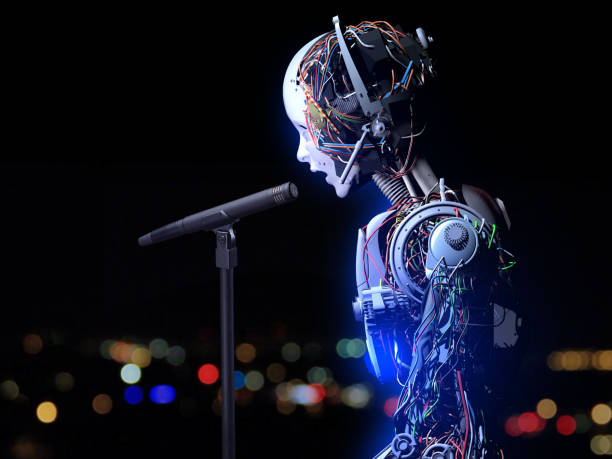
In this ever-growing world of technology and AI, the concept of what is “real” and what is not is at the forefront of our minds. Imagine you hear a song on the radio and the first thought isn’t “Who made this song? Did they write this themselves or did they have a ghost writer?” but rather “Did a human write this or did AI develop this?”
Growing up, a ghost writer was another individual paid to supply an artist with lyrics or a concept for a song without public credit. Even though their contributions to the song were hidden, we understood that a human being was behind the creative genius of the song. Human emotion, experience, and thought were shaping the art.
Now, however, the “ghost” in question may not be human at all anymore.
Artificial Intelligence began as a tool to aid in the efficiency and accuracy of completing tasks. AI-derived tools like Grammarly and QuillBot helped proofread papers and improve word flow, while still maintaining a level of human creativity. However, we are entering a society where AI can generate human ideas based on patterns it has curated over millions of already existing works. In music, algorithms can be used by AI applications to compose melodies, create lyrics, generate beats, and replicate human vocal tones to produce a fully functional song with almost no human involvement. The introduction of AI into one of our culture’s most sacred and stable cultural boundaries has challenged the line between human creativity and machine production. The shift is no longer about AI assisting in creation, but rather about AI taking authorship.
What Boundary is being Challenged
The music industry has always relied on invisible contributors to the music-making process. Producers, engineers, ghost writers, and artists all played their part in the creation of a musical piece. However, those contributors were all human. AI-generated music collapses the boundary between human artists and machine creators, distorting our perception of authenticity and human identity.
The process of creating has always been uniquely human—the ability to take lived experiences, emotions, and imagination to develop a fully structured, embodied piece that an audience would enjoy and listen to. When AI tools began generating music that listeners cannot distinguish from human-created work, the wall was disrupted—the purpose seems to be lost. No longer is authorship shared by a couple of human colleagues, but instead shared across a network of databases, algorithms, and users within a technological network.
Donna Haraway’s cyborg theory reflects this construct by arguing that these dichotomies—human/machine—are not isolated concepts but part of a hierarchical system. One is considered the norm as it is more authentic, natural, and, by society's standard, superior, while the other is secondary and artificial. Haraway describes these dissolving boundaries as “leaky distinctions” that clearly blur the line between the physical real and the non-physical machine.
In layman’s terms, when a computer can perfectly replicate a human voice audibly and create an entire song that feels emotionally authentic, the line between human and machine vanishes. This is not just about technology—it’s about identity. Who is the “artist” when creation emerges from a hybrid system of humans, machines, and data? The traditional markers of authorship, creativity, and authenticity become fluid. Human identity, once tied to creation, now intersects with machine intelligence, forcing society to redefine what it means to be a creative individual.
Liberation
While some argue that AI-generated music is stealing the spotlight and the jobs of authentic human artists, the boundary collapse has also been seen as a liberatory one. AI lowers the financial boundaries put up by the industry to allow for the proper production of music and art. No longer does a small artist have to “sell away their life” monetarily to afford to record and distribute their music. Moreover, these independent artists can now experiment with their own production and explore the avenues they love without the financial burden. The liberation can also be in the ability to create a hybrid system where the artist is not the sole contributor to the creation of the music. The AI tool can develop the beats or potentially aid in the musical theory to produce a palatable song for the public. Creativity here becomes fluid, as Haraway explains, empowering rather than debilitating.
Recalling back to The ArchAndroid, we remember the concept of what counts as “real.” AI invites us to reconsider our definition and importance of authenticity when a song is able to evoke the same emotion as a human-made song. In The ArchAndroid, Janelle Monáe uses the android to challenge the perception of the divide between human and machine. Her android was able to amplify humanity, not destroying what it means. Similarly, AI-assisted music might not be eliminating human creativity but instead allowing an avenue to reshape and expand it beyond our imagination.
In Donna Haraway’s A Cyborg Manifesto, she argues that the militarized cyborgs, which were made for technological control, can be repurposed for the greater good of humanity and its liberation. Though AI is seen as a product of corporate capitalism that primarily benefits the elites, it has the potential to be a form of accessible tools for public creativity. The liberation comes from finding a blend between the two binaries in order to allow the boundary to not necessarily “collapse” but to be “rebuilt.”
The Future of it All
If current trends continue, the next 20–30 years may bring even deeper integration between human and machine creativity. We are already seeing AI-generated vocals, virtual avatars performing at concerts, and artists collaborating with algorithmic systems. It is not difficult to imagine a future where award shows debate not whether AI-assisted music is eligible, but whether fully autonomous AI artists should compete alongside humans. The development of a new system of award shows might introduce categories to keep the competition fair and allow a clear distinction between humans and machinery, or both. On the contrary, we may see the default shift to where humans must label themselves “fully human-made.”
Conclusion
In conclusion, the rise of artificial intelligence in our society forces us to confront its presence in all facets of our human culture. With AI’s influence in creativity—specifically music—we must question whether creativity lies exclusively in the hands of humans, or if we can redefine it ourselves.
While the boundary between humans and machines may appear to be collapsing, it may be wise to think of it as another technological development and a shift in our culture. As Haraway describes, boundaries are never stable and finite. They are leaky, proposing the potential for innovation and hybridity—a future where the two can become a collaborative, mutualistic entity.
So perhaps in the Recording Academy Grammy Awards Showcase decades from now, the winner will not simply be the “best human artist” but rather a testament to the evolution in our humanity that made the collaboration between human and machinery imaginable.
References Haraway, D. J. (1985). A cyborg manifesto: Science, technology, and socialist-feminism in the late twentieth century. In D. J. Haraway, Simians, cyborgs, and women: The reinvention of nature (pp. 149–181). Routledge.
Monáe, J. (2010). The ArchAndroid [Album]. Atlantic Records.
Recording Academy. (2023). Recording Academy announces new Grammy eligibility guidelines for AI-assisted music. Retrieved from https://www.grammy.com
iStock. (n.d.). Robot and musical notes images [Stock photos]. iStock. Retrieved February 21, 2026, from https://www.istockphoto.com/photos/robot-song