Built From Code and Courage
Janelle Monáe performing live in 2014. Image via Wikimedia Commons. 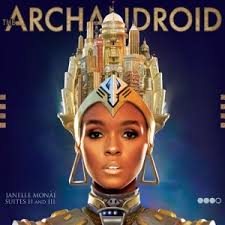
There is something very bold about refusing to stay in one category. That refusal feels especially loud right now.
If I had to pick a contemporary example of liberation through hybridity, I would point to the rise of digital avatars, AI-assisted creativity, and online identity experimentation among Gen Z and Gen Alpha. Not just influencers, but everyday people who move between physical bodies and digital selves without treating one as more “real” than the other. Think of VTubers who perform through animated characters, creators who use AI tools to co-produce music and art, and young activists who organize simultaneously in physical spaces and on algorithmic platforms.
This is cyborg territory.
In A Cyborg Manifesto, Donna Haraway (1985) argues that the cyborg collapses rigid boundaries such as human versus machine and natural versus artificial. For her, hybridity is not contamination. It is possibility. The cyborg does not dream of returning to some pure origin. It builds coalition out of fragments. That idea feels less like theory and more like a description of how identity already works online.
Consider how many people experiment with gender presentation, race aesthetics, fandom identities, and even vocal tones in digital spaces. Filters, avatars, AI voice changers, and augmented reality tools let users test versions of themselves that may not feel safe offline. The boundary between body and interface gets thinner every year. Smart watches track our pulse. Algorithms shape our feeds. Generative AI completes our sentences. We are not becoming machines, but we are entangled with them.
At the same time, this hybridity is not just technological. It is cultural and political. That is where Janelle Monáe becomes crucial. In The ArchAndroid (2010), Monáe creates Cindi Mayweather, an android who falls in forbidden love and becomes a fugitive in a futuristic metropolis. On the surface, it is science fiction. Underneath, it is Afrofuturism doing serious work.
Afrofuturism reclaims the future for Black people who have historically been excluded from dominant visions of progress. Scholars such as Ytasha L. Womack (2013) describe Afrofuturism as a way of blending science fiction, history, fantasy, and Black cultural production to imagine alternative futures. Monáe’s android is not just a robot. She stands in for anyone marked as deviant or disposable. By making the android the hero, Monáe flips the script. The hybrid figure becomes the site of resistance.
This is where the real world echoes both Haraway and Monáe. When marginalized creators use AI art tools to generate speculative worlds that center queer Black joy, that is Afrofuturism meeting cyborg theory in practice. When nonbinary teens use digital avatars to live in alignment with their gender identity before their offline world catches up, that is boundary collapse functioning as survival and liberation. The hybrid self becomes a rehearsal space for freedom.
Still, today’s hybridity diverges from Haraway’s vision in one important way. Platforms are corporate. Algorithms are proprietary. The same tools that enable fluid identity also extract data and reinforce inequities. A cyborg Instagram account still answers to advertising logic. Liberation is happening, but it is happening inside systems built for profit. That tension matters.
Looking ahead 20 to 30 years, current trends suggest even deeper integration. Brain computer interface research, immersive augmented reality, and increasingly autonomous AI systems could make digital layers persistent rather than optional. Instead of logging on, we might simply inhabit mixed realities all day. Identity could become modular. You might maintain multiple ongoing selves for different communities, each with its own aesthetic and social network.
If Afrofuturism continues to evolve alongside these technologies, we might see more speculative design led by creators of color who refuse dystopia as the default. Future movements may treat code as a cultural medium in the same way hip hop treated turntables. New forms of resistance could emerge through collective algorithm hacking, open source identity tools, and digital mutual aid networks that operate beyond national borders.
Haraway’s cyborg rejects purity. Monáe’s android refuses disposability. Together they offer a framework that feels startlingly relevant. The goal is not to become less human. It is to expand what human can mean.
And maybe that is the real courage. Not chrome limbs or glowing circuits, but the audacity to say that identity was never a fixed setting in the first place. It was always something we were building from code, culture, memory, and imagination.
References
Haraway, D. (1985). A cyborg manifesto: Science, technology, and socialist feminism in the late twentieth century. Socialist Review, 80, 65–108.
Monáe, J. (2010). The ArchAndroid [Album]. Bad Boy Records; Atlantic Records.
Womack, Y. L. (2013). Afrofuturism: The world of Black sci-fi and fantasy culture. Lawrence Hill Books.
AI Attestation
I used AI as a support tool during the writing process to help organize my thoughts and shape the connections between course concepts. The arguments, interpretations, and overall analysis are grounded in my own understanding of the readings and discussions. I carefully revised and refined the final draft to make sure it accurately reflects my perspective and meets the expectations of the assignment.