Identity 2.0: When Your Face Becomes Your Passport, Wallet, and Citizenship
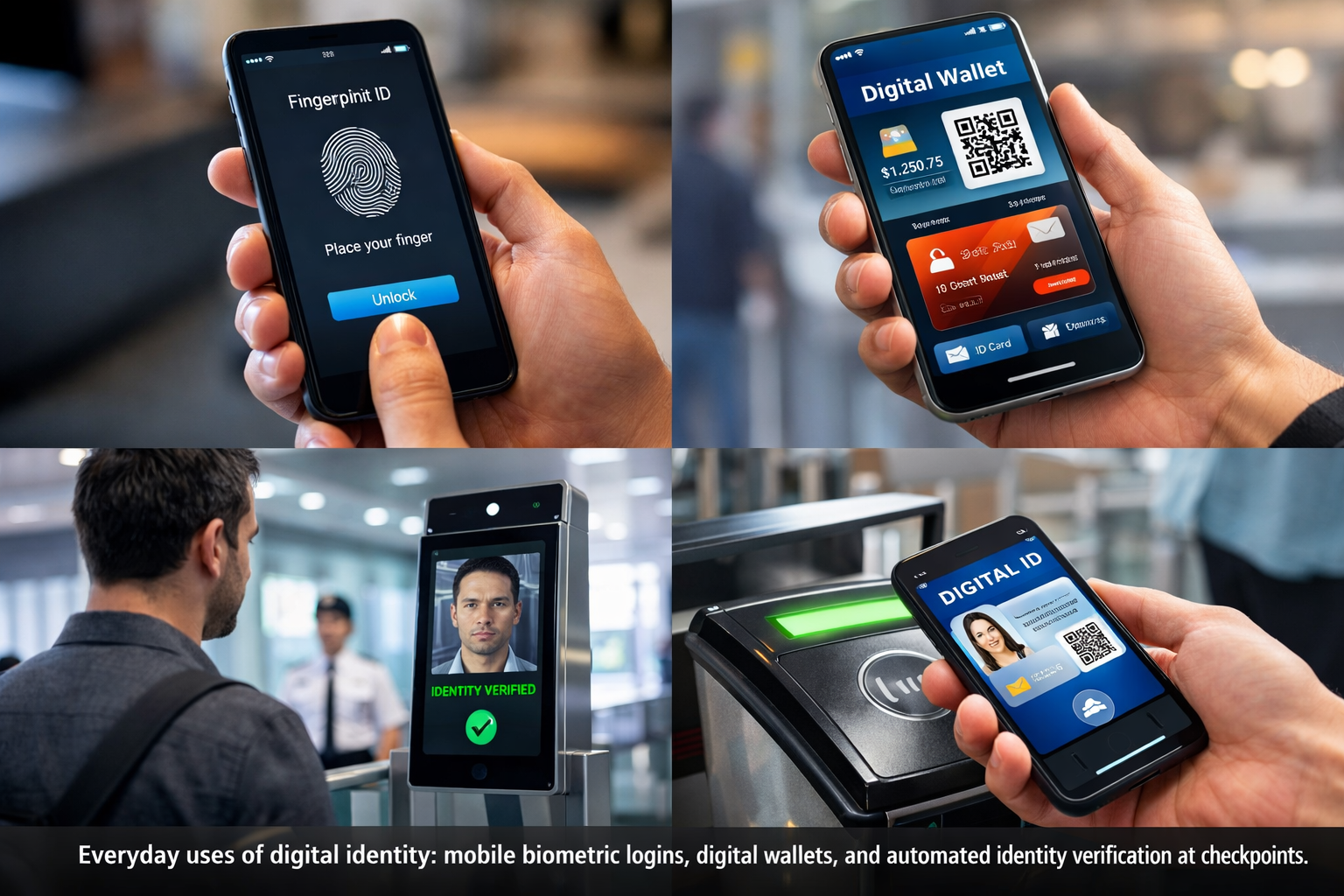
In a cyberpunk world, identity isn’t just who we are—it’s what corporations and governments can verify, commodify, and control. Today, the boundary between physical identity and digital identity is eroding. What once was a legal document in a wallet is now a constellation of biometric scans, mobile IDs, and digital wallets that follow us everywhere we go. This isn’t tomorrow’s speculation—it’s happening now.
The Boundary That Has Shifted
Historically, identity was rooted in the physical: passports, birth certificates, social security cards. In the digital age, identity became credentials we entered online—usernames, passwords, PINs. But in 2025 digital identity systems are increasingly biometric, mobile, and machine-readable, blurring the line between who you are and what a machine recognizes you as.
Governments and corporations are building systems that link your face, fingerprint, voice, or palm directly to essential services like travel, banking, healthcare, and even public benefits. The European Union’s eIDAS 2.0 initiative is creating a digital identity wallet usable across all member states, promising convenience but also redefining what it means to prove who you are in a digital society.
Meanwhile, biometric techniques—once exotic—now fuel everyday authentication. From palm biometrics in stores and hospitals to mobile IDs on a phone, the move toward identity tied to our bodies rather than passwords is accelerating.
What’s Driving the Shift
Technological forces: Biometric systems and mobile identity standards have improved dramatically. Industry reports show passwordless authentication increasingly replacing traditional login methods, with biometrics offering convenience and security advantages—at least superficially.
Economic incentives: Tech companies and governments alike see huge value in digital identity platforms. They reduce fraud, streamline services, and open doors to new monetizable data streams. No database is just for ID anymore—it’s also a goldmine for behavior, spending patterns, and social metrics.
Political and social pressures: The push for digital identity isn’t just consumer convenience. Governments argue it enhances security, prevents fraud, and enables digital citizenship in an era of global mobility. But critics warn that once biometric identity systems become ubiquitous, opting out becomes increasingly difficult.
How This Connects to Cyberpunk
Cyberpunk fiction vividly illustrates worlds where identity is mutable, encoded, and monitored by systems beyond individual control. In Neuromancer or Snow Crash, identity chips, corporate databases, and neural codes make every person traceable and manipulable. Today’s digital identity systems reflect that logic: your face, your palm, your biometric signature becomes a node in a global network, shaped by technical architectures and power structures.
Cyberpunk theory teaches us to see how technologies don’t merely serve users but also reshape social relations. The transition to biometric, mobile IDs recasts identity itself as something processable, shareable, and surveilled—no longer purely personal, but infrastructural.
Who Benefits—and Who’s at Risk?
Potential benefits:
- Faster border crossings and secure travel documentation.
- Passwordless security that reduces traditional cyber-attacks.
- Access to services for people without traditional documentation.
Risks and harms:
Surveillance and privacy erosion: Biometric systems can track movements across spaces, linking online and offline behaviors in ways never before possible.
Exclusion and inequality: Individuals without compatible devices or digital literacy risk being shut out of essential systems.
Permanent identifiers: Unlike passwords, biometric traits cannot be changed. If compromised, your faceprint or fingerprint is compromised for life.
These concerns echo fundamental cyberpunk anxieties about surveillance, agency, and control. When identity becomes a data point indexed and algorithmically processed, the human subject transforms into a profile—a mathematical object to be scored, categorized, and predicted.
Ethical Questions We Must Ask
Consent or coercion? When a digital ID is required for basic services, can consent truly be voluntary?
Who controls your identity? Is it a corporate cloud, a nation-state database, or the individual themselves?
What happens when borders are digital rather than physical? There’s a powerful allure to seamless global identity—but also a danger of borderless surveillance.
Understanding the collapse between physical and digital identity is urgent because it affects every person with a smartphone, a passport, or an online presence. The question isn’t whether identity is changing—but whether we will shape that change or be shaped by it.
APA-Style References
European Commission. (2025). eIDAS 2.0 digital identity wallet framework. TRUSTECH. https://www.trustech-event.com/en/event/news/digital-identity-trends-2025
Akhison, G. (2025). Towards a universal digital identity: A blockchain-based framework for borderless verification. Frontiers in Blockchain. https://www.frontiersin.org/journals/blockchain/articles/10.3389/fbloc.2025.1688287/full
Demystify Biometrics. (2025). Biometrics & digital identity: Top 5 trends. https://www.demystifybiometrics.com/post/march-2025-biometrics-digital-identity-top-5-trends
Digital identity in 2025: biometric wallets and privacy dilemmas. (2025). RTechnology. https://rtechnology.in/articles/1050/digital-identity-in-2025-biometric-wallets-and-privacy-dilemmas
Le Monde. (2025, September 1). The discreet rise of facial recognition around the world. https://www.lemonde.fr/en/pixels/article/2025/09/01/the-discreet-rise-of-facial-recognition-around-the-world_6744911_13.html
Strathmore University CIPIT. (2024). Global biometric and digital identity trend analysis (Global Report). https://cipit.strathmore.edu/wp-content/uploads/2024/05/Global-BDI-Trend-Analysis-Geographical-Assessment-Final-Approval-06.09.2023-compressed.
OpenAI. (2026). Digital identity and biometrics in everyday life [AI-generated image]. https://www.openai.com/dall-e