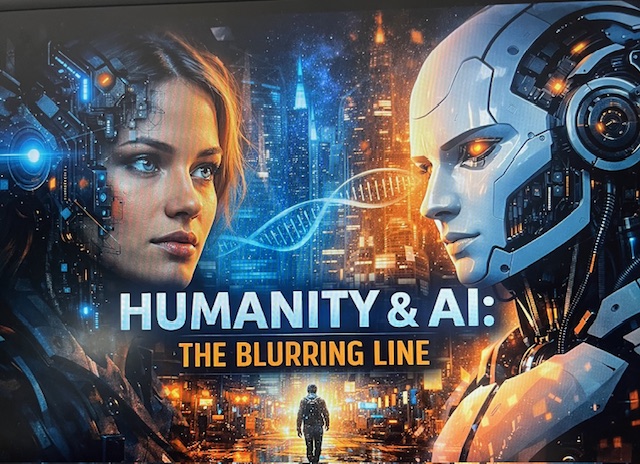
BP01

Blog Post #1: I’ve Seen Things You People Wouldn’t Believe

A central theme in cyberpunk is the collapse of established boundaries—whether political borders, the human/non-human divide, or categories of identity. These fictional boundary collapses mirror real shifts happening today.

Identify one specific boundary that has shifted significantly in the past five years. Describe what has changed with concrete examples and credible sources. Then analyze what's driving this shift (technology, economics, social movements, politics, culture). Connect your analysis to course themes like posthumanism, globalization, or technological disruption. Consider the implications: who benefits, who's impacted, and what questions does this raise?

Is It Reality Or Parasocial Perception

- Posted in BP01 by

As the world progresses and continues to incorporate technology into the everyday weaving of life, it’s natural to question the consequences of such advancement and how they shape our moral, social, and political parameters. One particular facet of technology that I feel has done irreparable damage, is social media. It truly is a double edged sword; on one hand it allows everyone the chance to voice their opinions and be heard, a necessity in regards to the furtherance of rights and safeties for marginalized groups. On the other hand, social media gives everyone the ability to voice their opinions and be heard, which obviously includes those who oppose civil justice being delivered to people who are different from them. Social media has expanded the way that we interact with one another, allowing us access to people who we would otherwise never see or interact with. Furthermore, social media has given most a false sense of confidence and a confusion in which they believe that just because they can do something, it means they should and are entitled to do so. Thus we have an expedited emergence of parasocial relationships that tend to push stereotypical agendas in regards to race, gender, sexuality, etc.

A parasocial relationship refers to a one-sided tether that one creates, in which they devote their energy and emotions to someone who doesn’t even know they exist, to put it simply.(Cynthia. Hoffner, 2022) A lot of times we see parasocial relationships form between celebrities and their fans with stan culture being a prime example. I want to preface that there is nothing wrong with admiring an artist or their work. However, it has gotten to a point in which people genuinely believe they know the ins and outs of a person they have never met. Oftentimes, this is because the person is constantly being fed posts and other forms of information about whatever interests them, by the algorithm. So even though they’ve most likely never met the person they admire, they are in constant contact with them.

With that said, it is important to understand that parasocial relationships transcend the dynamic between mega fan and idol; it also applies to those who consume 30 second media and then apply what they see to entire marginalized groups. In our current political climate paired with social media usage, it does not take much to inspire discrimination towards certain groups of people. All it takes is for a certain demographic to see a 30 second clip of young black students dancing and celebrating at their graduation, to stimulate the misuse of the term black fatigue. A term that was initially created to encompass the vast stress and exhaustion that comes with living in a country that champions systematic racism, had become a discriminatory term against the very community that created it. All it takes, is one conversation discussing the liberties that immigrants deserve and the injustices they face, to breed negativity from those who are ignorant and hateful. These interactions then begin to seep into the physical of everyday life. It’s not just comments under a tiktok post, but micro and macro aggressions in public, police brutality, ICE raids. Social media allows for the circulation of stigma that encourages people to stay true to their biases and never confront their prejudice. Thus the cycle continues. And we still use social media. In a way it kind of reminds me of the ‘bad faith'(Jean-Paul Sartre.) The idea of critiquing social media but still somehow glamorizing it, just how cyberpunk critiques aspects of society such as corporate capitalism while still being interested in the aesthetic of it all.

Assisted Intelligence: Are We Losing Skills in the Age of AI?

- Posted in BP01 by

In the past five years, the boundary between human competence and machine-assisted performance has shifted. As a society, we are moving to a world where people can assume a coat of knowledge simply due to their ability to input a prompt into program rather than developing their own skills. This idea raises a pressing question: is society’s competence declining as the influence of technology increases or is technology reshaping what is required of humans to be successful.

Examples of this shift is evident in our scholarly institutions, professional work, and the field of creatives. We have AI-derived tools like ChatGPT that can produce an answer to almost any response to any prompt submitted through its website—even moving to partnerships with Meta, Google, and other tech giants of the world. While initially, these programs were utilized as potential solutions to repetitive or more time-consuming tasks so that humans can focus on the creative and decision-making aspects. In the earlier days of AI, we have programs like Grammarly that helped students, teachers, creatives, and other professionals formulate their creative writing by checking for punctuation, verb tenses, and sentence re-phrasing. These features saved times on millions of pieces, offered help to writers and reduced errors in writings. Early AI systems mainly offered support with a large emphasis on clarity and correctness—leaving the content development to the human and refining to the AI tool.

However, as AI systems progressed and emerged as a widely accessible tool that could not only create but also produce products that required in-depth thinking and knowledge, users quickly began to rely on the application to produce these products rather than use it for its initial use. Students have begun submitting completely AI-generated papers and assignments. Pre-professionals use AI to draft their emails, business reports, resumé, and applications. We are having marketing team designers typing a prompt into an AI tool to produce pictures and videos of their work rather than mastering their own software skills. Now we are being questioned as a generation, primarily Gen Z and beyond, do we truly know how to do anything without the aid of the internet? While many Gen Z employees report that AI tools help them work faster and feel more capable, research suggests that heavy reliance on these systems may come at the cost of developing interpersonal and communication skills that technology cannot easily replace, pointing to a gap between perceived efficiency and well-rounded professional competence (Robinson, Forbes). Ultimately, the shifting boundary between human competence and machine-assisted performance reflects more than just technological advancement; it reveals a cultural turning point in how we define skill, knowledge, and effort. AI is not inherently a threat to human ability, but our relationship with it determines whether it becomes a tool for empowerment or a “handicap” that weakens essential cognitive and interpersonal skills. Like many technologies before it, AI forces society to adapt, but the pace of this change leaves little time to reflect on what might be lost in the process. Cyberpunk ideas have warned of futures where humans become dependent on the very systems they create, blurring the line between enhancement and erosion of identity. Today, that fiction feels less like distant speculation and more like a reflection of our lived reality. The key question moving forward is not whether AI will continue to advance, but whether humans will continue to develop alongside it, maintaining the depth of understanding, creativity, and critical thought that technology alone cannot replicate.

Blog Post 1: AI and the Quit Erosions of Human Cognition

- Posted in BP01 by

I was watching a TikTok video that talked about how youth are using AI for simple tasks. One lady uses AI to generate a grocery list because she "gets confused on what to buy, because there are so many options". This might seem small and ahrmless but it reflects a larger shift happening in our everyday. Artificial Intelligence is no longer helping us with complex issues, it is increasingly being used for brainstorming, organization, therapy, and even decision-making. This raises an important question: What happens to human thinking when machines think for us? The brainworks on a "use it or lose it' principle. The less we use our brains to brainstorm and critically think is the more we lose our ability to generate new ideas and learn and grow as a society. People are surrounded by technology that makes life easier, but also more controlled and less engaging. today AI does not dominate, but it creeps in in a way that we do not realize that we are diminishing our intelligence at a slight inconvenience rather than figuring ourselves out and diminishing our intelligence. It has been shown that cognition happens through the human brain; it is how we make our memories, create experiences, and solve real-world problems. When we leave all the planning and decision-making to AI, the problem is not that AI will become smarter than humans, but humans will cease to function on a cognitive level and stop trusting their ability to operate without technology. enter link description here[enter link description here] (https://httpsmediumcom-at-markaherschbergis-ai-just-a-tool-for-lazy-people-542c29a08020)

America’s Test Dummies

- Posted in BP01 by

Introduction

In the past five years we’ve seen many, and I mean many unprecedented events and choices being made especially when it comes to that related to our bodies. It seems as if since trumps’ inaugural tenure in office (being 2020/ a little over 5 years ago) that the care for quality of life has significantly decreased. Which to me feels like an eventual progression into the development of genetic/bodily augments to improve one’s health.

My Body, Your Rights?

This trend started with the overturning of roe v wade, where we saw the erasure of protection of abortion rights, spurred by a republican regime that often cited religion and cruelty as justification for said decision. Taking one’s autonomy over their own body even when it risks their life. Furthermore many call them out on hypocrisy on said decision as following this there was a shocking lack of care for parents and/or children through the policies they push. Whether it be defunding the department of education or not working to reform the foster care system, two sectors that could become notable/far more severe issues for our country in the future.

Pay or Die

The stricter eligibility rules on healthcare also showcase this, watching as affordable treatment is becoming a mere myth. Negative sentiments on this development can be represented by the Luigi Mangione case, where a man killed a healthcare CEO in broad daylight for similar reasons. It seems as if the country is going backwards when it comes to health and pharmacy, almost as if they’re trying to kill off the less fortunate.

The Downwards Pyramid

My final and most recent example is the hiring of RFK as the secretary of health and human services, who has repeatedly touted seemingly nonsensical claims about the health of Americans and what we need to do to fix those issues, such as his reformed food pyramid that emphasizes meats and dairy which were limited previously due to how much fat they contain.

Conclusion

Clearly all of these examples are political as we see their causes being the upper echelon and or the politicians we have in office, with their chaotic policies and use of power when it comes to influencing how we can use and in theory “should” use our bodies. Furthermore this ties back to Elon Musk and his venture into the world of brain chips. If left unchecked these cyberpunk life forms could become very much real.

This progression of events to me will become a large reason for our species integration with technology. Eventually people will become so unhealthy that it will be necessary for survival and success in everyday life, a dependency that will control our entire lives. They’re looking to use us citizens as lab rats for early body augmentation, and this is the first phase, breaking us down so that it’s needed.

https://www.npr.org/2026/01/07/nx-s1-5667021/dietary-guidelines-rfk-jr-nutrition

https://pmc.ncbi.nlm.nih.gov/articles/PMC9824972/

https://www.nbcnews.com/news/us-news/handgun-silencer-manifesto-items-luigi-mangiones-backpack-arrest-polic-rcna248025

When the Human Body Became a Dataset

- Posted in BP01 by

In cyberpunk stories, explosions and futuristic weapons aren't usually the scariest things. Instead, they show up when well-known lines start to blur. One of the largest boundary changes of the last five years is the blurring of the lines between digital data and the human body. What used to be private, personal, and internal is now always being watched, recorded, and looked at. In today's society, the body makes information instead of just being there. Wearable technologies and apps that help you keep track of your health are now a normal part of everyday life. Devices like Apple Watches, Fitbits, and smartphone health applications keep track of things like your heart rate, sleep patterns, physical activity, oxygen levels, and even your menstrual cycle. These tools claim to give people knowledge and control over their health, and they are often marketed as empowering. This adjustment, though, means more than merely being useful. It shows a change in how people see the body, from seeing it as a lived experience to seeing it as a series of measurements. This change in boundaries happened faster after the COVID-19 pandemic, when digital health monitoring developed quickly. Health data became highly crucial for making decisions about safety, risk, and productivity. At the same time, commercial companies might access incredibly personal biological data. Reporting by NPR has highlighted growing concerns about how period-tracking and health apps may collect, store, and potentially expose sensitive reproductive data, especially in the wake of shifting abortion laws [NPR, 2022]. Taking care of yourself could develop into snooping. Cyberpunk theory can help us figure out why this transition makes us feel bad. Posthumanism regards the human body as a hybrid system interconnected with technology, rather than a static biological boundary. Wearable technology improve perception by turning physiological processes into real-time feedback. Technology can read the body before we do by using vibrations to show a quicker heart rate or an abnormal rhythm. Data is what makes human experience possible. But cyberpunk often stresses that technology needs electricity systems to work. Data is not impartial. Institutions that often care more about making money than helping people collect, analyze, and control it. Your health data can affect your ability to receive insurance, get a job, keep your reproductive health secret, and get resources. In this view, the body is valuable not because of what it has done, but because of what it can do that can be quantified. Globalization makes this boundary disintegration much worse. Health apps work across borders and save data on international servers that have different privacy rules. A person may produce bodily data in one nation, while companies scrutinize and capitalize on it in another. Cyberpunk often shows this: systems that go beyond national borders but people are still affected by them. This change really does have benefits. Early medical detection, keeping an eye on chronic illnesses, and making healthcare easier to get have all saved lives. Health technology gives many users peace of mind and control. But the hazards are not spread out evenly. Communities that are already under more surveillance are generally more at risk when physiological data becomes institutional knowledge. In a society based on data, who really owns the body? This is a key question in cyberpunk. When biological data is turned into a product, personal freedom becomes weak. It gets harder and harder to tell the difference between care and control. In Blade Runner, artificial beings try hard to be seen as more than just things that were made. Today, people have a quieter version of same problem. As our bodies become dashboards, algorithms, and projections, we may be perceived more as data sets than as persons. The breakdown of the line between body and data makes us question if technological advancement can go hand in hand with respect, or whether making ourselves measurable means we are more likely to be controlled.

The Human AI Competition

- Posted in BP01 by

Before, humans used to utilize technology to perform their tasks more efficiently. Now, AI is being used to replace the human altogether. An example of this occurred in late 2025 when Amazon announced it would cut roughly 14000 corporate jobs as part of a larger restructuring focused on automation and efficiency while shifting more of its internal work to AI driven systems. This collapse of the human and nonhuman divide in the workplace directly mirrors a core cyberpunk idea where technology no longer assists people but competes with them. It also adds to the ongoing economic crisis where people already struggle to pay their bills and live comfortably.

A central theme in cyberpunk is the collapse of established boundaries whether political borders, the human and nonhuman divide, or even categories of identity. These fictional boundary collapses mirror real shifts happening today. One specific boundary that has shifted dramatically in the past five years is the boundary between human labor and machine labor. For most of modern history there were jobs that were understood to require a human mind such as writing reports, analyzing data, customer support, design work, and planning. That line has now been blurred because AI systems can do all of these things at a speed and scale that humans simply cannot match. Companies no longer see humans as essential workers for many of these tasks but instead as optional and replaceable.

What has changed is not just that machines can help but that they can fully perform roles that were once human only. Large corporations now openly replace employees with AI software. In addition to Amazon, companies like Microsoft, Google, and many financial firms have reduced staff while expanding their investment in AI tools that handle emails, coding, research, scheduling, and even creative work. Research institutions have also shown that modern AI models can perform many office and administrative tasks at a level close to or sometimes better than human workers. This means that even people with degrees and professional experience are no longer protected from automation.

This shift is being driven by several forces working together. Technology is improving extremely fast, especially large language models that can understand and generate human language in a convincing way. Economics also plays a huge role because companies are under constant pressure to cut costs and maximize profits, and replacing thousands of workers with software that runs twenty four seven is much cheaper in the long run. Culture also contributes because society increasingly treats AI as something inevitable and unstoppable which creates a rush to adopt it before competitors do. Politics and regulation have not kept up, so there are few real protections for workers whose jobs disappear due to automation.

Some people benefit greatly from this shift. Executives, investors, and tech companies gain massive financial rewards when they automate work and reduce labor costs. Productivity numbers go up and profits increase. But workers lose stability, income, and in many cases their sense of purpose. Whole communities can be affected when large employers replace human jobs with machines. This raises serious questions about what work will mean in the future and how people are supposed to survive in a system where they are no longer needed in the traditional sense.

What should humanity do to solve this issue. Humans should develop a system that embraces AI but uses it to create a world where people do not have to live paycheck to paycheck. In theory this could happen if society worked together to distribute the wealth created by automation in a fair way. But in reality this feels more like a utopian dream than something that will actually happen. Instead AI will likely replace more jobs and increase economic inequality, leading to instability and possibly a major crash. A new financial system may be introduced that claims to fix these problems, but it will likely be controlled by the same people who invested in the AI that caused the disruption in the first place. This is exactly the kind of future cyberpunk stories warned us about where technology advances but humanity is left behind.

There is no Private Anymore

- Posted in BP01 by

Security cameras with popular social media platforms on their screens by: Electronic Frontier Foundation#### Introduction

Having privacy used to be personal to yourself where what you did was unnoticed. Within the last five years, that boundary has changed tremendously. Digital surveillance, whether that is through games, apps, cameras, and facial recognition, has made and allowed being constantly monitored very normal on a day to day basis. This shows a core theme of cyberpunk, technology develops faster than its rules and regulations to maintain its ethics.

What Has Changed

Surveillance is not just at the government and law enforcement level. It is with civilians using our phones. An article by Wired talks about TikTok collecting and storing data from users, that includes location and data that can identify specific devices (Wired, 2026). This goes on in the background even when app users are not posting and unfortunately the users do not even know the extent of their data being collected. This blurs lines between sharing the information being shared and being constantly monitoring. Surveillance goes beyond apps, it also includes studying and scanning people’s facial and physical features. Facial recognition is being put in public places that can identify people based on their biometric data. According to an article by ISACA, this brings lots of privacy concerns because biometric information like faces cannot be changed like a password and credit card information. This data can be stored, shared, and used without people even knowing they are being tracked. Additionally, facial recognition data is normally not encrypted so it is easier to be hacked and exploited by criminals (ISACA, 2025). This also weakens the boundary between public spaces and personal privacy.

These show how privacy has to be guarded and protected opposed to it being the default that most people would expect.

What Is Driving This Shift

Several of things are speeding up the growth of surveillance: Technological advancement: AI and facial recognition tools are cheaper, faster, and more accurate.

Financial benefits: Companies make profit from collecting and selling user data, while cities are encouraged to use technology to monitor public places

Social Acceptance: Constant data collection has become expected in exchange for convenience and connectivity.

Weak regulation: Lawmakers struggle to keep up with quickly evolving surveillance technologies.

These agree with cyberpunk’s focus on powerful systems working beyond meaningful public control (ISACA, 2025).

Cyberpunk Connections

A common theme within cyberpunk is a world where people are being constantly watched by powerful companies or governments. This is not just an idea from a movie or a book anymore, but real life. As the idea of privacy goes away, technology gains more power and control over people which turns normal everyday activities into an opportunity for their data to be collected. The posthuman idea is also relevant as people are less defined by themselves, but by their digital footprint and online profiles. These surveillance systems only see people as data and digital points. Who Benefits, Who Is Harmed These surveillance technologies can and do improve security and its efficiency, but also bring about problems and concerns. It has the potential to benefit governments, companies, and civilians, but can also hurt civilians. The more data that is collected, the more control civilians lose. As their information is collected, stored, and shared, the less they can protect it. The chances of this data being leaked and exploited goes up, and the blame typically falls on the user (ISACA). Users are typically unaware of how much of their information is being collected. Therefore, the consequences of surveillance also harms civilians the most.

Conclusion

Digital surveillance is a part of everyday life, but still leaves questions. What or who controls the data collected about civilians? How much privacy do civilians have to sacrifice for convenience and safety? At what point is surveillance not protecting, but controlling? These issues show that society is already living out the ideas of cyberpunk where there is a thin line, if any, between privacy and public.

Sources Ahmed-Adnan-Sheikh, H.(2025, November 13) Facial Recognition and Privacy: Concerns and Solutions in the Age of AI. ISACA https://www.isaca.org/resources/news-and-trends/isaca-now-blog/2025/facial-recognition-and-privacy-concerns-and-solutions-in-the-age-of-ai Rogers, R.(2026, January 23) TikTok Is Now Collecting Even More Data About Its Users. Here Are the 3 Biggest Changes. Wired https://www.wired.com/story/tiktok-new-privacy-policy/

The Mind Is No Longer Human

- Posted in BP01 by

The Boundary That Used to Matter

For much of modern history, intelligence marked a clear boundary between humans and machines. Machines calculated; humans thought, created, and judged. Over the past five years, that boundary has begun to collapse. We now have generative artificial intelligence systems that are capable of writing essays, generating images, composing music, and simulating conversation. This has blurred the distinction between human cognition and machine processing in ways that feel identical to cyberpunk. What once belonged exclusively to the human mind is now shared with algorithmic systems, forcing us to rethink what it even means to think.

When Information Lost Its Body

This shift reflects what theorist N. Katherine Hayles describes as the moment when “information lost its body.” In her work on posthumanism, Hayles explains how cybernetics reframed humans and machines as systems of information rather than fundamentally different beings. Once intelligence is understood as a pattern instead of a biological trait, it no longer needs a human body to exist. Generative AI makes this idea real. These systems treat language, creativity, and reasoning as data that can be modeled, trained, and reproduced without a human brain. Intelligence becomes something that circulates through networks rather than something anchored to flesh.

Thinking With Machines, Not Just Using Them

This collapse of the human–machine boundary aligns closely with posthumanism, a central theme in cyberpunk. Posthumanism challenges the idea that identity or consciousness must be rooted in a stable, biological self. Humans no longer simply use technology, they think with it. People rely on AI for any task. In these moments, the human mind functions less as an original origin of thought and more as an interface within a larger system. This dynamic mirrors what philosophers Andy Clark and David Chalmers describe in their theory of the extended mind, which argues that cognition can extend beyond the brain into tools and environments. When external systems support thinking, they become part of the thinking process itself. Generative AI pushes this idea further than ever before. Intelligence is no longer purely human or purely machine, it is distributed across both.

High-Tech Progress, Uneven Consequences

As cyberpunk narratives warn, technological progress rarely benefits everyone equally. While corporations that control AI infrastructure gain enormous power and profit, everyday people face uncertainty and displacement. Cognitive labor, once considered uniquely human, is increasingly being devalued. This reflects cyberpunk’s familiar “high-tech, low-life” condition, which is rapid technological advancement paired with growing inequality and concentrated control.

Living After the Boundary Collapsed

The blurring of human and machine intelligence raises urgent questions. If machines can convincingly simulate thought, what remains uniquely human? Who owns creativity when AI systems are trained on collective human culture? And how do we preserve dignity in a world where cognition itself is treated as a resource to be optimized?

Cyberpunk has always insisted that the future arrives unevenly and prematurely. The collapse of the human–machine boundary is no longer unpredictable fiction it is a lived reality. Like cyberpunk protagonists navigating systems they did not design and cannot fully control, we are learning to survive in a world where intelligence has slipped its biological limits. The challenge now is deciding what kind of posthuman future we are willing to accept.

Sources

When the Home Office Becomes More Office Than Home

- Posted in BP01 by

In the past 5 years, home office have become the reality of many people. After COVID hit, many jobs had to adapt to this idea of working from home. What people wouldn’t expect is that many of these jobs would never go back to “normal”. Many companies realized that it was more beneficial to have their employees working from their homes, since they could avoid the cost of maintaining an office. Furthermore, the comfort of not having to commute every day was definitely appealing for everyone, besides not having to worry about transportation, traffic, food, or even clothing. Because of that, after the pandemics, many of these jobs remained remote. According to a 2023 working paper by researchers at Harvard Business School and the University of Illinois, survey data from U.S. firms and workers shows that the shift to remote work was not temporary but became a persistent feature of post-pandemic labor arrangements (Bartik et al. 2023), showing how home office came to stay.

The Collapse of The Boundary

This change collapsed a huge established boundary in our society, the one between our personal and professional space/life. Activities and subjects that were before kept inside offices and among coworkers moved to domestic spaces such as bedrooms and living rooms, being shared with family members. As a result, it gets harder to cross the line between personal and professional life, possibly causing loss of privacy and identity (work becomes who you are), besides constant availability, and, consequently, faster burnout. Therefore, home office has been making many people’s lives easier, however it has a side effect that has to be considered. Is it worth it?

How was it possible?

But let’s take a step back for now. We know that COVID marked the rapid increase of home office jobs, but technology - video conferencing platforms, cloud storage, messaging systems - is what made this shift possible, while economy is what allowed it to persist. When I say that, I mean to answer the question some might have: “why didn’t society just ‘go back to normal’?”. And the answer is because economic incentives reinforced this change. As I mentioned before, companies could cut the cost used to maintain offices while workers benefited from the flexibility provided by home office. This allowed both employers and employees to accept the collapse of the boundaries between their personal and professional lives.

Connecting to Course Themes

When trying to relate this to what we’ve discussed these past weeks, the first thing that comes to mind is the character Case from Neuromancer (Gibson, 1984). His ability to work depends on his nervous system. When it’s damaged, he is no longer able to work. The Cyberspace, where Case works, is accessed through his nervous system - there’s no physical office. This means that there is no boundary between his professional and personal life. And that’s what all of this is about. Just like Case had his nervous system damaged because of work, modern workers might be risking their personal lives as professional demands enter intimate spaces.

Important implications

Who benefits: employers, Tech companies, workers (do they actually?). Who is impacted: workers’ privacy, mental health. Finally, I want to clarify that this is not a rejection of home office. I am actually a supporter of this work style and want to pursue it myself. However, I believe it is a very important topic to be taken into consideration.

Sources

Bartik, A. W., Cullen, Z. B., Glaeser, E. L., Luca, M., & Stanton, C. T. (2020). The rise of remote work: Evidence on productivity and preferences from firm and worker surveys (Working Paper No. 20-138). Harvard Business School. https://www.hbs.edu/ris/download.aspx?name=20-138.pdf

Gibson, W. (1984). Neuromancer. Ace Books.

AI: no use of AI for this assignment

When Borders Stop at the Map but Digital Life Doesn’t

- Posted in BP01 by

Boundary Collapse Between Physical and Digital Worlds

A central theme in cyberpunk is the collapse of boundaries that once seemed stable, whether it’s the line between human and machine, or the borders that separate nations. As we talked about in class, cyberpunk worlds often expose how technology makes physical borders feel almost symbolic, while digital networks stretch across continents without friction. One boundary that has shifted dramatically in the past five years is the line between physical borders and digital borders. Today, work, crime, identity, and even citizenship can move freely online, regardless of geographic separation. In many ways, our world is inching closer to the same boundary collapse that cyberpunk fiction uses to critique power, globalization, and inequality.

Digital Labor and the Rise of Borderless Work

One clear example of this shift is how remote work has restructured global labor. Since the pandemic, companies routinely hire workers across countries without requiring physical relocation, turning the internet into a borderless workplace. Digital platforms now allow employees and contractors to live in one nation while working for another, blurring which country’s laws, wages, and protections apply. At the same time, governments are rethinking the meaning of citizenship. Estonia’s e-Residency program, which gives “digital citizenship” to people around the world, has expanded rapidly and now includes more than 110,000 global participants who run businesses within Estonia’s digital system without ever crossing a physical border (e-Residency, 2024). This is a real-world illustration of how digital systems can extend a nation’s influence beyond its physical territory, creating a new form of digital belonging that cyberpunk worlds often imagine.

Cybercrime, Cyberwarfare, and the Erasure of Geographic Limits

Another example comes from rising cybercrime and cyberwarfare, which operate completely independent of geography. Attacks on hospitals, banks, and infrastructure now routinely originate from actors across the globe. According to the European Union Agency for Cybersecurity (2024), cross-border ransomware attacks have surged and increasingly target essential services, making national boundaries meaningless barriers in digital conflict. Countries can be harmed, threatened, or destabilized without a single physical soldier crossing a border. This collapse of distance aligns with what we have discussed in class: in postglobal and posthuman settings, the “enemy” or the “threat” is no longer tied to a physical space. Instead, power flows through digital systems that exceed human-scale borders.

Forces Driving the Shift: Technology, Economics, and Politics

Technology, economics, and politics all drive this collapse. Technologically, global networks allow information, money, and identity documents to move faster than states can regulate. Economically, remote work, global outsourcing, and digital entrepreneurship encourage multinational structures where labor and profit are distributed across continents. Politically, governments are racing to control cyber threats, regulate digital residency programs, and determine whose laws apply when conflict unfolds online (Anderson & Rainie, 2022). These forces echo the course themes in your cyberpunk class: technology destabilizing old systems, globalization altering power, and digital life challenging traditional categories of belonging, citizenship, and control.

Consequences and Inequities in a Digitally Borderless World

The implications of this shift are complicated. People with access to education, stable internet, and digital skills benefit the most—they can work globally, earn higher wages, and participate in digital economies that cross borders. Governments like Estonia also benefit by expanding their global influence without territorial expansion. But others are left behind. Workers in lower-income countries face wage competition from international labor markets, and communities without strong digital infrastructure lose opportunities entirely. Meanwhile, cyberattacks disproportionately harm hospitals, schools, and municipalities that lack cybersecurity funding, revealing uneven protection against digital threats. All these changes raise difficult questions: Who is responsible for security when attacks ignore geography? Should nations extend rights or protections to digital citizens? How do people maintain identity and belonging in a world where borders matter less online?

Cyberpunk Themes Reflected in Modern Global Realities

Like many cyberpunk narratives, our real world is reshaping the meaning of borders, power, and citizenship. The collapse between physical and digital borders reveals a future where geography still matters, but not nearly as much as the networks that connect us. These shifts challenge us to think critically about who gains control, who becomes vulnerable, and how we prepare for a world where digital boundaries increasingly define our lives more than the physical ones ever did.

References

Anderson, J., & Rainie, L. (2022, February 7). Changing economic life and work. Pew Research Center. https:// www.pewresearch.org/internet/2022/02/07/5-changing-economic-life-and-work/

How many Estonian e-residents are there? Find e-Residency statistics. (2026, January 14). E-Residency. https://www.e-resident.gov.ee/dashboard/

Reports, E. (2025). ENISA THREAT LANDSCAPE. https://www.enisa.europa.eu/sites/default/files/2025 10/ENISA%20Threat%20Landscape%202025%20Booklet.pdf

Page 3 of 5